Eat your cup: could edible packaging help solve the world’s plastic problem?
The name of the Northamptonshire hamlet of Nobottle means “new building” in Old English. But on a Tuesday last month, the name of the tiny cluster of houses in the East Midlands took on a whole different meaning.
Parked on a driveway opposite the village green, a van handed out Innocent ginger shots with one notable difference: there was no bottle. The drinks were in edible pods as part of a pilot project with Notpla, a company that makes biodegradable packaging. Roughly half of the 30 or so local residents tried the product lined up on trays.
“It was something quite different. Most people reacted really well to it,” said Steve Anderson, 57. “The only negative reaction I heard was to the ginger shot, which some found too strong … but that’s a preference thing. The pods themselves were very palatable.”
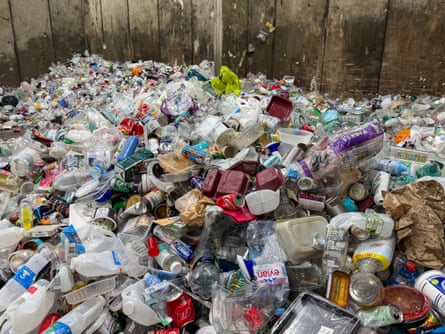
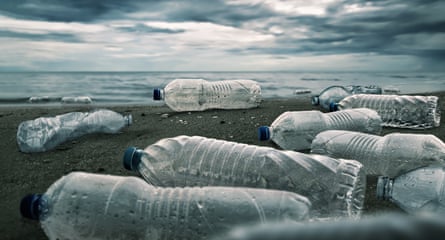
Global packaging waste is on course to hit a projected 434.5m tonnes in 2025, rising to 525m tonnes by 2030, a compound annual growth rate of 3.9%, according to research from Smithers. Plastic is at the heart of this: between 2000 and 2019, the volume of plastic waste doubled, with packaging responsible for about 40% of it. Yet plastic is among the least recycled materials, with a worldwide recycling rate of just 27.9% in 2024. The UK’s overall plastic packaging recycling reached 52.5% in 2023, up from 51.4% in 2022.
Edible packaging could be part of the answer to this problem, with the market size valued at $1.04bn (£790m) in 2024 and poised to grow to $1.84bn by 2033, driven by consumers’ environmental concerns.
But market research says challenges exist. One report said this was “due to the sensitivity of edible packaging to fluctuating environmental conditions, necessitating special handling during shipping and storage”. It also said customers were reluctant to use edible utensils and the challenges hindered “widespread adoption”.
However, beyond the science of packaging, a wider debate remains about our consumption habits. Environmental campaigners argue that the ultimate solution to the plastic waste crisis is not finding better ways to wrap single-use items, but moving away from a throwaway culture altogether.
Even for those who do want to create better packaging, money remains a hurdle. Prof James Elliott at the University of Cambridge, who is working on plastic packaging alternatives, said manufacturers were not keen to pay more for biodegradable alternatives. “They are very cost driven,” he said, adding that the non-biodegradable plastic market was $265bn “so the $1bn proportion being edible is small”.
Andrew Wallis, packaging lead at Innocent Drinks, said 78% of consumers would consider buying ginger shots encased in seaweed, according to a survey. He said it could also be used in Innocent’s kids’ range, which currently uses paper straws in plastic packaging. “Could that wrap be exchanged for a seaweed wrapper?” he said.
Notpla created similar pods for the London Marathon. Other examples of innovation in this area include Xampla, which created a stock cube wrapped in edible film, and Cupffee, which made the world’s first edible cup.
At Notpla’s headquarters, in east London, seaweed is used to encase small amounts of olive oil as well as for sandwich packaging and to replace plastic film in cardboard packaging. The team has also made spoons out of seaweed, which are used in ice-cream parlours including Ice Cream Union in London.
Rodrigo García González, co-founder of Notpla, said seaweed was a good sustainable solution because it grew rapidly. “Some seaweed can grow up to 60cm a day,” he said. “It’s one of the fastest-growing plants on Earth, much faster than bamboo, and it doesn’t compete with anything on land.” He also said it biodegraded more quickly than a leaf.
At Notpla, a machine pushes out ginger shots into seaweed casing, like sausages on a factory conveyor belt. The company is still working out how a product such as this could work in a supermarket: it lasts only three days, but in an unopened bottle could be kept for weeks.
Elliott said one of the big problems with edible packaging was about scale: “About 30-40% of all plastics used worldwide are used in packaging … the scale is phenomenal. We use 2m tonnes of plastic in the UK per year.” He said it would be hard to “harvest that much seaweed without making huge changes”.
But González said seaweed “already operates at a scale most people don’t realise”. He added: “Around 40m tonnes are harvested every year, almost all of it farmed, and it’s already in everyday products from toothpaste to ice-cream. It’s also one of the fastest-growing organisms on the planet.”
Elliott has been working on developing a non-edible packaging made from cellulose. “It’s designed to be composted. Cellulose is abundant in every plant, so we take waste plant material and turn it into films.”
He pointed to Xampla, another company developing plastic alternatives, which makes film from pea protein. A big advantage, he said, is that the material was not just farmable but could be made in vats, like a biochemical process.
after newsletter promotion
Lubomila Jordanova from Cupffee and a Berlin-based expert in sustainability solutions, said the hardest part “was that there was nowhere to turn for answers”. She said an edible cup “isn’t bread and it isn’t a wafer. It has to behave like a real cup: hold coffee at 85C, not leak, and not go soft in your hand while you drink.”
Cupffee is now producing millions of edible cups, and its recipe is patented in 14 European countries, she said. But it was very difficult to scale. “Because customers expect every cup to be identical, exactly like a plastic or paper cup. But we’re making food. Getting that consistency took heavy investment in automation, quality control and our own machines.”
Elliott said cost was also an issue. “The manufacturers’ question is whether they pass the cost on to consumers, or whether consumers are prepared to pay extra for things in edible packaging. There may be niche applications. A ginger shot is a premium product, but if you have a cabbage wrapped in film, will you pay double to wrap it in something edible?
“But the more you scale up, the lower the cost will be. We could get there with edible films, but it will take time and investment.”
Sian Sutherland, co-founder of the campaign group A Plastic Planet, said: “Edible packaging is fun, it’s eye-catching and it’s brilliantly marketable. It’s the ultimate proof point for the safety of plastic alternatives. If you can safely eat the packaging, nobody can tell you that plastic-free materials aren’t safe enough, or that they can’t break down harmlessly.
“But I’m sceptical about its long-term feasibility. The whole job of packaging is to shield what’s inside from the outside world. Anything that’s been handled, stacked, shipped and left on a shelf will have picked things up along the way. People will always worry about eating it, and that’s understandable. So, I don’t think wrapping our food in more food is a solution for the long run.”
She said she wanted to “keep the broader picture front of mind”.
“Any innovation that takes us away from plastic is a good innovation,” she said. “Government must lead and support the pioneers making this shift.”
Make your own ginger shot
-
60g ginger, skin on
-
400ml apple juice
-
juice of half a lemon
Chop the ginger and blitz in a blender with the apple and lemon juice. Strain over a very fine sieve, pressing the pulp with the back of a spoon. The drink will keep in the fridge for up to four days.
KioskNews shows a cleaned-up reading view extracted from the publisher’s page — the original always lives on their site, not ours.