There’s an absurd gap in our road rules, as I discovered by accident
On top of everything else he’s inflicted on the world, Elon Musk has just unveiled the Tesla Roadster, an airborne vehicle that accelerates from standing to 97km/h in less than one second, not a pothole in sight. With awesome built-in screen options and no self-driving capacity, the Roadster is not, the trillionaire admits, “necessarily a safety-optimised car”.
Great. As if we’re not already having enough trouble driving safely on terra firma.
Musk, who has talked about having Asperger’s syndrome and an attention disorder, probably doesn’t do much driving himself, and might (or might not) know that brain drift and cars are a worsening contemporary combo. At a time when a motor vehicle is the most dangerous instrument most of us handle or trust others to handle, we are also plunging into a crisis of inattentiveness.
So while we’re still Earthbound, let’s be down to earth about the facts.
Inattention is becoming public enemy number one on Australian roads. After decades of decline, road fatalities have risen in each of the past four years, according to the federal transport department.
“Distracted driving”, in a 2024 Griffith University survey commissioned by the Australian Automobile Association, accounted for 16 per cent of accidents, and using a phone while driving was found to decrease reaction time by 18 per cent. According to a 2022 Victorian survey of 2403 drivers, 52 per cent used their handheld mobile phone to interact with an app, make or receive a call, email or text while driving.
Insurer Allianz has presented new research suggesting that inattention has been drastically underestimated as a cause of accidents. Researching data going back to the 1990s, it has suggested that distraction is responsible for as many as 33 per cent of accidents, rather than the reported 1.4 per cent. Up to two-thirds of drivers involved in crashes said distraction had been a factor. Three-quarters of the 1200 drivers surveyed by Allianz said in-car technology had become more distracting in recent years.
Who hasn’t been hit or nearly hit by someone who, while wielding two tonnes of fast-moving metal, is on their phone? I’ve been rear-ended by a driver who was viewing me through their windscreen as the second or third window in a multi-screening exercise. My brother was nearly killed by such a driver. Our roads are, increasingly, populated by an army of Messrs Magoo with lethal weapons. And that’s not counting the brain-fogged pedestrians who wander onto a road while absorbed in their phones, or those who forget even to press a crossing button and may, like Robinson Crusoes, still be stuck on their traffic islands years later, oblivious.
Distraction at the wheel can mean death. Speed camera warning signs are a good thing because, unlike hidden radars, they target inattention. If you’re distracted enough to miss three big roadside signs, you may be more of a menace to others than a fully focused driver going 55km/h in a 50km/h zone. Together, speed and distraction multiply the danger.
Inattentive driving is increasingly being recognised and punished – if it is defined by handling a phone. I’ve been fined for holding my phone while driving. Guilty, no excuses. Fines for touching your phone, ranging from $410 to $1251 in Australian states, were issued to 330,926 drivers in 2024 (compared with 3.3 million speeding fines and 57,801 positive random breath tests).
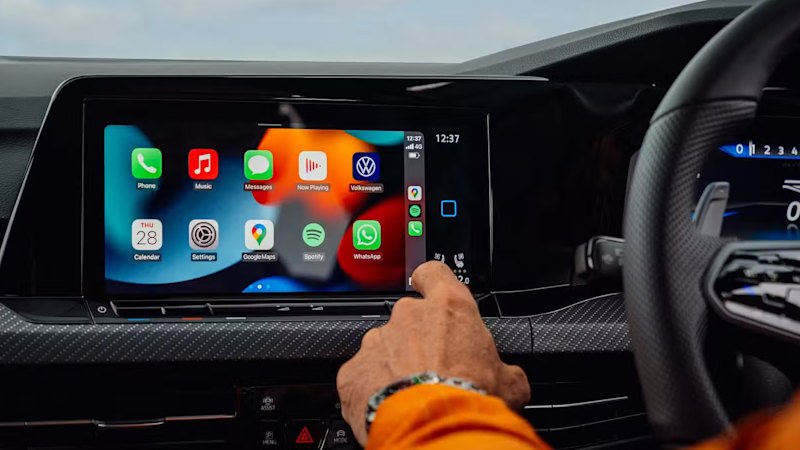
Yet there is an enormous gap in our rules, as I found recently when I hired a rental car with the latest screen technology.
In a word: Yikes. It wasn’t just that the car’s inbuilt screen was unfamiliar, confusing and hard to understand, let alone operate. It wasn’t just that the screen responded grudgingly, if at all, to my baby-soft fingers. It wasn’t just that the screen had a habit of speaking Chinese. It wasn’t just that, when I connected my phone to make things easier, the screen basically became my phone, complete with email, text, music and other apps.
No. The yikes thing was that tapping this screen while driving, faffing about with navigation, phone calls, radio, podcasts and what-all else, is legal.
When it comes to attentiveness and screens, our laws trail dangerously behind reality. Under Rule 299 of the NSW Driving Rules, a driver isn’t allowed to see “a television receiver or visual display unit”, but other kinds of screens are OK. This rule assumes that watching TV is the only dangerous visual distraction. Also, the visual display unit becomes legal when it “is an integrated part of the vehicle design”. So distractions that are hazardous if on your device suddenly become safe if they’re built into the car.
Under Rule 300, meanwhile, you can touch your mobile phone if it’s in a holder. Touching an “integrated part of the vehicle design” is permitted. This is strange and illogical, assuming as it does that the devil only works through your busy hands, and not your eyes or ears. The University of Melbourne’s Professor Mark Stevenson, who conducted a seminal 2005 study that found a driver’s phone use made accidents four times more likely, said, “Using a hands-free device isn’t any safer.”
Our contradictory rules take no account of the multiple ways in which we can be distracted: through our eyes, mouths and ears, through the epidemic wanderings of our helpless little minds. Nor do they allow for the ever-more-complicated screen technology of the latest vehicles. A friend of mine recently traded in a brand-new car purely because its complicated inbuilt screen technology impaired her ability to drive. Yet all of it was legal.
The Australasian College of Road Safety is pressing the federal government for changes – specifically, to built-in touch screens that require up to 11 taps to program a destination. China has regulated a return to physical buttons in new car designs. It’s a recognition of the fact that holding a mobile phone is a narrow and arbitrary way to define “distraction” and distinguish safe from unsafe driving.
Amid falling worldwide sales for Tesla, Musk’s flying Roadster is probably “a publicity stunt”, Michael Milford, director of the Queensland University of Technology’s Centre for Robotics, told the ABC. It’s unlikely to ever cruise into Australian airspace. It’s a metaphor for freedom without responsibility, for big tech’s elision of the consequences for other humans. Or, as Milford put it, “Flying cars in close proximity to the ground and everything that entails is in some respects the most complex problem because the whole journey is spent in close proximity to squashy, unpredictable people as well as other vehicles.” Tech malfunctions. Humans die.
We’ve got trouble enough without giving ourselves the power to get to 97km/h in one second (and why the hurry?). With loose, illogical and inconsistent laws allowing our fried brains to be further distracted by inbuilt car screens, we have our work cut out keeping ourselves safe down here on Earth.
Malcolm Knox is a journalist, an author and a columnist for The Sydney Morning Herald.
The Opinion newsletter is a weekly wrap of views that will challenge, champion and inform your own. Sign up here.
KioskNews shows a cleaned-up reading view extracted from the publisher’s page — the original always lives on their site, not ours.