Trump comments on Irish unification
FROSTY RECEPTION: ‘I conveyed the strong view of the Irish people that the normalization of war and genocide can never be accepted,’ the Irish president said
US President Donald Trump on Saturday said that he would “love to see” a united Ireland, wading into a politically sensitive subject as he embarked on a two-day Irish visit that blurs the lines between his presidency and personal business interests.
After meeting Irish Prime Minister Micheal Martin in Dublin, Trump said reunification of the Republic of Ireland and Northern Ireland — split for more than a century — would be “a fantastic thing.”
“It’s going to happen eventually. It may as well happen now,” he told reporters, adding that “the UK will have something to say about it, obviously.”
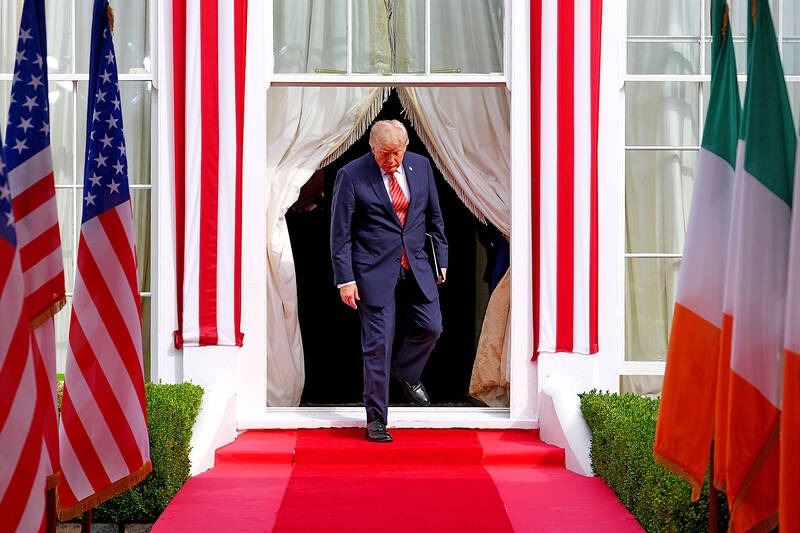
US President Donald Trump arrives to deliver remarks to US embassy staff at Deerfield Residence in Dublin on Saturday.
Photo: AP
The island of Ireland has been split between the Irish republic in the south and Northern Ireland, which is part of the UK, since 1921.
Under the 1998 Good Friday Agreement, which ended three decades of sectarian violence in Northern Ireland that killed about 3,000 people, a referendum can be held if the British government determines a majority there is likely to favor joining the Republic of Ireland.
Republic of Ireland voters would also have to endorse reunification in a poll for it to happen.
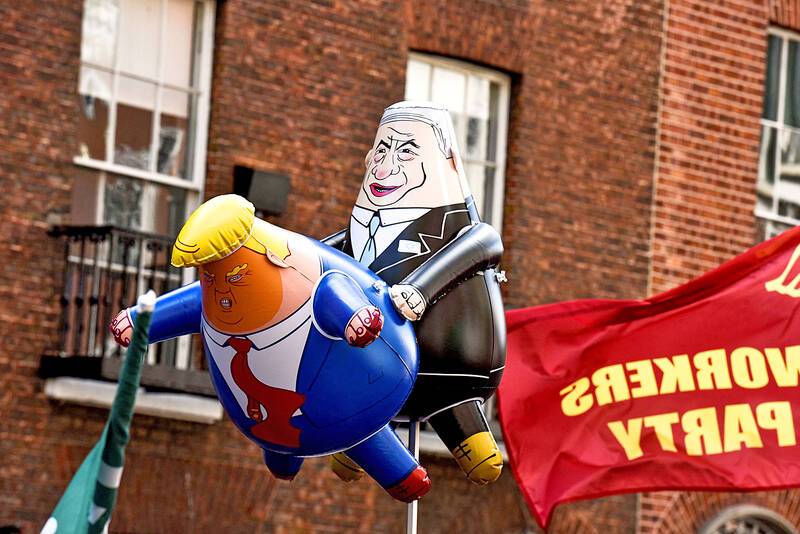
Balloons depicting Israeli Prime Minister Benjamin Netanyahu, right, and US President Donald Trump are carried during a protest in Dublin on Saturday against the US president’s visit.
Photo: Reuters
The US has previously adopted a neutral position on the issue.
British Prime Minister Andy Burnham last month said that a unity referendum was “off the table,” drawing a sharp response from the pro-unity party Sinn Fein.
Asked about Trump’s comments, a spokesperson for his Downing Street office referred reporters to comments Burnham made in parliament on Wednesday last week when he vowed to “stick to the Good Friday Agreement 100 percent.”
However, Gavin Robinson, leader of the pro-British Democratic Unionist Party, said on social media that “as unionists we are not interested in the destruction of our country by joining with the Irish Republic.”
Trump had touched down at Dublin airport shortly before 8:25am under a security operation dubbed one of the largest ever mounted in Ireland and reportedly costing 20 million euros (US$23.2 million).
At least 4,000 police and other personnel, including snipers, have been mobilized.
In Dublin, at least 2,000 protesters waving Palestinian flags and holding placards rallied on Saturday lunchtime against the US president’s visit, chanting: “Donald Trump’s not welcome here.”
One sign read: “No imperialists in Ireland,” while some held explicit inflatable balloons showing Trump in sex acts with Israeli Prime Minister Benjamin Netanyahu.
“Trump is a warmonger,” student Cillian Whelan, 19, said. “He has no right to be in my country. He should be on trial.”
One small group of demonstrators — dressed in black and wearing masks and dark glasses — set a US flag on fire, according to The Irish Times.
In Dublin, Trump appeared to receive a frostier reception from left-wing Irish President Catherine Connolly, an outspoken critic of the US leader.
“I conveyed the strong view of the Irish people that the normalization of war and genocide can never be accepted,” Connolly said in a post-meeting statement.
He then met Martin, when the Iran war and US tariffs on EU pharmaceuticals and immigration were on the agenda.
KioskNews shows a cleaned-up reading view extracted from the publisher’s page — the original always lives on their site, not ours.