As Japan looks to strengthen defences and security strategy, analysts warn of escalation
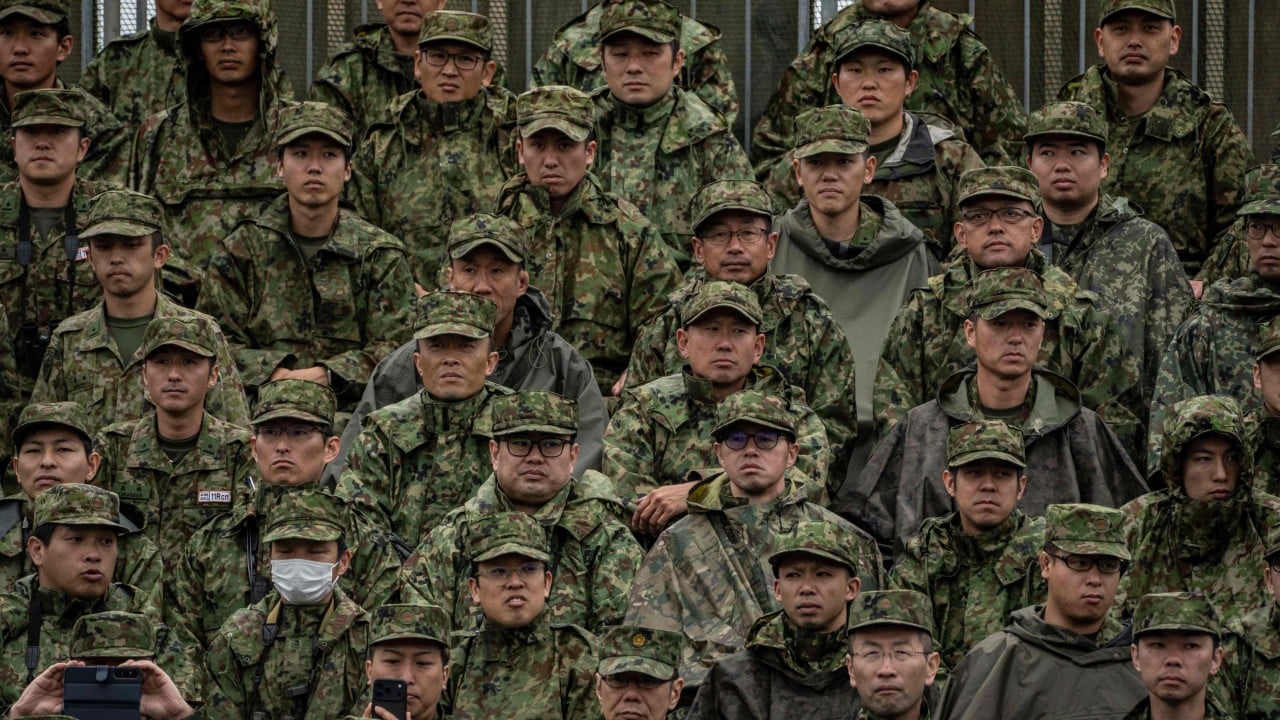
Analysts said the proposed revisions could make it more difficult for China to achieve its military objectives or use financial leverage on Japan, but that their impact would depend on Tokyo’s ability to translate its plans into practical capabilities.
Some also said that stronger Japanese defences could prompt Chinese countermeasures, raising the risk of escalating regional tensions.
Trump praises Takaichi ahead of Xi’s US visit
The country’s ruling Liberal Democratic Party and its coalition partner, the Japan Innovation Party, began working-level talks this week on the planned changes, with the government outlining measures to strengthen military deterrence, prepare for prolonged conflict and bolster resilience against economic coercion.
The proposed revisions, which come as Tokyo continues to regard Beijing as its “greatest strategic challenge”, would prioritise unmanned systems, long-range missiles, integrated air and missile defences and the ability to sustain prolonged combat. They would also strengthen joint operations across the Self-Defence Forces’ ground, maritime and air branches, according to the Yomiuri newspaper.
Expected to receive cabinet approval in December, the updates would revise the National Security Strategy, National Defence Strategy and the Defence Build-up Programme adopted in 2022.
Central to Tokyo’s military proposals is the acquisition of capabilities that could deny an adversary its objectives and that could be particularly significant around Japan’s southwestern islands, which lie close to Taiwan and could become strategically important in a conflict over the island involving Beijing and Washington.
Tokyo also plans to introduce an advanced AI-based decision-making system at the SDF’s Joint Operations Command to enable faster, more accurate military decisions, according to Yomiuri.
Other measures include closer defence-industrial cooperation with the US and potentially expanding production through government-owned, privately operated factories.
To address persistent personnel shortages, Tokyo aims to streamline military commands and units to improve staffing levels, particularly in frontline formations.
Tokyo is considering a 70 trillion yen to 80 trillion yen (US$437 billion to US$500 billion) defence programme for the 2027 to 2031 financial years, compared with about 43 trillion yen under the current plan, according to a Reuters report early this month, citing people familiar with the matter.
The final figure remains under discussion. Policymakers are also weighing a possible study of nuclear-powered submarines, although no decision on acquiring them has been made.
China has repeatedly criticised Japan’s planned security revisions, with its foreign ministry accusing Tokyo on November 5 of using China as a pretext for military expansion and accelerating its remilitarisation.
Misato Matsuoka, an associate professor at Teikyo University, said Tokyo wanted to undermine Beijing’s confidence that it could achieve its objectives with “a relatively limited use of military force or economic pressure”.
Stronger Japanese capabilities could interfere with Beijing’s maritime and air operations in the East China Sea, she said, adding that Tokyo could also shape a Taiwan contingency even without directly taking part in combat.
Beijing sees Taiwan as part of China to be reunited by force if necessary. Most countries, including the United States and Japan, do not recognise Taiwan as an independent state, but Washington is opposed to any attempt to take the self-governed island by force and is committed to supplying it with weapons.
Michael Bosack, director of the Parley Policy Institute and a former US-Japan alliance manager, said Japan was drawing lessons from Ukraine’s defence against Russia, but China was also likely to be adapting. Japan’s plans could improve its ability to “frustrate Chinese military actions”, he said, while the real test was which side could turn policy into “real-world capabilities”.
He added that while concerns about Taiwan were long-standing, the “tactics, techniques and technologies involved” had evolved.
Chinese analysts said that shift was already visible in Tokyo’s growing readiness to move beyond defensive deterrence towards active intervention in regional flashpoints.
Lian Degui, director of the Centre for Japanese Studies at Shanghai International Studies University, said Tokyo’s refusal to walk back Prime Minister Sanae Takaichi’s remarks from November 2025 suggesting a Taiwan contingency could trigger Japanese military intervention showed it intended to follow Washington regarding cross-strait affairs.
Japan’s security overhaul would further strengthen its capacity to intervene in cross-strait affairs and “inevitably increase uncertainty in the Taiwan Strait”, Lian said.
Xu Weijun, an associate research professor at the Institute of Public Policy at South China University of Technology in Guangzhou, said if the revisions were finalised, Japan’s role in a conflict could expand from surveillance, missile defence and supporting US forces to independent long-range operations.
“In the event of a military conflict, China would therefore need to factor Japan’s own long-range operations and their sustainability into its security assessments for its near seas and homeland,” he said.
He said that if Beijing conducted large-scale military drills or a prolonged maritime blockade of Taiwan, Japan could intervene early by sharing intelligence with Washington and coordinating facilities and logistical support, before potentially escalating to maritime and aerial patrols, missile defence or long-range strikes.
“At that point, China would face simultaneous tensions in the Taiwan Strait, as well as in the East China Sea and the Yellow Sea.”
01:06
Japan finds rare earths in deep-sea mud off remote island
Beyond military deterrence, Tokyo seeks to reduce economic vulnerabilities that Beijing could exploit during a crisis.
Its revised National Security Strategy would incorporate “collective resilience”, a concept involving cooperation with like-minded and developing countries to diversify supplies of critical minerals, energy and food, according to Kyodo News. Tokyo also envisages greater use of development aid and trade arrangements.
Matsuoka said Japan wanted to signal that Beijing should not assume economic dependencies translated to “political leverage”.
Bosack said: “It’s one thing to write policy, and it’s another to implement it.” He said Beijing would pay closer attention to Japan’s actions than its announcements.
Matsuoka also warned of a potential “security dilemma” in which Beijing responded to stronger Japanese capabilities through military countermeasures, potentially fuelling escalation.
“Deterrence may be necessary, but it cannot substitute for diplomacy or address the underlying political disagreements between the two countries,” she said.
KioskNews shows a cleaned-up reading view extracted from the publisher’s page — the original always lives on their site, not ours.