Put this quirky European ski resort (and its pies) on your radar now
My luggage slides past me, bound for my “forest house” aboard a human-drawn, metal-framed sled that looks like it was made in a shed by an eccentric, pragmatic tinkerer. I shuffle from the cable-car station to the Hotel Waldhaus in two minutes, powder snow puffing from my boots.
Not a single internal combustion engine has been fired up in my name since I left Zurich Airport for Aletsch Arena, a triple village Swiss Alps ski resort cloistered away in the southern canton, or state, of Valais. A handful of anxiety-inducing tight train connections – perhaps only possible in Switzerland or Japan – deliver me to Bettmeralp Talstation, where the hydro-electric-powered cable car swooshes me up, over a sliver of Rhone River, into Bettmeralp.
Helicopter or hiking notwithstanding, this is the only way for travellers to reach the hamlets of Bettmeralp, Riederalp and Fiescheralp because these snow-globe-esque Bernese Alps villages are car free. If not for the falling snow and low clouds, I’d already be snapping shots of a couple of Swiss Alps celebrities: the Matterhorn (well south-west) and Jungfrau to the north.
Aletsch Arena’s ski lifts and dapperly groomed trails have a Swiss-train-network quality to them. Fanning upwards from Bettmeralp, the clinically logical piste layout makes it easy to swoop down into and back out of Riederalp, gondolas soaring over snow-dolloped chalets. It’s actually challenging to get lost here, although one particularly tantalising forest run flows all the way down to the valley floor, finishing between villages. A five Swiss francs ($9) taxi ride will rectify your “mistake”.
The south-facing (sun-facing, when it’s out) ski area is beginner- and intermediate-focused. The terrain, relatively mild by Swiss standards, is peppered with a healthy smattering of approachable and family-friendly terrain parks and snow-cross courses, with easy plans Bs if you want to chicken out.
Sign up for the Traveller Deals newsletter
Get exclusive travel deals delivered straight to your inbox. Sign up now.
I zigzag towards Fiescheralp, lunching at Battmerhitta mountain hut where I order a Valais staple, Walliser Cholera, thankfully not an intestinal infection, but a pie made with apples, cheese, potatoes, onions, leeks, bacon, and pears in flaky pastry. Over lunch, I gossip with the restaurant’s owner about the condition of his fighting cows – a springtime tradition in this part of Switzerland, through which local herds establish a social hierarchy. Sated, I ride the Eggishorn gondola to the resort’s craggy high-point (2869 metres), a prime perch to behold the Aletsch Glacier. The 20-kilometre UNESCO-listed glacier (unfortunately receding) is the resort’s dramatic natural northern border, two kilometres wide and 800 metres deep in places.
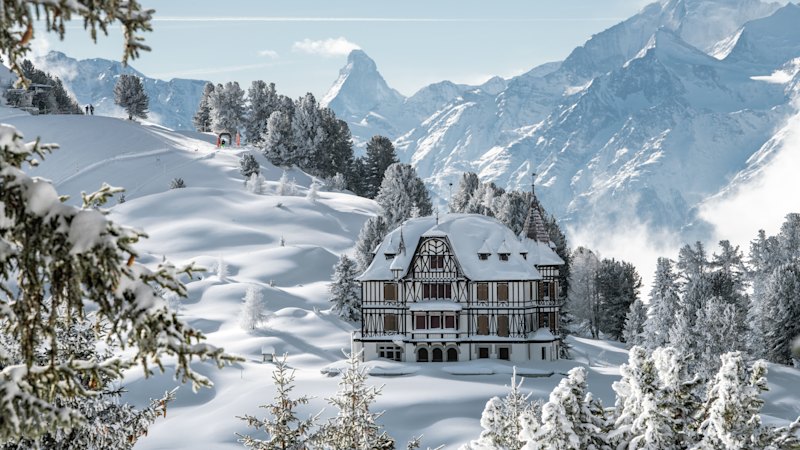
I wholeheartedly recommend executing some turns on trails on the resort’s extreme west (above Riederalp), if only for a glimpse of kitschy Villa Cassell. The compact early 20th-century castle was a folly of a burnt-out German-born English banker, who holidayed here in summer on doctor’s orders. Winston Churchill also hung out in the parquet-floored curiosity, now home to the conservation-focused Pro Natura Centre.
I slide into Hotel Alpfriden for premature après, resting my Aperol Spritz on al fresco wine barrels. “Good evening altogether,” toasts my host, David, even though it’s early afternoon. Apparently, a local bishop once tried to ban day-drinking here so the day-drinkers simply redefined the meaning of evening.
Shouts of “santé” and “ciao” rise above the après hubbub, a soundtrack of early ’90s bangers and the occasional buzzing snowmobile. The Valais German dialect is patently flavoured by its geography – France, 60 kilometres west; Italian mountains in plain sight southwards. Unlike glamour-puss resorts like St Moritz (80 kilometres east), most of Aletsch Arena’s visitors seem local, more or less, as you might expect of a place so far off the radar that it’s rarely a first-choice ski town for foreigners. It’s also a place still unapologetically comfortable in its own skin.
I over-confidently schuss back to Hotel Waldhaus, settling into my Holz100 room, a design made from a quarter of local timbers, with dowels replacing nails and glue. I love the panoramic-window alcove, the 1980s-spec rotary phone and the turn-down Swiss chocolates. Daniela Berchtold’s family has owned the hotel since 1955, a couple of years after the cable car was built, pre-resort days. Before that, farmers would walk up their cows to graze on summer pastures, leaving before winter snows settled.
The ingredients for Waldhaus’s cholera pie are grown in the same “hippy” organic way that Daniela’s parents have always done; heaving with garden potatoes, apples and onions. Every household has a different recipe for this dish, the unappetising name for which is either linked to families making-do during the pandemic, or Chola or Cholu (Valais German for coal), as the pastry was baked on coals, depending on which story you choose to believe.
When I depart Bettmeralp, the human-powered sled slides my luggage back to the cable car. Snow falls, heavier now, settling on the storybook Chapel of Maria zum Schnee (Mary of the Snows). People walk their fluffy dogs, ski into the store for local cheese, and drag their hyperactive kids out of snowdrifts. Back on the train, these car-free days already seem like make-believe.
DETAILS Hotel Waldhaus Bettmeralp has rooms from 230 Swiss francs ($400). See waldhaus-bettmeralp.ch/en; an eight-day Swiss Travel Pass, with unlimited travel by train, bus and boat, costs from 665 Swiss francs. See switzerland.com; swisstravelpass.com
KioskNews shows a cleaned-up reading view extracted from the publisher’s page — the original always lives on their site, not ours.