Delhi choking, where are its road sweeping machines? A year later, still on the way
When The Indian Express investigated Delhi’s fight against road dust in May, in the summer period with little smog or GRAP restrictions, it found that the national capital was barely cleaning its roads. Delhi had 76 Mechanised Road Sweeping Machines (MRSMs), a shortfall of 429 against the 505 the Centre had recommended. Over a year, the machines had covered only about 23 per cent of the city’s motorable roads.
Six months on, as Delhi enters its peak pollution season, the gap between what the national capital needs and what it has is no closer to being bridged.
Of the additional 70 MRSMs the Municipal Corporation of Delhi (MCD) said in May would join its fleet by October, only 11 will be on the road before December, an investigation by The Indian Express reveals.
The other 59 are scheduled to reach in two batches by December-end, when pollution typically peaks, or even later by January, according to a procurement timeline reviewed by The Indian Express and interviews with corporation officials.
On November 8, Delhi recorded its worst Diwali-day air quality since 2021, with monitoring stations logging dangerous spikes around midnight that rank among the highest particulate readings since continuous monitoring began in 2010.
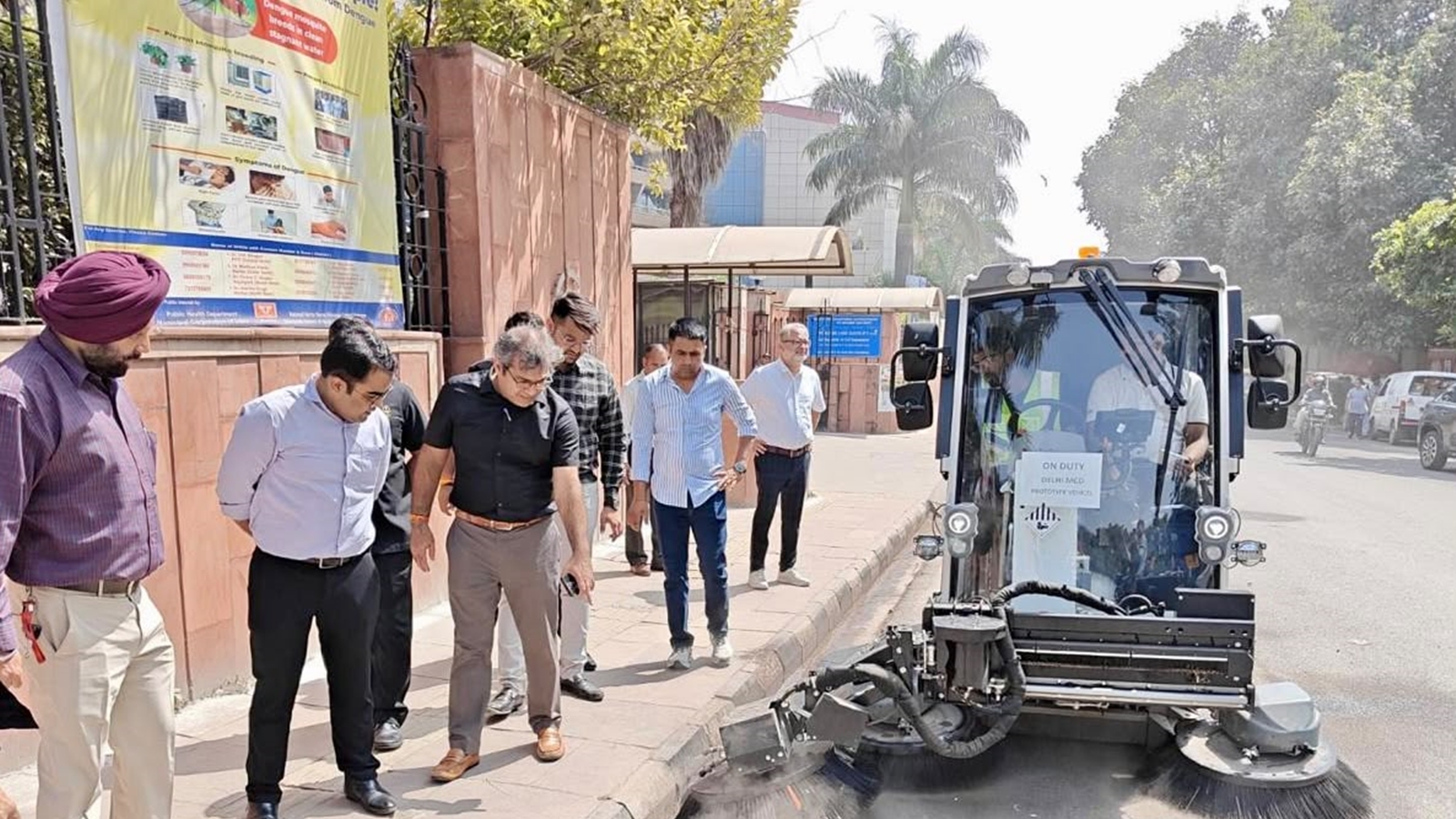 MCD chief Sanjeev Khirwar (in black shirt) and other officials inspect a road sweeping machine on October 1. (Image source: MCD)
The real cost of the delay, however, will be felt as winter rolls out.
It was on December 17, 2025, nearly one full year ago, that MCD officials told a high-level crisis meeting of the corporation that there was an urgent need to procure at least 88 mechanised machines to sweep road dust — identified in multiple studies as the main villain in the pollution story.
Story continues below this ad
However, records show, tenders worth nearly Rs 924 crore were floated for 70 of the 88 machines only on April 2 this year, 106 days after that crucial meeting; and, work orders for procurement were issued on August 24-25, 145 days after the tenders were floated.
Explained
Why road dust keeps coming back
Road dust is difficult to control because it is a primary and persistent source of air pollution — once deposited, it is repeatedly resuspended by vehicular movement. In Delhi, the dry summers, loose alluvial soil and a weakened Aravalli range mean that dust needs to be actively removed and managed. A January 2026 report by an expert panel of the Commission for Air Quality Management (CAQM) identified road dust as a major pollution source in Delhi, blaming potholes, broken edges, unpaved stretches, and debris from construction and demolition. A 2025 CAQM road-dust committee traced resuspension to dust along medians and road edges, poor road design, weak maintenance and encroachments that obstruct cleaning. A separate joint study by the Council of Scientific and Industrial Research (CSIR) , National Environmental Engineering Research Institute (NEERI) and Central Road Research Institute (CRRI) submitted in February 2025 recorded PM10 as high as 1,700 µg/m³ within 10 metres of some roads, against a 24-hour limit of 100 µg/m³.
A senior MCD official told this newspaper that only nine of those 70 machines are in hand so far and even these are expected to be operational by this month-end or December. Representatives of two of the three companies contracted to procure these machines from abroad told The Indian Express that they are mandated to complete the full consignment only by March 2027.
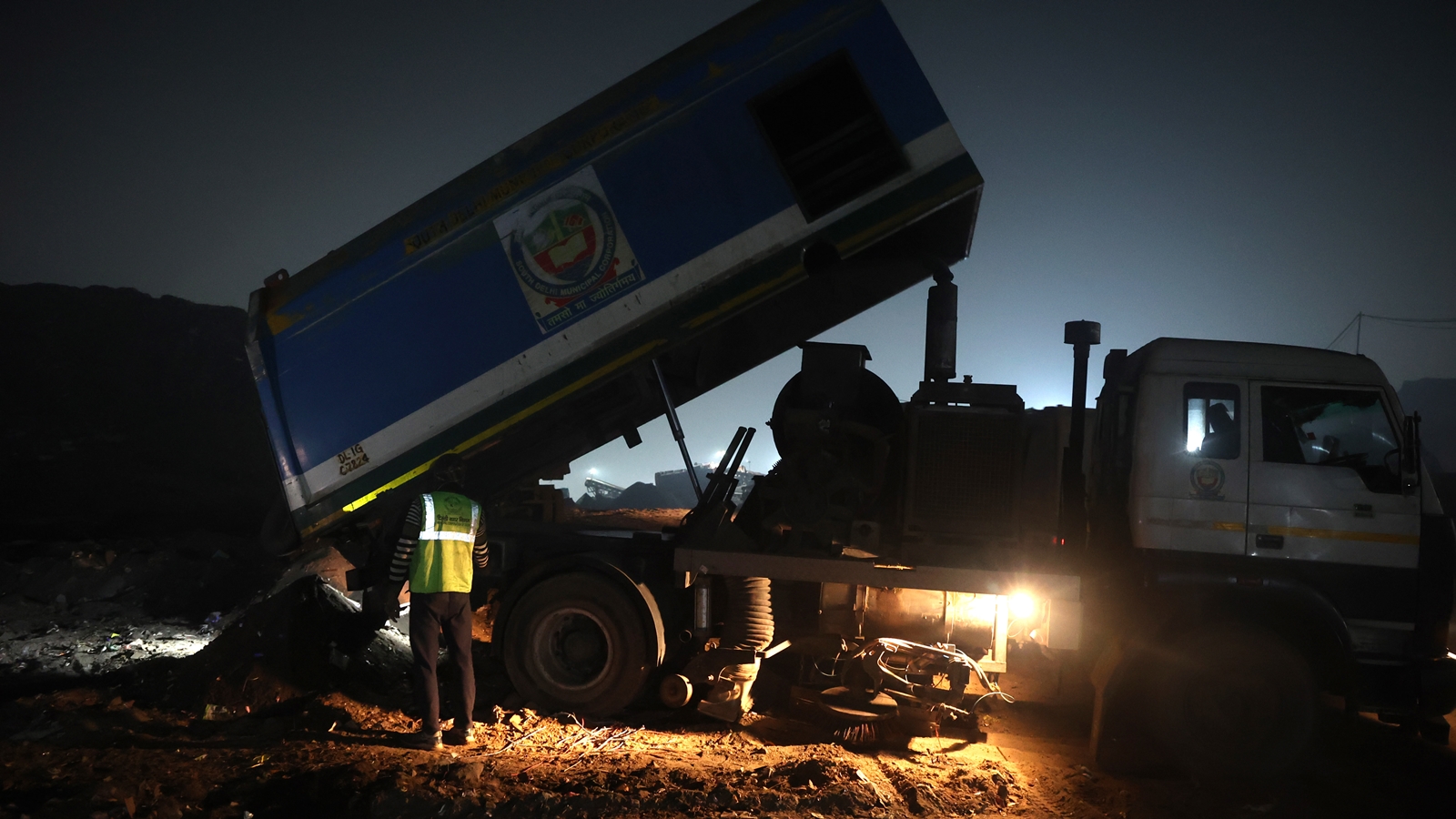 An MCD Sweeper truck cleans the stretch between Kalkaji Mandir to Tughlaqabad Landfill area. (Express Photo by Tashi Tobgyal)
To plug the shortfall for now, the MCD is planning to “hire” nine MRSMs from a company in Telangana. MCD officials said they have also increased the daily schedule of the MRSMs currently operating, from eight to 12 hours a day.
‘West Asia crisis delayed shipment’
When contacted by The Indian Express, MCD Commissioner Sanjeev Khirwar said: “The MCD has been monitoring the deployment of machines closely with meetings being conducted with vendors every week. The machines have to come during the pollution season, and the supply of these will commence by November; 60 are expected by December-end, the remaining in January. The disruption due to the West Asia crisis has delayed the shipment time. We are trying our best to get the machines earlier than the tender deadline.”
Story continues below this ad
The MCD currently has 66 MRSMs: 40 large machines with 6 cubic-metre containers, and 26 smaller versions with 4.5 cubic-metre capacity. A cubic-metre container, or bin, typically holds 1,000-1,100 kg of dust, depending on whether the dust is dry, slurry or has horticulture waste, an MCD official said.
According to MCD records, the tender for 70 additional MRSMs — 55 electric and 15 CNG-run machines — was awarded to three Delhi-based companies: G A Infra Pvt Ltd (lead member of a consortium with V N Engineering), Lion Services Ltd and J S Enviro Services Pvt Ltd. This time, MCD and company officials said, machines with more advanced features are being procured from Tenax and Dulevo (Italy) and Boschung (Switzerland).
MCD data shows that the 15 large CNG machines have been booked with Dulevo while the 55 electric MRSMs are being bought from Tenax, Boschung and Deluvo. Records show the break-up:
- G A Infra: Rs 368.8 crore — 22 electric MRSMs (2-4 cubic metres), six CNG (4-6 cubic metres)
- Lion Services: Rs 369.5 crore — 25 electric (2-4 cubic metres), four CNG (4-6 cubic metres)
- J S Enviro Services: Rs 185.2 crore — eight (2-4 cubic metres), five CNG (4-6 cubic metres).
When contacted by The Indian Express, a senior Delhi-based representative of J S Enviro said the project was awarded in August and, under the tender, the delivery deadline is March 2027. “But we understand there is an urgency, and every bidder is now taking utmost care of reducing the timelines. These are supposed to reach India by either end of December or start of January,” the official said.
Story continues below this ad
An official of G A Infra said: “On the tender side, we have a March deadline to bring in all the machines and run them on Indian roads, but we are trying to import all of them by the end of December, as the civic body has requested.” Representatives of Lion Services were not available for comment.
The companies echoed the MCD line: longer shipping routes due to the closure of the Strait of Hormuz means they will now go around the Cape of Good Hope.
“It has to travel almost 1.5 times the distance. The earlier transit was supposed to be 25 days. Now it will take almost 40-45 days from the country of origin to reach Nhava Sheva port in Mumbai. The MCD has asked us to airlift at least a bare minimum quantity of machines, but electric machines come under dangerous goods, which has its own complications,” the J S Enviro official said.
Silver lining, better machines
The new machines, however, hold hope for the future.
According to tender documents and officials, the current procurement differs from the one under which MCD bought these machines around eight years ago. The new MRSMs are being imported because no Indian manufacturer offers features the MCD now wants, an official said.
Story continues below this ad
“Indian manufacturers mount an auxiliary suction engine on a goods truck, which is a makeshift arrangement. This makes the machine run very slowly, at just 2-3 km per hour. Since these were not designed for 40 km per hour, which is the need, performance gets compromised after one-two years,” the J S Enviro official said.
Sanitation workers also had to walk ahead of the old sweepers with shovels to clear large waste — that will no longer be needed, he said. “The new machines are self-propelled and built only for road sweeping. There is a big centre brush, almost two-and-a-half feet wide. It can pick up small debris and bigger objects, and no manual intervention is needed while it sweeps. It lifts garbage through vacuum suction as well as mechanical suction,” the official said, adding that cloth filters are used to stop dust from getting re-suspended.
Yet, there is a challenge, a GA Infra official said. “These machines are developed for foreign countries, where soil and dust are of a single type. In India, especially Delhi, they are of different types. During trials, we saw that in some places it is dust; at other places, there are extremely fine particles. We have asked the companies to modify the machines for Indian roads,” the official said.
The early signs are encouraging, MCD officials said.
A set of four machines — three of 2-4 cubic-metre capacity from all the three vendors and one of 4-6 cubic-metre capacity from Dulevo — was airlifted to India jointly by the vendors and MCD, and tested at the International Centre for Automotive Technology (ICAT) in Haryana’s Manesar in September, and received MCD clearance.
Story continues below this ad
Responding to a questionnaire from The Indian Express about the delay, a senior official of MCD said the tenders involve large sums of money and machines with advanced features need research and scrutiny at every step.
“Earlier, these machines had to be procured by PWD, but the civic body was informed only at the end of December last year that we had to purchase them. The tendering process has multiple steps, including preparation of tender, floating it, opening of technical and financial bids, negotiating the amount with the bidder. The machine needs to be tested as well before it goes for manufacturing,” the official said.
KioskNews shows a cleaned-up reading view extracted from the publisher’s page — the original always lives on their site, not ours.