Exclusive: On US-Iran War, Malaysia PM's "Reluctance To State Facts" Charge
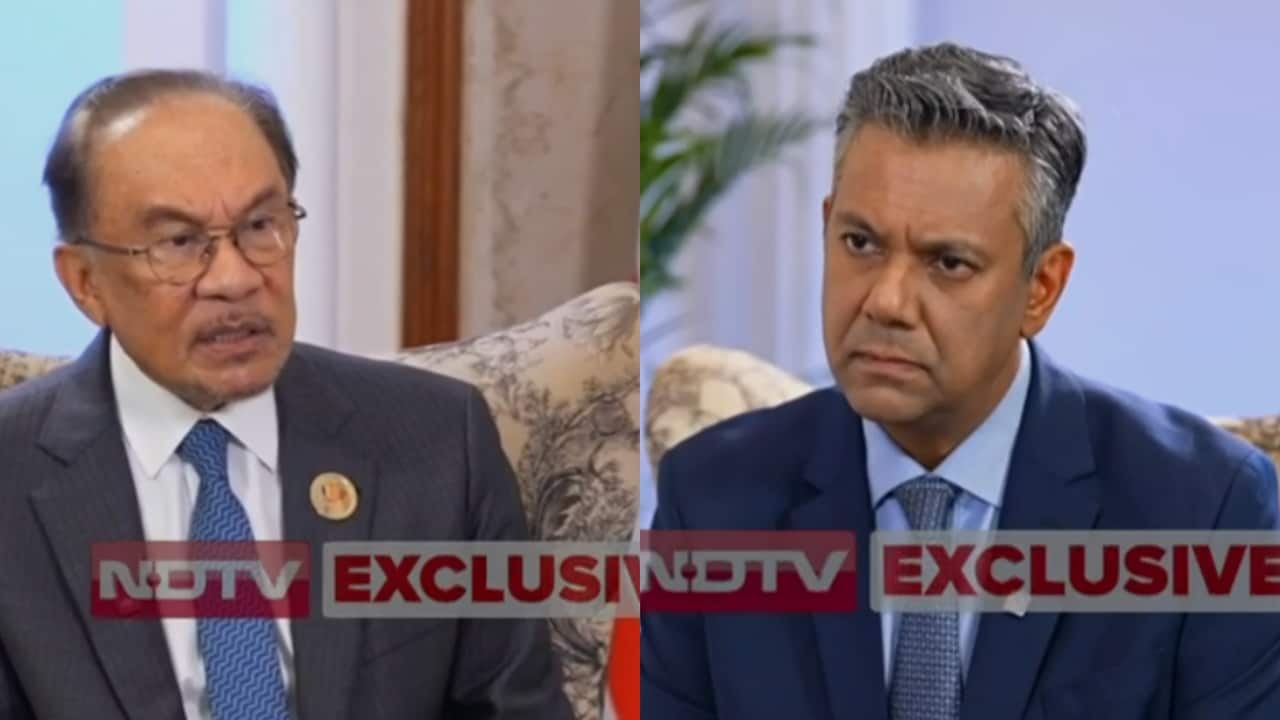
Malaysian Prime Minister Anwar Ibrahim has called for an end to the violence between the United States and Iran, but has also argued that any discussion of the current conflict must begin with the "initial aggression" by the US and Israel.
In an exclusive interview with NDTV, PM Ibrahim said there was a reluctance among countries to acknowledge the origins of the confrontation with Iran. He argued that condemning attacks by Iran was not inconsistent with identifying what he sees as the initial act that set the latest conflict in motion.
"The latest so-called conflict with Iran is due to the initial aggression of the United States, of course initially with Israel. And there is reluctance of many of the countries to state the facts. The fact is that, stop that sort of continued aggression," PM Ibrahim told NDTV.
Follow Live Updates From BRICS Summit
Asked whether Iran and the US were both adopting "maximalist positions" that could make a peaceful settlement more difficult, PM Anwar agreed that a peaceful resolution was necessary.
"If we can only secure that sort of understanding of a peaceful resolution, cessation of violence is important. But then we have to to do justice. I mean, we don't -- unless it'd be hypocritical, contradictory in terms of opposition," PM Ibrahim told NDTV.
"Now, how do you resolve it? Stop the violence. I mean, the violence perpetrated by the United States or Israel or Iran. I'm with it," he added.
Iran on Wednesday struck an American military base in Jordan in retaliatory strikes for US bombing of Iranian oil tankers. Iran continued to target ships in the Strait of Hormuz, while the US continued attacking Iran. When asked if he condemned both sides for the regional disturbance, PM Ibrahim told NDTV that an immediate end to violence is necessary, but so too is an examination of the causes and the initial use of force.
"Cessation and hostilities affect both the United States and Iran, and of course there's no contradiction as far as it's concerned. But why do they have so much reluctance to say, what's the cause of the conflict? Because the conflict is unwarranted aggression against one country. That to me very clear," PM Ibrahim told NDTV.
The 79-year-old Malaysian leader also rejected the idea that the aggression in the besieged Palestinian enclave of Gaza and the bigger Israeli-Palestinian question could be understood solely through the actions of Hamas.
"The issue of Gaza or Palestine is not necessarily a new issue, or because Hamas -- Hamas is 20 years or 30 years ago, the conflict has been there 70 years, without Hamas," he said.
PM Ibrahim was speaking in New Delhi as India hosted a two-day BRICS summit.
Prime Minister Narendra Modi welcomed world leaders, including Russian President Vladimir Putin and Chinese President Xi Jinping, to the summit on Saturday. The gathering brought together leaders from across the BRICS grouping.
Among those attending were Iranian President Masoud Pezeshkian, South African President Cyril Ramaphosa, Malaysian Prime Minister Anwar Ibrahim, Indonesian President Prabowo Subianto, Abu Dhabi Crown Prince Mohamed bin Zayed Al Nahyan, Ethiopian Prime Minister Abiy Ahmed Ali, Egyptian President Abdel Fattah El-Sisi and Vietnamese President Le Minh Hung.
UN Secretary General Antonio Guterres was also attending, along with World Trade Organization Director General Ngozi Okonjo-Iweala, World Health Organization chief Tedros Adhanom Ghebreyesus, New Development Bank President Dilma Rousseff and Asian Infrastructure Investment Bank chief Zou Jiayi.
KioskNews shows a cleaned-up reading view extracted from the publisher’s page — the original always lives on their site, not ours.