Emmy Rossum Confirms the Meaning Behind 'Furious' Season 1's Final Minutes: "It's Not an Easy Hit List"

Carly Lane is an Atlanta-based writer and critic who has been with Collider in some form or fashion since 2021. She considers herself a television nerd, diehard romance/sci-fi/fantasy reader, and nascent horror lover. Her fondness of books is only eclipsed by the towering TBR that her shelves can't possibly contain.
She is the author of A REGENCY GUIDE TO MODERN LIFE: 1800s ADVICE ON 21ST CENTURY LOVE, FRIENDS, FUN AND MORE, published through DK Books (an imprint of Penguin Random House) and currently available wherever books are sold.
Sign in to your Collider account
Editor's note: The below interview contains spoilers for the Furious Season 1 finale.
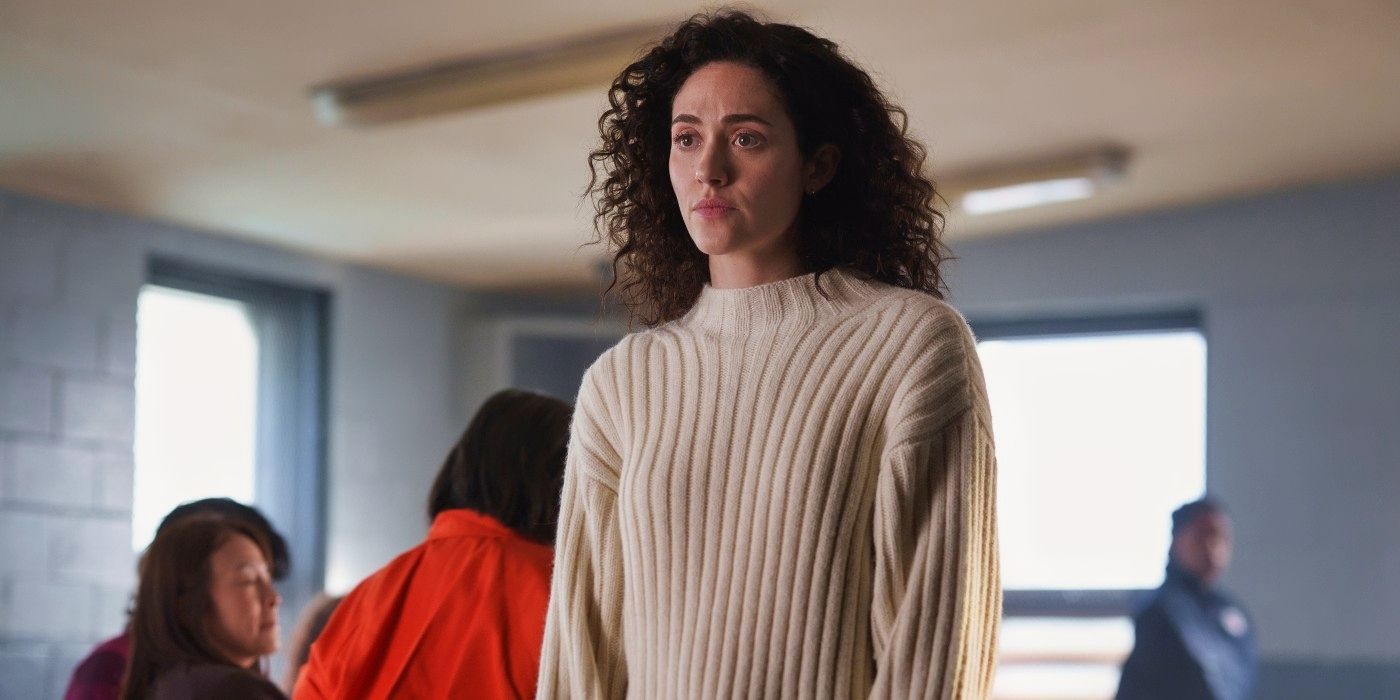
While Hulu's new crime thriller Furious has always been rooted in the potential cat-and-mouse chase between fledgling serial killer Catherine Grace (Lola Petticrew) and FBI agent Alice Black (Emmy Rossum), the series created by Liz Meriwether has unearthed new layers for these characters, both in their individual storylines and in the moments when their paths unexpectedly cross. A chance meeting at a domestic violence shelter evolves into an unlikely connection that culminates at Jay Easton's (Peter McRobbie) mansion, where the wealthy businessman unexpectedly goes into cardiac arrest — or so it seems. Later in the finale, when Alice pays a visit to Catherine, who's in prison for her crimes, the young woman correctly deduces that Easton's death was no mere accident. Paired with the damning flash drive that Alice now has custody of, Furious — which has officially been renewed for Season 2 — is poised to set up an even darker story moving forward.
After the finale's airing, Collider spoke with Rossum about how Alice and Catherine's mid-season meeting set the tone for everything that happened between them later on, why Alice and Danny's (Scoot McNairy) romance still has plenty of complications built in, the meaning behind Alice's two very different looks to camera before the end credits, and more.
COLLIDER: I spoke with Liz [Meriwether] about the decision to bring Alice and Catherine together before audiences would expect them to cross paths, and how that really lays the foundation for their connection. I was curious about what you enjoyed about these two getting to be in each other's company, so that by the time everyone descends on the Easton house and there are all these revelations, you and Lola [Petticrew] have that incredibly moving scene in the secret room. How did that first meeting both set the tone and inform everything that came after?
EMMY ROSSUM: One of the things that I always loved about the movie Black Widow was how much time Debra Winger and Theresa Russell's characters spend on the beach, just two lonely people looking for connection, kind of getting to know you, and obviously they're both lying.
And Liz wrote the shelter scenes so beautifully in Episode 6. That playground scene where they're both kind of moving around the playground equipment — it's the first time that Alice is really telling a true story about herself, a really personal one about being in the shower, when she thought she was going to die and she realized she hadn't washed the shampoo out of her hair. Catherine knows that she's for real, even if she's not for real. I think it's the fact that Alice is lying about who she is that she can actually tell the truth about who she is. I don't think that she's a person that's comfortable being vulnerable or really talking about herself. I think she's a person who’s most comfortable lying.
But that bond is really formed in the shelter, and Nora calls her out on it and says, “The way you talk about her is different when you're outside the motel. Did you like her?” And Alice kind of lies and says, “No. She’s just a suspect. Nothing's different.” Then, obviously, in the next scene, when they find her in the bathroom, something is very different. There's a deep connection between these two people.
One of the things I love about Alice and the way that Liz writes her, that gives me such freedom, is she's a character who engages in such risky decision-making, risky behaviors, and that’s set up so well from the first episode when she's courting violence into her own life on Tinder. So, there's a lot about the character that's very flammable and also buried really deep, and these are very complicated things that are really juicy and challenging to play.
Emmy Rossum Explains the Complicated Nature of Alice and Danny's Romance
"Whenever she starts to feel that there might be softness creeping in, she shuts it down."

One theme that has unexpectedly come up in my conversations with Liz and some of your castmates has been caregiving and how different characters are in unique positions to offer care to each other. Steve [Way] pointed out how Alden and Catherine's relationship is mutual caregiving, and I spoke with Scoot [McNairy] about how Danny is positioned as a safe space for Alice. He's willing to sit outside the shower for her in a way that feels intimate without being sexual, and I love how that's paralleled in the finale, too. In the lead-up, how did you want to approach blocking that scene? Alice is the one to undress Danny, to initiate the kissing, and really sets the pace of their intimacy.
ROSSUM: I think it makes sense. He says, “I can't be rough with you,” and she says, “I know.”
I think Alice isn’t someone who has believed that she deserves justice for herself. In the show, the characters talk about the “right kind of victim” and the right kind of victim that can get justice from a jury, and Alice has a lot of secrets and a lot of damage in her past, a lot of people that have hurt her at different times and different ways, and complex PTSD and obsessive tendencies, if not OCD. There's a lot going on for this gal. She's also functioning in a job in which her own defense mechanisms serve her. She's a person who has learned to separate from her vulnerability, from her emotions, who can function under extremely high-pressure circumstances and take in a phenomenal amount of challenging material and content and keep moving forward.
Danny is somebody that has always wanted to save her, and it's something she's been very, very resistant to, and she's told him that. But also, I think it's hard for her to accept that someone good or kind could come into her life, that she can trust that. She's trained to be hypervigilant and had to be hypervigilant and untrusting, because some of her relationships with people that she trusted most turned out to be very dangerous. Whenever she starts to feel that there might be softness creeping in, she shuts it down. You see that when he offers to go to the shore — she wants to and can't. That's why she goes into the house, and she's so angry because she doesn't know how to let somebody love her, even though that's what she wants most of all.
So later, when they finally do get together on that beach, I think she's still wondering if he could love her, knowing all of the totality of what's happened to her, now having seen part of this video himself. And I think that's so human, wondering if somebody could love you with all of the damage and all the knowledge of people that have hurt you. How to know if that person is really consenting, if they do really want to be there. I think that's why he kind of just stands there, and that's why Alice undresses Danny, and that's why she lightens the mood by talking about Parcheesi again, by letting him know, “It's okay. I'm here. It's me. I'm saying yes as an adult, my whole self.” And then again, he's outside the shower for her, and he's giving her the tape and saying, “I don't want to look at that stuff anymore, but I know you do, too.” They are at very different points in their lives, so we’ll have to see what happens for them next.
It's also not just Alice's past, but the relative present — and what really goes down in Jay Easton’s bedroom. It feels definitive in the moment, but later, there's a longer version of that interaction. Did you and Liz talk about the direction that was going to go in before you got a script?
ROSSUM: Liz and I had talked about that from before there was even a first script, about Alice starting as what you think is the good guy, and Catherine as the bad guy, and these inverse arcs of realizing that maybe the good guys aren't all good, and maybe the bad guys aren't all bad. I knew that that was going to culminate in the taking of a life, and so, yes, I was very aware of how we were going to place breadcrumbs in order to earn that rage and to earn that desire, and stepping into your full power of, “Oh, I did that.”
Did you have to justify it to yourself at all? Did you find yourself having to do that — or, at least by that point in the show, did you feel like the breadcrumbs had been laid enough that this feels like an act that makes sense for Alice, even if she doesn't know she's going to do it until she's face to face with Easton?
ROSSUM: I never assumed that it was premeditated until he recognizes her and says that thing — “I loved your video. It was one of my favorites. You're the movie star.” And that, to me, is just so chilling.
Nora has been saying he's just going to die peacefully in his bed, and Catherine has been saying, “Have you ever killed anyone? It's power. It's like you're eating everything that they've ever done, and you're not scared anymore.” I think Alice pretends all the time that she's not scared, but we know how scared she is. We know she double locks her door. We know she sleeps with a chair in front of the door. We know she's been afraid to take a shower in her own house with the doors locked. So, yeah, I think that door’s opened up inside of her.
Emmy Rossum Only Needed 1 Take To Nail the 'Furious' Finale's Very Last Scene
"It's just a shared knowing."

In the finale, there are two shots of your face, the close-ups where it feels like you're looking directly to camera — one when Alice has been given the code to the room by Nora to look at the video and all the information about who's downloaded it, and one while she's meeting with Catherine, who's been able to put two and two together based on the incident report. What did you and Liz want to convey to the viewer in terms of both of those looks and what they signal about Alice's state of mind before the cut to black?
ROSSUM: The last one is scripted as a smile. I think Liz told me that what she ended up using is take one, and she never watched any other take. She was like, “I love it. That's the one.” I think that that one is really about, in a moment, being almost inflated with your own power, having a secret, how intoxicating having a secret is, and how good Alice is at having a secret. She's not about to say, “Oh, yeah, you're right.” It's just a shared knowing.
The journey of watching the video is so challenging because I'm not looking at anything; I'm looking down the barrel of the lens, and certainly there's no material for me to watch. The content is obviously very intense, to imagine you're watching a sex tape taken against your will as a child. Watching yourself be assaulted as a teenager, it’s hugely intense to imagine your way into. There's also, unfortunately, so many documented cases of these things happening that there's so much material to read about and op-eds that have been written. So, I was, in the days leading up to it, really just holding those people's names in my gut and feeling a shared space. Even though a character is imaginary, they can hold a lot of truth for a lot of people that have been in those situations.
Then you're in the room, right? And it's you and your camera operator, and there's no dialogue for a minute and a half or two minutes. That is the greatest gift — to have an operator who's with you and a scene that has been so beautifully written with all the beats and all the little X's. And Liz and Cory [Finley] just gave me so much freedom to be able to find my way through that scene. We must have done that scene six or eight different ways. We did one completely stoic. We did one working our way up to the final take, which is what I think is used — various degrees of at times it's surreal, at times it's retraumatizing, at times it’s confirmation that the things that you know that happened to you and the people that you know hurt you really did those things. Because these things are 25 years ago, and yet they feel like hundreds of years ago and also yesterday. So, I think it's just channeling all those things and moving through.
Then it's harnessing the, “Okay, now I’ve seen it, I know it's real. I know it's out there. How many people also have watched this?” And then clicking over to know that there are 50,000 people that have watched this. It's just a huge number. It's probably larger than the number she anticipated. It's not an easy hit list. But as Nora says, you have to have your eyes wide open. So I think there's power in knowing that that really happened, and that there's that level of exposure.
You mentioned hit list; I feel like that's worth pointing out. Is there anything you're hoping to dig into with Alice in a second season now that it's been greenlit?
ROSSUM: All I can say is I've talked to Liz about what she wants to do, and I think it's really exciting. But Liz loves to pivot and keep the process really fluid as she imagines her way into it. So, there have been a lot of text message pitches and a lot of thumbs-up, and then a lot of no responses. I can take a hint, you know what I mean? [Laughs]
All episodes of Furious Season 1 are now available to stream on Hulu.
KioskNews shows a cleaned-up reading view extracted from the publisher’s page — the original always lives on their site, not ours.