10 Far Side Comics That Are Still The Strangest Larson Ever Drew

Emedo Ashibeze is a tenured journalist and critic specializing in the entertainment industry. Before joining ScreenRant in 2025. he wrote for several major publications, including GameRant.
Few comic strips in pop culture history have caught the public eye quite like Gary Larson’s legendary creation, The Far Side. Debuting in syndication during the 1980s, the beloved strip stood out by abandoning traditional multi-panel storytelling in favor of singular frames. Larson used scientific concepts, anthropomorphic animals, and other elements to get reactions out of his audience.
While many panels offered straightforward punchlines, Larson frequently pushed the boundaries of traditional humor into the realm of sheer absurdity. Some of his works have left audiences thoroughly bewildered, as they defy standard logic and require multiple reads to digest. Others are more understandable, but inspire unsettling levels of unease within readers.
Headless Man At The Lost & Found

This strip uses disturbing imagery to depict what would be a regular occurrence if anything other than a human head were involved. It features a headless man in a blue jacket standing before a lost-and-found counter. He is attempting to locate his missing head among a box full of detached human heads, while the clerk gets increasingly impatient.
What makes the comic so bizarre is how casually both characters treat this grotesque dilemma. A man lacking a head is odd enough, but the clerk’s agitation, despite the man’s lack of a means to effectively pick out his face, makes for a thoroughly unsettling picture. The presence of severed heads in the box also adds to the scene’s surrealness.
Bears Eating Cub Scouts

In one of his more recent subversions of outdoor tropes, Gary Larson turns a regular camping expedition into an alarming scene. The illustration depicts a group of bears gathered around a wooden picnic table deep within a dense forest. Rather than rummaging through trash cans, the creatures have meticulously plated young scouts and are preparing to devour them.
There is hardly any humor to be seen for the average person in this strip, as all that is happening is a group of bears preying on defenseless children. The humanization of the bears might count for something, but the horrific nature of the events unfolding far outweighs any amusement that could be gotten from it.
The Unlucky Mailman

This piece stands as one of Gary Larson’s few departures from his signature single-panel format. It features an unsuspecting mail carrier who approaches a standard countryside mailbox as part of his daily route. However, as soon as he sticks his hands inside, an invisible force begins dragging him into the box.
He is sucked in stages as he thrashes around wildly before disappearing entirely, with the lid snapping shut and the red flag resetting itself automatically. No explanation is given for what occurred, and what makes the scene even more puzzling is that a fully grown adult managed to fit into such an improbable space.
The Scientists and the Melted Face

Published in October 1990, this classic panel showcases one of Gary Larson’s most eerie creations centered around scientists and their experiments. The comic takes place inside a research laboratory where a group of white-coated scientists are gathered around a wooden workstation. They collectively stare at a liquefied puddle of pink flesh dripping from it onto the laboratory floor.
While some watch in horror, the lead researcher excitedly remarks that the goo represents what is left of Professor Dickle. Sparing no remorse for his doomed coworker, he is solely concerned about saving the project and tells others to carry on as usual. The cold reaction and the horrific state of Professor Dickle make for an extremely disturbing visual.
The Blow-up Cow

Gary Larson frequently found success in anthropomorphizing cattle, and this particular strip stands out as one of his most outlandish ventures on the subject. It depicts two adult bulls inside a cozy suburban living room. One sits in an armchair, laboriously blowing air into a synthetic-rubber doll, newly unpacked from a box and labeled an inflatable cow.
The second bull eagerly observes his companion, rubbing his hooves together in anticipation while admiring the new product. The scene fully projects dark human depravity onto ordinary livestock, for no other reason than to get a kick out of its audience. It is less humorous than it is disturbing, and it continues to leave audiences bewildered to this day.
The Donner Party Memorial

This is one of the most notable Gary Larson comics that illustrate his willingness to tackle grim historical topics. It captures sightseeing visitors standing quietly beside a large plaque in a remote park. Sitting atop a pedestal behind the plaque is a massive sculpture shaped like a foot, tucked neatly between two slices of bread.
It serves as a reference to the famous tragedy involving a group of stranded Americans called the Donner Party, who resorted to cannibalism as a means of survival. The panel presents a macabre topic such as cannibalism in a deadpan comedic manner, with the unsettling image of a severed human appendage on full display.
Desert Spam Storm

This comic transforms what would normally be a life-threatening natural event into a nonsensical absurdity. It displays a lone desert traveler named Ali, huddled against his camel amidst vast, rolling sand dunes. Instead of a devastating sandstorm as one would expect, the sky rains dense blocks of Spam across the arid landscape.
The strip treats the phenomenon as a natural occurrence, and both figures featured in it are stated to be fully knowledgeable about how to weather the storm. The relevance of Spam in this context, however, is totally lost on readers, as no explanation is offered as to why chunks of meat are falling from a desert sky.
The Star Trek Crew Encounter Zsa Zsa Gabor

As the title implies, this comic pits space military personnel against world-famous glamour icon Zsa Zsa Gabor. It showcases the Starship Enterprise bridge crew as they face the disembodied head of a renowned celebrity. It is a stark subversion of what audiences would normally expect, such as alien warships or spatial anomalies.
She is portrayed as quite the prominent threat as well, with Captain Kirk instructing Mr. Sulu to activate their defense shields with haste. Readers are once again left completely in the dark, as they wonder why such a figure would appear here specifically, with no apparent correlation between Star Trek and the affluent socialite.
Cow Tools

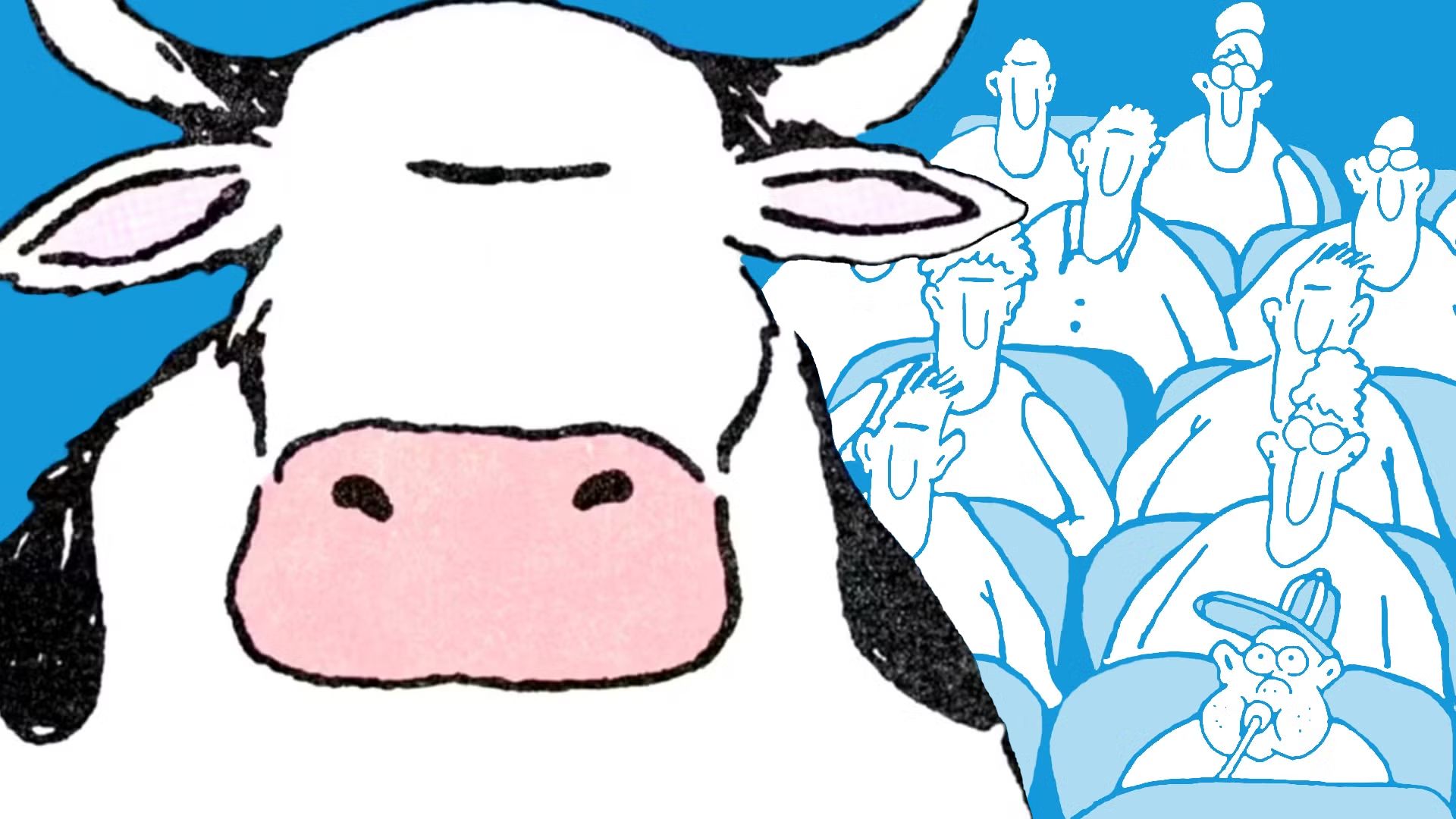
Cow Tools is one of the most infamous Far Side comic strips ever made, sparking never-ending discourse and reaching unprecedented levels of fame. It stars a vacant-looking cow, standing right behind four bizarre artifacts on a platform, without a single word of context beyond the caption “Cow Tools” framed under the panel.
The objects appeared so alien that audiences struggled greatly to determine their intended meaning. Things got so out of hand that immense pressure was placed on Larson to explain his perplexing joke. He clarified that it simply illustrated how crude cow-made tools would be, but even with his input, it still remains one of his most controversial works.
Some of the Non-Vital Organs

Some of the Non-Vital Organs is an incomprehensible comic that hints at less essential human components that have little or no meaning. It arranges six absurd, seemingly internal organs isolated against a plain white backdrop. Rather than picturing recognized human viscera, the panel displays completely nonsensical shapes that do not resemble any known anatomy whatsoever.
Some do feature recognizable elements, though; for example, one with a miniature fedora and another with a sandwich at the base of its structure. Many of the others do not even grant their observers that much clarity, and simply stand as random objects with no apparent purpose other than to instill confusion.
KioskNews shows a cleaned-up reading view extracted from the publisher’s page — the original always lives on their site, not ours.