Traffic fines to be fully allocated to road safety
By Wu Liang-yi and Jake Chung / Staff reporter, with staff writer


The Ministry of Transportation and Communications (MOTC) yesterday announced amendments to the Regulations Governing the Allocation and Use of Road Traffic Fines (道路交通違規罰鍰收入分配及運用辦法) that would increase the proportion of revenue from traffic fines used to improve traffic safety and enforcement from “at least 12 percent” to 100 percent.
For traffic citations issued by special municipalities or city and county governments, 75 percent of the revenue goes to the local government.
In the six special municipalities, 99 percent of the fines are deposited into the municipal treasury according to regulations.
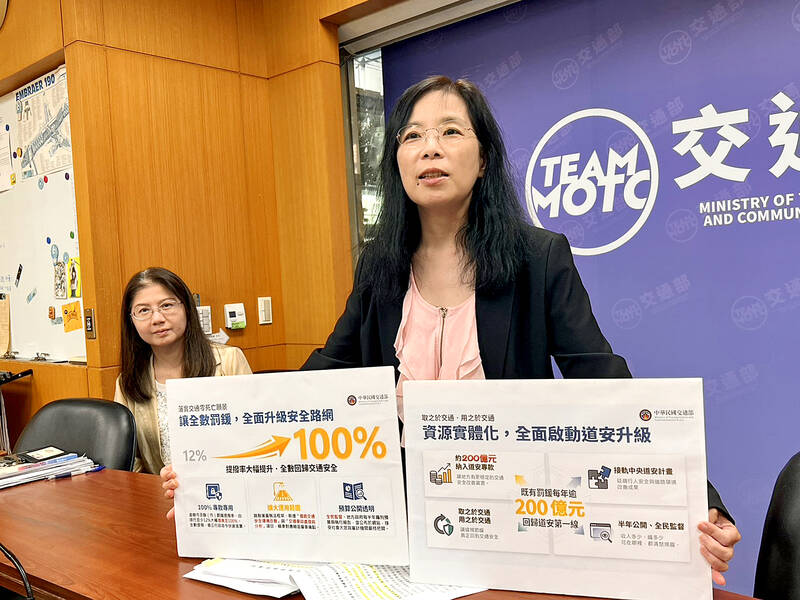
Department of Public Transportation and Supervision Director-General Hu Ti-chi, front, displays placards at a news conference in Taipei yesterday.
Photo: CNA
Another 24 percent is allocated to the issuing authority to cover operational costs and law-enforcement-related incentives, while the remaining 1 percent goes to the national treasury.
The system has often drawn criticism, with some saying that it creates an incentive for local governments to issue more traffic tickets as it boosts municipal revenue.
The issue is particularly pronounced in the six special municipalities, where nearly all traffic fines flow into the city’s coffers, critics said.
Department of Public Transportation and Supervision Director-General Hu Ti-chi (胡迪琦) said that with the changes, revenue from traffic violations would hopefully go toward ameliorating roads and financing law enforcement efforts.
The changes require city and county governments to issue a public report every six months on how they have used money generated from traffic fines, allowing auditors and the public to scrutinize their use, she said, adding that local governments must budget for and spend the funds in accordance with the Budget Act (預算法).
If the funds are not used for their designated purposes, competent authorities should demand local governments rectify the situation within a specified period, Hu said.
Official statistics show five of the special municipalities leading in collection of traffic fines: New Taipei City, NT$3.67 billion (US$115.3 million); Taipei, NT$3.15 billion; Taichung, NT$2.89 billion, Taoyuan, NT$2.5 billion; and Kaohsiung, NT$2.48 billion.
Citing the NT$20.5 billion in revenue generated by fines last year from all local governments, once the new regulations are implemented, an additional NT$18 billion should be available for traffic improvement and road safety, she said.
Local governments would be able to flexibly allocate the funds for infrastructure projects in accident-prone areas in their jurisdictions, including upgrading road signs, markings and traffic signals, renovating pedestrian overpasses and underpasses, and installing additional guardrails and traffic mirrors.
The new system would be implemented in line with local governments’ budget cycles, and is expected to take effect in 2028, she said.
KioskNews shows a cleaned-up reading view extracted from the publisher’s page — the original always lives on their site, not ours.