Movie industry backsliding on gender: director
When Danish director May el-Toukhy was selected for the top competition at the Venice Film Festival in July, she was the only female filmmaker in a 20-strong field — with a movie “about the invisibility of women.”
She joked about the irony at a press conference on Sunday, while pointing out that progress on gender bias made in the wake of the 2017 #MeToo movement appeared to be reversing.
“After #MeToo, I think all of us were really aware of this gender imbalance,” she told reporters.
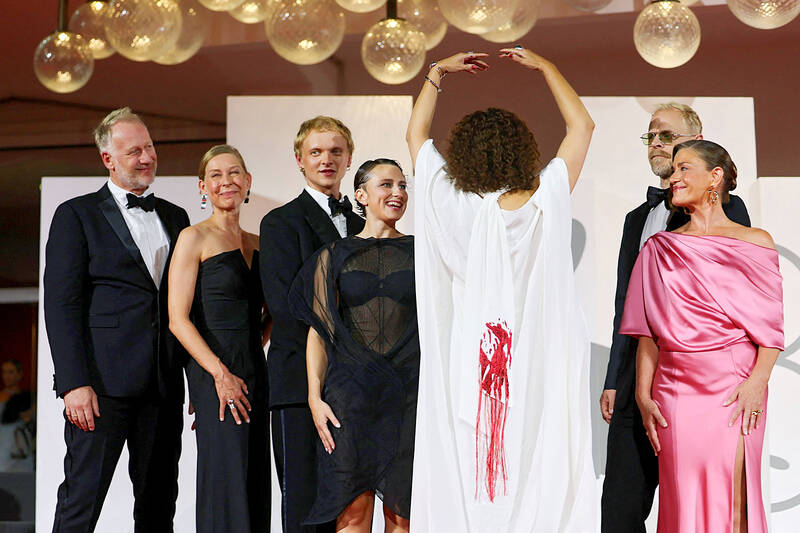
Danish director May el-Toukhy, front, and cast members Thorbjorn Hedegaard, Marina Bouras, Carsten Bjornlund and Mathilde Arcel pose on the red carpet prior to the screening of the movie Woman Unknown at the 83rd Venice International Film Festival in Venice, Italy, on Sunday.
Photo: Reuters
“And something has happened over the course of the last couple of years where we’re kind of returning to, you know, what it used to be — and so we have to be better,” she added.
The protagonist of Woman Unknown is a bride-to-be struggling to hide her wartime secret — a relationship with a Nazi during the German occupation of Denmark during World War II.
Women accused of having consorted with the enemy are seen in the film violently stripped, their heads shaved and red swastikas painted on their bare flesh.
The powerful film, which drew enthusiastic applause after a press screening on Sunday, is “about being objectified on one hand and on the other hand being unseen and voiceless,” el-Toukhy said.
The dearth of females in the top Venice competition has sparked nagging questions about the selection process and female representation.
Festival artistic director Alberto Barbera angered many observers in July when he said the initial 20-1 male domination of the top competition was because the submissions from women “were not enough to put them into the competition.”
Since then, the festival has added another film co-directed by a woman, the documentary NAZA about the Israeli killing of civilians in Gaza, which is to premiere on Thursday.
El-Toukhy, a Danish-Egyptian director who has worked on Netflix’s The Queen, said she had encountered gender bias throughout her career and even with her latest film.
“When I pitched the film to people, I could see that they were glazing over because they were, like, ‘Oh, another Second World War film,’ which I feel is unfair because we’ve told so many stories about the male experience during war or post-war, and we haven’t really explored what it meant to be a woman during that time as much,” she said.
After film school, she said she struggled to find financing for her first film.
“I think it took me six or seven years, whereas my male peers, they were much faster than me,” she said.
“My second film was really hard to get done as well,” she added.
She sees the underrepresentation of women at the top of the industry as a “structural problem” — echoing a similar point made by American star Maggie Gyllenhaalm, who is head of the competition jury in Venice this year.
“I do think it’s much harder for women to get their films financed,” Gyllenhaal said in the first week of the festival.
“Also, could it be possible that the things that women, having had a different experience of being alive in the world, want to make movies about are not always deemed high art?” she added.
Award-winning Italian actress Jasmine Trinca told reporters on Sunday: “When I see that there is only one woman in competition, I’m alarmed, I’m angry.”
“I think it’s a question we really need to ask ourselves and confront,” Trinca said.
A study from the USC Annenberg Inclusion Initiative described last year as a “Great Recession” for women directors in the US: Just nine women were attached to the 100 top-grossing films at the box office.
Only three women have won an Oscar for Best Director: Kathryn Bigelow, Chloe Zhao (趙婷) and Jane Campion.
KioskNews shows a cleaned-up reading view extracted from the publisher’s page — the original always lives on their site, not ours.