Tiny patients are facing strain of a warming climate
When an underweight hoglet arrives at Italy’s only hedgehog rescue center, it is placed in an incubator, given fluids and oxygen if needed and assigned a name — a small gesture of hope that it will survive.
Prolonged drought and unusually high summer temperatures linked to climate change have made the La Ninna rescue center in northern Italy’s Piedmont region busier than ever. The center cared for 450 animals two years ago and more than 700 last year, with a similar number expected this year.
“We’re in the middle of autumn, and we are literally being inundated with tiny hedgehogs weighing 100 to 200 grams,” said veterinarian Massimo Vacchetta, who founded the center 14 years ago after recognizing the animals’ increasing vulnerability. “They were born late in the season because of global warming and cannot survive outside.”
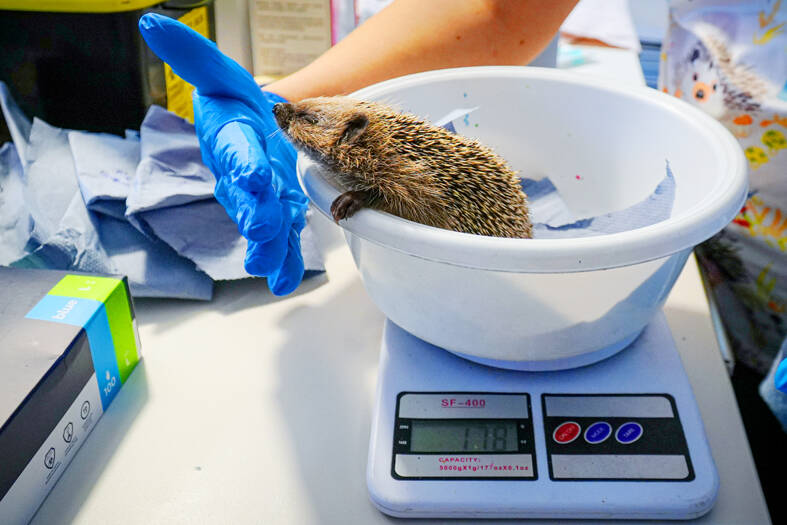
A rescued hedgehog is weighed at the La Ninna wildlife hospital in Novello, Italy, on Nov. 5.
Photo: AP
A hedgehog needs to weigh at least 700g to hibernate successfully, Vacchetta said.
A decade ago, late-season second litters typically arrived by early September. Now, some are born as late as November, leaving the hoglets too little time to get to a healthy hibernation weight before winter.
The center, funded mostly through donations, has eight full-time staff along with a host of volunteers. It is equipped like an emergency clinic, with incubators, ultrasound equipment and oxygen tanks.
Staff members name the animals to distinguish them and as “a form of hope,” said Elisa Mangione, who wore a hedgehog-print medical top.
“It is precisely that name that gives them existence; they are here for a purpose, and with the goal of returning to their natural habitat,” Mangione said.
By the middle of this month, the center was caring for some 300 hedgehogs and Vacchetta was expecting another 100 to 200 before winter. About two-thirds were hoglets. The rest were adults that were either ill or severely malnourished due to a shortage of insects and other invertebrates, whose populations have been affected by drought and high temperatures.
The food shortage has forced the nocturnal animals to forage even during the day, Vacchetta said.
“All those arriving now will stay until spring because, obviously, the conditions outside don’t allow them to survive,” Vacchetta said.
Most are found locally, but thanks to word of mouth and social media, reports of hedgehogs in distress arrive from all over Italy.
Vacchetta and his team are working to give as many hedgehogs as possible a chance of survival.
“We are on the front lines of the battle to defend animals, which are facing a major crisis due to climate change,” Vacchetta said. “People do not realize the gravity of the situation because these are silent deaths. Animals fall ill and die far from our sight.”
KioskNews shows a cleaned-up reading view extracted from the publisher’s page — the original always lives on their site, not ours.