Mort la révolution! Why UK film loves a failed rebellion

The British are perverse. We fetishise our failures, even if they are essentially tangential to a national narrative that should be about imperial conquest, slavery and being unremittingly unpleasant to foreigners. We tell and retell, for instance, the story of Captain Scott even though he died in Antarctica in 1912 after losing the race to reach the south pole first to the unacceptably Norwegian Roald Amundsen. Similarly, Christopher Nolan’s 2017 film Dunkirk typified the British tendency to snatch national glory from the jaws of defeat. And then there was the tragicomic disaster of the Charge of the Light Brigade during the 1853-56 Crimean war in which our boys raced to putatively glorious if stupid deaths. It’s as if, for us British, pointless sacrifice and embracing failure are what heroism means. And our cinema has colluded with this perversity.
But there is an exception to this national veneration of failure. Britain has been reluctant to embrace its revolutionary defeats. There is, for instance, no film dealing with the Chartist movement’s 19th-century struggle for universal suffrage. Even more strikingly yet, it is only now, in 2026, that a film has been made about the calamitous 1381 Peasants’ Revolt, even though it is a pivotal event in British history. Paul Greengrass’s The Uprising, starring Andrew Garfield as a – let’s just get this over with – revolting peasant, joins a mere handful of other movies, including Kevin Brownlow and Andrew Mollo’s 1975 Winstanley, Bill Douglas’s 1986 Comrades and Mike Leigh’s 2018 Peterloo, that dare depict how radical collective action was crushed by a ruthless state.
For Stephanie Barczewski, author of Heroic Failure and the British, our fetishisation of glorious disaster is a corollary of the 19th-century British private school ethos of stoic duty and crypto-S&M suffering culled from an ancient Roman exemplar. Revolutionary failure doesn’t fit this template; hence, one might suppose, its absence from our cinema.
The Uprising, however, for all its flaws and missteps, is a bold attempt to correct a national wrong by depicting a collective uprising devoid of heroism. Greengrass tries to make sense of how a mass movement of riff-raff from the rough ends of Kent and Essex arose, and how its momentum was compromised of factionalism and conflicting aims. It shows how, ultimately, the revolutionary leaders were duped by the boy king Richard II, leaving the rebels winding up to be either slaughtered en masse in London’s Smithfield or skulking defeated back to their homes to work harder to pay the poll tax whose unfairness they had risen up against in the first place.
It is an important – if belated, improbable and commercially dubious – addition to our national story.
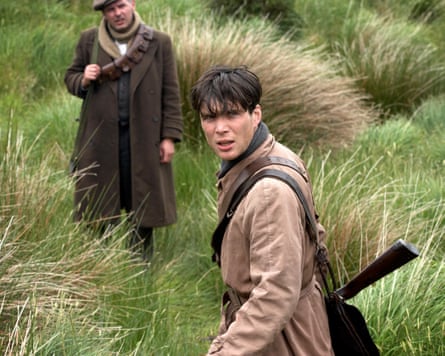
In contrast, other countries have been more fortunate in their revolutionary heritage and as a result their national cinemas teem with examples of successful uprisings. From the advent of cinema, for instance, Americans have incessantly revelled in making movies about their war of independence – including silent features such as 1917’s The Spirit of 76 and DW Griffith’s America (1924), not to mention Bugs Bunny in Friz Freleng’s delightful period romp of a cartoon Bunker Hill Bunny (1950). The French have been making cinematic homages to their 1789 revolution going back the 1913 biopic Robespierre.
In Russia, Grigori Aleksandrov and Sergei Eisenstein’s October, in 1928, typified how the Bolshevik revolution’s success against the odds made Russian spirit what it is. Movies such as Neil Jordan’s Liam Neeson-fronted biopic Michael Collins (1996) and The Wind That Shakes the Barley (2006), set during the Irish war of independence and starring Cillian Murphy, depicted the triumphs and tragedies of Ireland’s revolutionary heritage – even if the latter had an English director in the shape of Ken Loach.
But it isn’t just the deeply classist notion of what failures count as heroic that has made British cinema reluctant to embrace our failed revolutionary heritage. It is the result of how our culture has been reverse-colonised by Hollywood, with historical narratives only deemed filmable if they fit into American movie industry’s tropes. Whenever Hollywood deigns to make a movie about British history, it includes Downton-style upstairs-downstairs hokum, those crazy sexed-up murderous Tudors and, of course, that cod-historical franchise that never stops giving, Robin Hood.
Equally, it is axiomatic in Hollywood that political struggles are always about one thing – a very American notion of freedom, individual freedom from presumed oppression. That’s why Mel Gibson’s 1995 Braveheart was possible: even though William Wallace’s struggles against the English ended in failure with his execution at Smithfield (not far from where Wat Tyler was murdered by Richard II’s lackeys), the biopic involved the classic Hollywood trope of the little guy fighting for freedom. Any other political goal (tax reform, wealth redistribution, solidarity, fraternity) scarcely makes a dent in the Hollywood narrative juggernaut.
And that’s what makes Greengrass’s The Uprising problematic. Compromised by Hollywood values, it is conflicted about representing a failed political revolution as what it was – a collective struggle. It depicts the Peasants’ Revolt in the frame of one fictional man, Garfield’s Ploughman. Conceived by Greengrass as a representative everyman, Ploughman – with a disregard for historical truth that should make the film’s historical adviser Dan Jones wince – pops up Zelig-like to parlay with the king, catch the king’s mother’s eye, rally the rebels, scythe down the bad guys, as if he were a real-life historical figure. The collective struggle becomes individualised drama, betraying the positioning of the apostrophe – what happened in 1381 was the Peasants’ Revolt not the Peasant’s Revolt.
Worse yet, the film includes a very silly coda in which, a year after the defeat of the revolt, Ploughman and a rump of rebels have retreated to the English greenwood to form an outlaw band of unmerry men. The corollary of this coda is to make the Peasants’ Revolt a kind of origin story for the legend of Robin Hood, even though that is nonsense: the folkloric rebel operated – if at all – about 200 years earlier. The whole idea may seem ridiculous, but the US distributors for The Uprising, Focus Features, leaned into this barmy interpretation by changing the film’s title to The Uprising: The Rise of Robin Hood earlier this year, suggesting that it would show events “that helped inspire the legend of Robin Hood”. Sensible Guardian readers will know of course that Robin Hood was a supporter of Richard I and foe of King John both of whom ruled England almost exactly two centuries earlier.
Such absurdities are a great shame since Greengrass’s – worthwhile – intention was to make a film about the Peasants’ Revolt that resonates topically for our age. A collapse in trust of our rulers, a seemingly endless cost of living crisis, widening inequality, political discourse dominated by lies and nonsense: 2026 is more like 1381 than we realise.
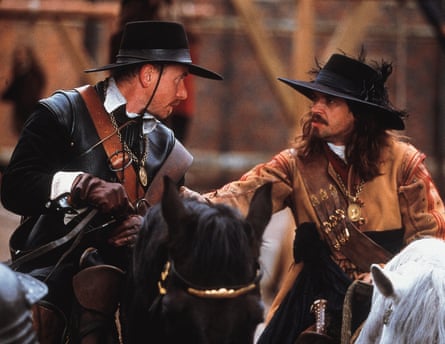
It’s worth pointing out that there has been one successful military revolution in British history, namely the English civil war. Cinema of course has been a failure at depicting it: there was Ken Hughes’s wildly inaccurate 1970 drama Cromwell starring Richard Harris and Alec Guinness and Mike Barker’s 2003 To Kill a King with Tim Roth and Dougray Scott. But our most enduring and successful revolution was scarcely cinematic: the so-called Glorious Revolution of 1688-89 in which the Catholic King James II was replaced by his Protestant daughter Mary II and her Dutch husband William III of Orange was hailed by Bertrand Russell as “the most moderate and successful of all revolutions. Its aims were modest, but they were exactly achieved.” Yawn! Who wants to see that movie?
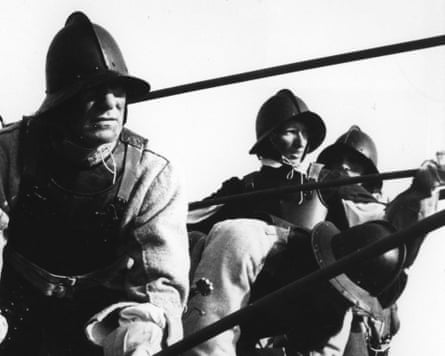
Perhaps the greatest film about British revolutionary failure was the aforementioned Winstanley, about a group of proto-communists called the Diggers who settled common land on St Georges’s Hill outside Weybridge, Surrey during the English civil war. They hoped to create a utopia devoid of private property and for a few weeks lived self-sufficiently until they were violently evicted by the local gentry. To clinch the point that the Diggers’ experiment was a failure, just go on to property website Rightmove. There you can find a “stunning and elegant” £25m mansion on Cavendish Road, St George’s Hill with “fairway views, seven individually themed bathrooms, two staff apartments, and a leisure complex” and 1.5 acres of carefully landscaped gardens. Not what their leader Gerrard Winstanley wanted at all. He wrote: “Was the Earth made to preserve a few covetous, proud men to live at ease, and for them to bag and barn up the treasures of the Earth from others, that these may beg or starve in a fruitful land; or was it made to preserve all her children?” Our radical history, so often absent from our national cinema, has been built over in a field in Surrey for real estate scarcely any of us can afford. A very British coup if ever there was one.
KioskNews shows a cleaned-up reading view extracted from the publisher’s page — the original always lives on their site, not ours.