Google smacks forehead, realizes $899+ thin-and-lights were what it was missing
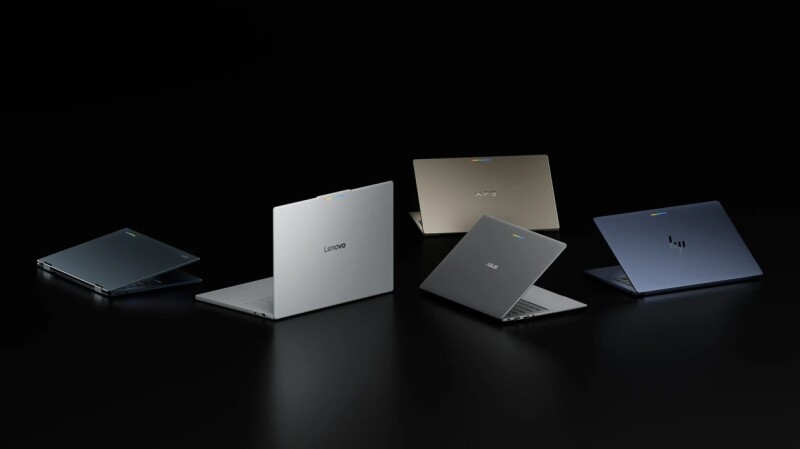
'A new category,' insists the Chocolate Factory, not a premium Chromebook - yet some of the family resemblance remains
Google is trying once again to escape the Chromebook reputation for cheap, chintzy hardware and compromised computing.
$899 for a glorified web terminal isn’t exactly the easiest sell, but that’s not stopping the search and advertising giant from trying. On Monday, Google unveiled five new Googlebooks in collaboration with Dell, HP, Lenovo, Acer, and Asus.
Googlebook, if you aren't familiar, is what Google describes as a new category of laptops, rather than a Chromebook or a rebranding of one. With that said, some familiar software limitations remain. A major emphasis has, however, been placed on premium materials and components like aluminum or magnesium alloys, carbon fiber, haptic trackpads, high-resolution touchscreens, and speedy high-end processors.
REG AD
With prices starting at $899, Google is clearly trying to woo would-be Apple MacBook Neo buyers, with similarly premium build quality, while sweetening the deal with more memory and compute.
REG AD
Under the hood, the initial machines offer a choice of Intel Core Ultra 5 or Qualcomm Snapdragon X Elite processors, paired with 16 GB of RAM and 512 GB of storage.
MediaTek is also on tap to supply SoCs for the systems. While best known for its budget-friendly mobile processors, its notebook-class parts, including Nvidia’s GB10-based RTX Spark APU, have proven quite potent.
But while Google’s launch announcement touts “a baseline of 16GB” of memory, that actually appears to be the only config available for pre-order. It’s also worth noting that the $899 starting price only applies to one Acer model, with other systems reaching as high as $1,299 — putting them in MacBook Air territory.
It’s possible additional SKUs will eventually offer higher memory capacity and storage, but with memory prices already at a record high, the jump to 32 GB of DDR5 and 1 TB of storage would likely push these devices well north of $1,500.
Earlier this year, Omdia analysts had predicted a shift to higher margin devices, which have more headroom to absorb skyrocketing memory prices. Despite this, ChromeOS device sales were still predicted to shrink 27.6 percent in 2026.
Whether you can actually use that compute is going to depend heavily on what software you use. Unless your work can be done in the browser or an Android app, you might struggle to take full advantage of Google’s premium new notebooks. That said, there are plenty of folks buying MacBooks to doomscroll X, and at least you can rest assured knowing those web pages will be extra snappy.
Google cheekily suggests that creative apps like Adobe Photoshop and Lightroom run on these machines. But while they certainly have enough compute to do so, if you do make that mistake, you’ll be stuck editing your photos in a web app.
Likewise for gaming: while the GPUs in these systems are more than capable of running modern titles on device, you’re more likely to rely on services like GeForce NOW than on the notebook’s onboard GPU.
REG AD
For better or worse, that should help with battery life, which Google quotes at a not bad, not amazing 14 hours of use. For reference, Apple quotes the MacBook Neo and Air at 14-18 hours of use, and both can run any Mac app.
On the software front, Google has introduced some multi-device productivity features that anyone who's owned a Mac and iPhone in the last six years will probably recognize.
This includes application and web page handoff, enabling users to start work on one device and seamlessly continue it on another. Googlebook also gains native support for Android apps and quick access to files stored on a paired Android phone.
There is also no shortage of Gemini integrations because Apple and Microsoft can't be the only ones shoehorning generative AI features into our daily lives. This includes a feature called Magic Pointer, which summons Gemini simply by wiggling the cursor. So, the next time you lose your cursor on screen, you can just ask Gemini to find it.
Other features include Rambler, a voice dictation tool that uses language models to transcribe and format speech, and Create My Widget, which builds custom desktop widgets from natural-language descriptions. So even though it can’t run full Photoshop, it can still build you a custom home screen widget based on your description.
The first five systems are available for preorder now and ship with 12 months of Google AI Pro. ®
KioskNews shows a cleaned-up reading view extracted from the publisher’s page — the original always lives on their site, not ours.