China develops plant to extract hydrogen, fresh water and uranium from the sea
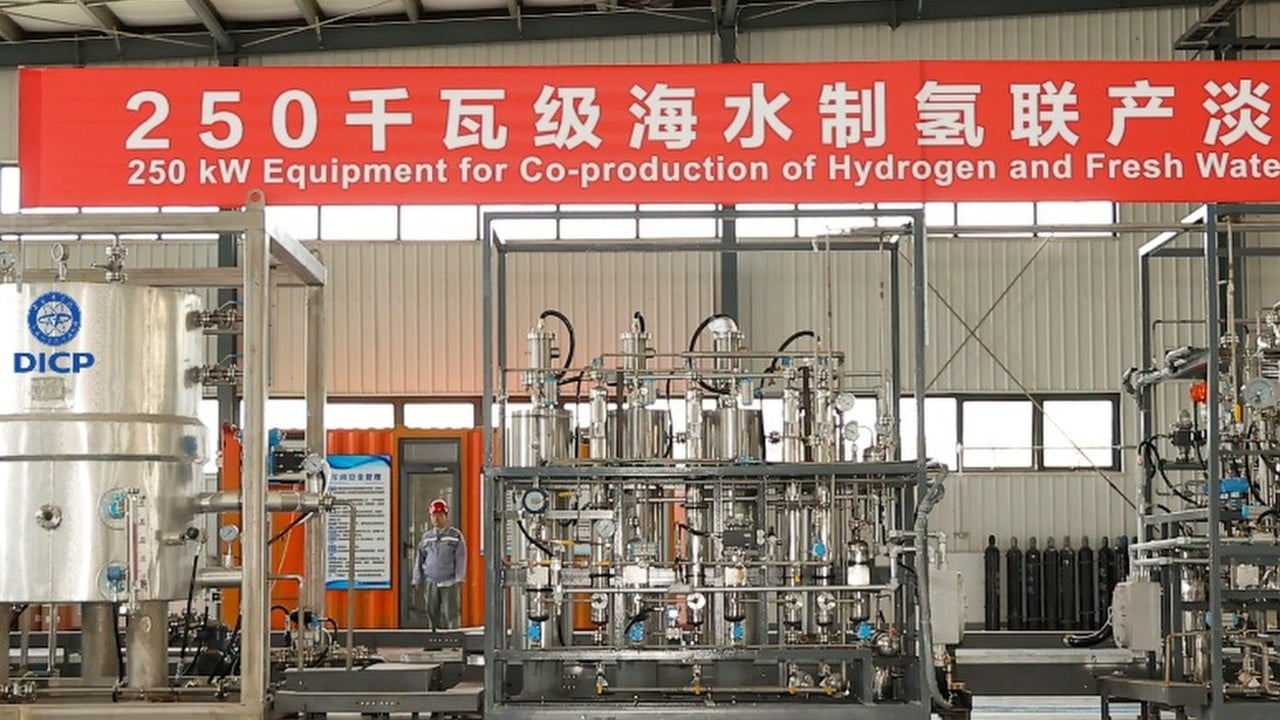
Chinese scientists have built a small, stable co-production plant that uses one system to extract hydrogen and fresh water from seawater, while also recovering uranium and bromine and improving electricity use efficiency by about 15 per cent.
The team, led by Deng Dehui and Liu Yanting from the Chinese Academy of Sciences’ Dalian Institute of Chemical Physics, improved on an existing technology that is both costly and power hungry, according to a paper in the peer-reviewed journal Nature Energy.
Producing hydrogen from seawater in a process powered by renewable energy is an important route to green hydrogen, but both of the two main approaches have their drawbacks.
In the direct seawater electrolysis method, the high levels of chloride ions react with the anode, corroding the electrode, while calcium and magnesium ions form scale on the cathode and reduce efficiency.
The second approach is a two-step route: first, desalinate the seawater and then electrolyse it. Reverse osmosis or distillation turns seawater into pure water, which is then used to make hydrogen.
02:59
China’s Great Green Wall stands against the spread of desert sands
The Chinese scientists proposed an improved technology based on the mature second route, with its expensive desalination equipment and high electricity requirements, according to the study that appeared on September 15.
In 2023, the team built a small 25-kilowatt unit, based on the desalination technology, that the China Petroleum and Chemical Industry Federation rated as internationally leading.
The researchers then scaled up the design, building a 250kW plant and targeting an overlooked power leak. Calculations showed that the system could turn a profit because it used energy efficiently, the paper said.
In existing commercial systems, at 80 to 90 degrees Celsius (176 to 194 degrees Fahrenheit) about 30 per cent of electricity becomes low-quality waste heat that is hard to recover and is usually removed by cooling water systems – further increasing energy and freshwater consumption.
To solve the problem, the team linked the electrolyte with a desalination unit, sending waste heat from electrolysis directly into a vacuum distillation tower where it drives seawater to boil and evaporate at a low temperature of 40 to 50 degrees. The vapour is then condensed into fresh water.
According to a Chinese Academy of Sciences press release, the system produces enough fresh water to run the electrolyte and still leave extra. Salt, uranium, bromine and other marine resources could be extracted from the remaining concentrated seawater in multiple stages, it said.
The 250kW unit can produce 380,000 standard cubic metres (about 13.4 million standard cubic feet) of hydrogen per year, with purity reaching 99.9999 per cent. It also produces 256 tonnes of fresh water, the scientists said.
The study found that compared with traditional alkaline water electrolysis for hydrogen, the system improved electricity utilisation by 14.4 per cent. It also ran stably for 40 days under daily start-stop conditions with no obvious decline.
Deng wrote in the paper that a cost analysis showed the system was more economically competitive than the traditional two-step process of pre-desalinating seawater and then electrolysing it for hydrogen.
According to the paper, the system holds promise for highly profitable hydrogen production, with an estimated average cost of US$2.1 per kg when electricity costs are at US$0.033 per kilowatt-hour from onshore wind, and US$2.9 per kg at US$0.049 per kWh from solar power. Hydrogen currently sells for about US$3.9 per kg.
Deng also said that future research should focus on developing better catalysts, improving recovery of waste heat from electrolytes and using artificial intelligence to optimise process parameters and maximise overall system performance and efficiency.
Passionate about science? Dive deeper with the Dark Matters newsletter, a weekly in-depth analysis on China’s rise in science, technology and military that goes beneath the surface. Sign up for free now.
KioskNews shows a cleaned-up reading view extracted from the publisher’s page — the original always lives on their site, not ours.