‘We just want more rest’: China workers lament extra workdays ahead of Golden Week holiday break
BEIJING: “Before the holiday has even begun, we’re already so exhausted that all we want to do is lie down and do nothing.”
That complaint from a user on the popular Weibo microblogging site is among a wave of frustration from workers in China over the country’s longstanding practice of shifting workdays to create longer public holidays, as millions prepare for the annual Golden Week break beginning on Thursday (Oct 1).
Coming just days after the Mid-Autumn Festival holiday from Sep 25 to Sep 27, this year’s Golden Week holiday has reignited debate over whether China’s “tiaoxiu”, or adjusted rest, system actually gives workers more time off - or simply leaves them more exhausted.
The tiaoxiu policy creates longer, uninterrupted breaks when public holidays fall in the middle of a working week. Weekday breaks are effectively swapped with working days on weekends before or after the holiday.
Under the arrangement, workers were required to work on Sep 20, a Sunday, to make up for one of the working days that fell within the Oct 1 to 7 holiday period.
They will then have to return to work the following Saturday on Oct 10 - to make up for the remaining working day.
But with the Mid-Autumn Festival and Golden Week falling within days of each other this year, workers are questioning how much additional rest the policy actually provides.
A Weibo user by the handle doctor Xu Chao, noted that the seven-day Golden Week break comprises three statutory public holidays for National Day, two weekend days and two days shifted from other weekends.
“If there’s no tiaoxiu, it looks like we would only have five days of holidays,” Xu wrote.
“For those who want to travel and visit their relatives, it’s definitely enough.
“But for some working adults, this would disrupt their work days and rest days, throwing their work schedules out of sync as well.”
Another user, Yang Xiaolei forever, questioned why the two holiday periods were not simply combined.
“If tiaoxiu is required, why didn't we just (have a long holiday) from Sep 25 to Oct 4?” the user wrote.
“MORE REST, WITHIN REASON”
The debate has also sparked broader discussion over whether the system is designed primarily to give workers a break or to stimulate consumption during concentrated holiday periods.
A Weibo hashtag translating roughly as “Tiaoxiu is not for rest, it’s to encourage spending” was inaccessible on the platform.
“Due to related laws and policies, we are not able to display content related to this topic,” read a notice on the site seen by CNA.
Some individual posts discussing the issue, however, remained accessible.
A user with the handle “Don’t squeeze my bubble” said debate over tiaoxiu and consumer spending repeatedly surfaces on Weibo’s trending searches.
“On paper, it looks like you're given more days of break, but in actual fact, there isn't a lot,” the user said. “The reason why (so many) people get heated over the topic is because we just want more rest, and within reason.”
HOLIDAY SPENDING IN FOCUS
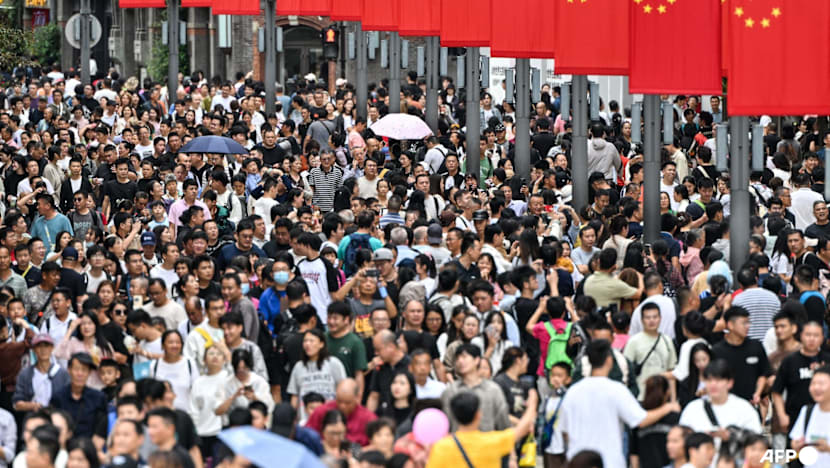
The debate comes as China prepares for one of its biggest annual travel periods.
Golden Week is typically closely watched as a gauge of household spending.
This year’s holiday comes amid weak consumer demand, deflationary pressures and a prolonged property market downturn affecting homeowners, tenants and landlords alike, Reuters reported.
Observers are hopeful that the extended holiday period will provide a boost to the tourism sector, but it remains unclear whether strong travel demand will translate into similarly strong spending.
Travel volume rose during last year’s Golden Week, but average spending per trip fell to a three-year low of 911.04 yuan (US$135.70), according to Reuters calculations based on Chinese government data.
But there are still signs that travel demand will be robust.
In a report on Monday, state-affiliated newspaper China Daily noted that the country’s aviation sector was preparing for a surge in passenger traffic over the holiday period - with major airports expecting heavy passenger flows and particularly strong growth in international travel.
Beijing Capital International Airport is expected to handle more than 1.66 million passenger trips during the Golden Week holiday - roughly an average of around 237,000 passengers a day.
Other popular domestic destinations include Shanghai, Guangzhou, Shenzhen, Chengdu, Chongqing and Guiyang - with Bangkok, Singapore, Ho Chi Minh City and Bali among leading international destinations for Chinese travellers, China Daily said.
KioskNews shows a cleaned-up reading view extracted from the publisher’s page — the original always lives on their site, not ours.