Liberman backs Eisenkot for PM, but rules out minority government with Arab support
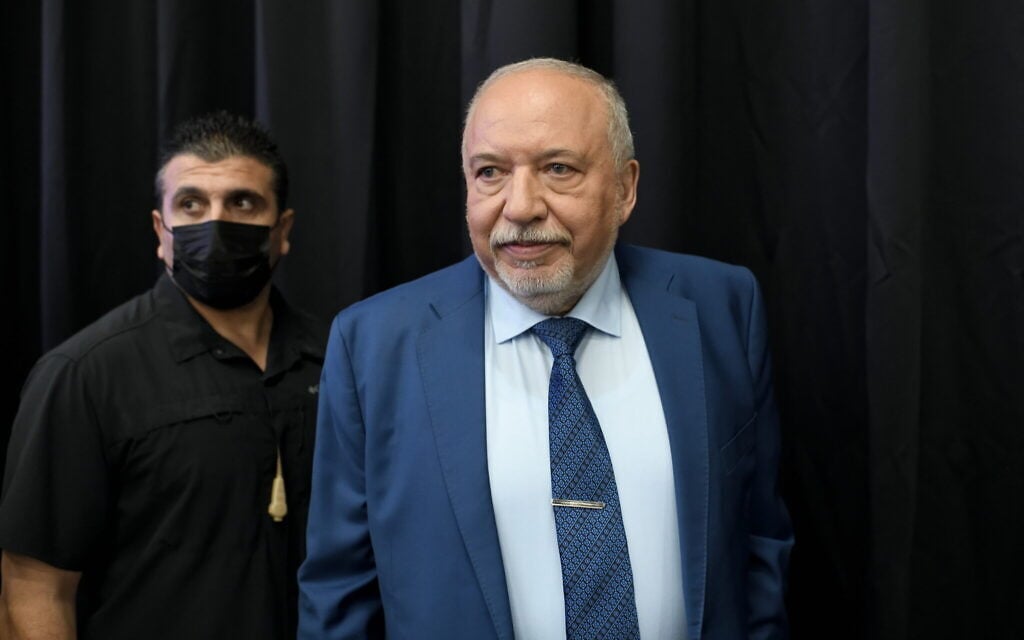
Avigdor Liberman, chair of the hawkish Yisrael Beytenu party, vowed on Monday to back leading opposition candidate Gadi Eisenkot for prime minister, uniting all of the Jewish-led opposition parties behind a single candidate.
But Liberman also threw cold water on the prospects for forming an opposition government, repeating his pledge that he would not join a minority coalition supported from the outside by Arab lawmakers, considered one of the only possible scenarios for unseating Prime Minister Benjamin Netanyahu. He also criticized Eisenkot for what he said was a failed campaign.
Nearly a week after the October 27 election, the anti-Netanyahu parties are charting a pathway to forming a government. While the opposition will hold a majority of 67 in the 120-seat Knesset, it is split between Jewish-led parties with 48 seats and Arab-led parties with 19. Netanyahu’s outgoing coalition will hold 53 seats.
0:00 / 0:00
Promoted: American Technion Society

The 48-seat bloc is now united behind Eisenkot, but is far short of a majority in the Knesset. On Monday, the leader of the largest Arab party, the Joint List, spoke of a “historic moment” for change, and said the party could provide external support to an Eisenkot-led government without joining the coalition.
The other Arab party, Ra’am, has eight seats. If Ra’am were to vote for an Eisenkot government, and the Joint List were to abstain from the vote, Eisenkot would have a majority.
Get The Times of Israel's Daily Edition by email and never miss our top stories
By signing up, you agree to the terms
But at a press conference on Monday, while he said he had told Eisenkot “face to face” that Yisrael Beytenu would recommend him as the next prime minister, Liberman rejected the idea of a minority government.
“I was also clear on the topic of a minority government: It won’t happen,” he said, predicting that such a coalition would be short-lived. He accused the Arab parties of being backed by the West Bank-based Palestinian Authority, saying the PA was “very involved, a link we cannot allow.”
Eisenkot’s centrist Yashar party is the largest of all opposition factions, and the two other Jewish-led parties — B’Yachad and the Democrats — have already vowed to support him for prime minister. President Isaac Herzog, who is tasked with choosing a candidate to lead the next government, will begin meeting with parties on Wednesday.
Herzog has publicly backed the idea of a unity government of the opposition parties with Netanyahu. But Netanyahu’s camp is resisting that idea, with coalition whip Ofir Katz ruling out a rotation agreement that would see Eisenkot and Netanyahu alternate as prime minister. Eisenkot has also ruled out a rotation.
Liberman likewise said at the press conference that he would not serve in a government with Netanyahu under any circumstances, even as part of a rotation agreement in which Liberman would serve as prime minister first. Liberman has long been open about his desire to serve as prime minister.
He said on Monday that since the election, he had been “approached by leaders from the coalition with the strangest proposals,” but that he hadn’t met with Netanyahu himself.
Liberman said he would support appointing Yair Lapid, B’Yachad’s No. 2, as Knesset speaker in place of Netanyahu ally Amir Ohana. That would allow the opposition to pass some legislation, even without holding the reins of government.
He mused that members of Netanyahu’s Likud party could defect to give the opposition a majority, considered a highly unlikely scenario.
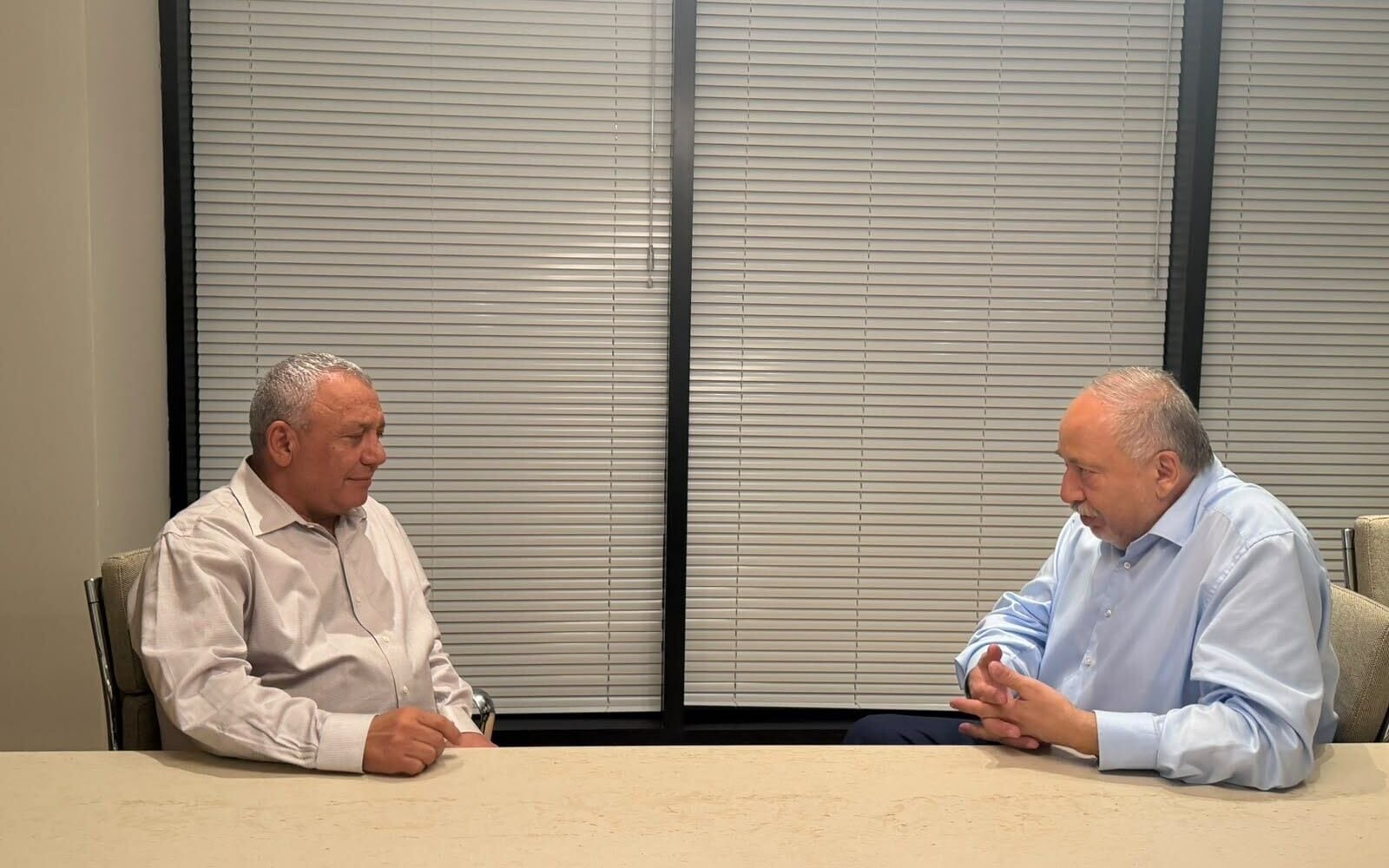
He also bashed Eisenkot for bringing the Jewish-led opposition bloc to only 48 seats, accusing him of prioritizing the interests of his own centrist Yashar party over the broader goal of unseating Netanyahu.
“We failed – 48 seats is far lower than what we expected,” Liberman said, and charged that Eisenkot had run an “egotistical” campaign.
Joint List leader floats partnership to end ‘awful four years’
Before Liberman’s press conference, the head of the Joint List, the largest Arab party, indicated on Monday in an interview with The Guardian that his lawmakers were prepared to provide external support to a minority government led by Eisenkot.
“In order to use our political power to get rid of the extreme Netanyahu government, we said that we will consider the possibility of supporting from outside,” Yousef Jabareen told the UK publication. “This is an opportunity to change policies, to change attitudes, including toward the Arab community and toward the Palestinian people.”
He added, “This is really a historic moment and I hope that there will be partners within the opposition to go ahead with that. We are thinking that this could be the start of a change.”
Jabareen said that the Joint List’s 11 incoming MKs had no intention of joining an Eisenkot-led coalition due to Israel’s continued control of the West Bank.
Eisenkot has laid out four principles any of his coalition partners must support, and Jabareen contended that the Joint List would not be bound by those terms.
“The conditions that [Eisenkot] speaks of are more relevant for parties who would be in the coalition. We are not planning to be in the coalition… for very clear reasons,” he said. “As long as the occupation of our people in the West Bank continues, we cannot be part of a government.”
“This has been an awful four years… in all areas of life: in terms of house demolition, criminal gangs within the Arab community without any [intervention] from the police; not allocating the needed resources for our municipalities, for our education, for our youth in general; racism in all areas of life – physical attacks against Arabs, the brutality of the police,” he said. “So this has been really a very dangerous period.”
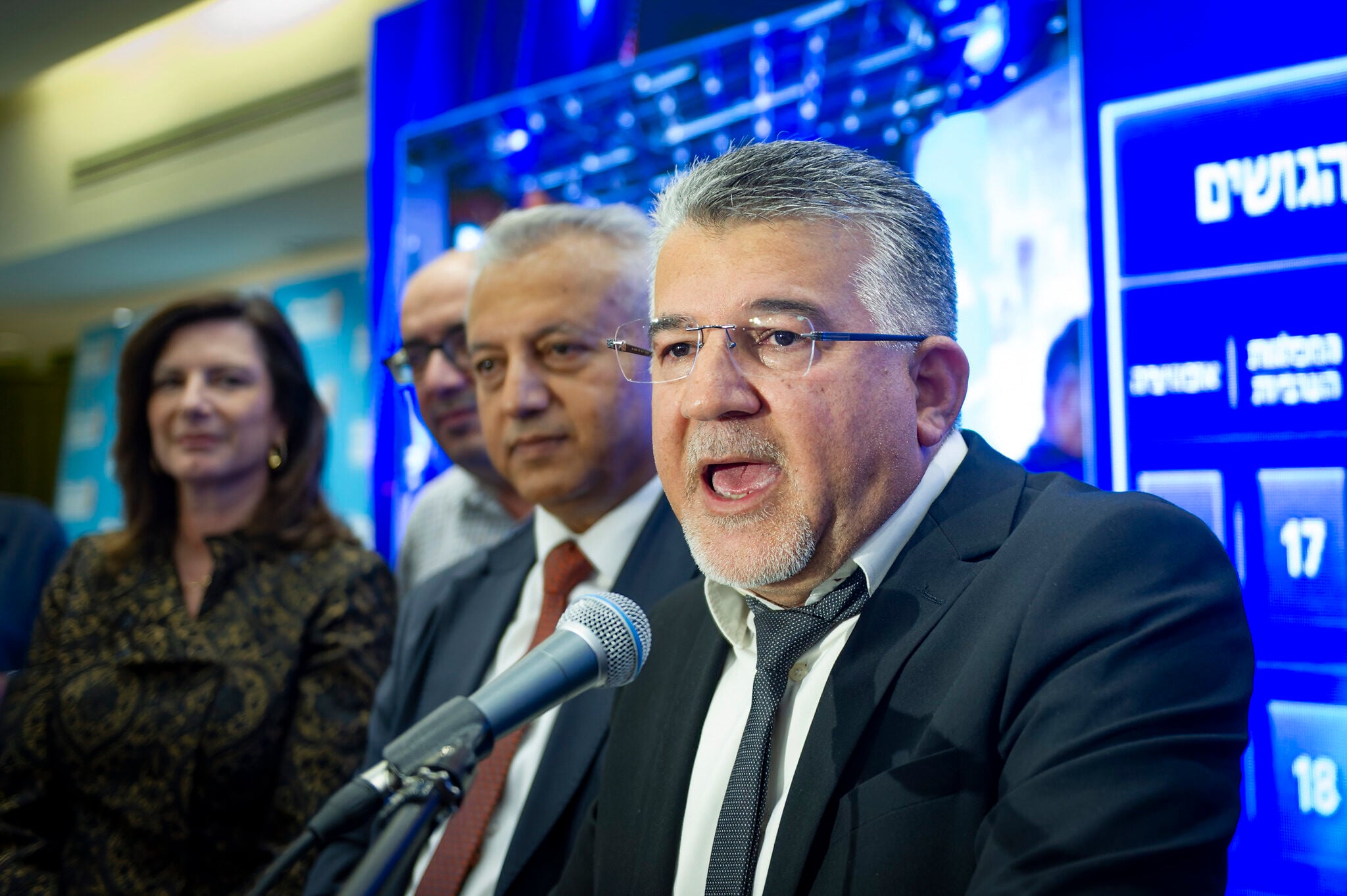
Jabareen added that it is “crucially important” that Ohana be replaced, and one of the priorities should be repealing laws passed under the government’s contentious judicial overhaul.
Protester tells Eisenkot, ‘You murdered your son’; Yashar slams PM’s ‘rotten’ politics
Amid the coalition bargaining, pro-Netanyahu demonstrations have heated up, targeting opposition politicians and their supporters.
On Monday, Yashar condemned an incendiary protest outside Eisenkot’s Herzliya home the previous night, and laid blame for it at the feet of Netanyahu’s camp.
At the demonstration, protesters called Eisenkot a “traitor,” and one man accused the former IDF chief of staff of being responsible for his own son’s death in battle in Gaza following the Hamas-led October 7, 2023, onslaught.
Footage from the incident showed the man shouting through a megaphone, “You murdered your son,” referring to Master Sgt. (res.) Gal Eisenkot, who was killed in December 2023.
The protester also directed threats and insults at Eisenkot’s wife, Hannah, telling her, “You will be next to your son.”
הפרגוד: מפגיני ימין מחו מול גדי איזנקוט. במהלך המחאה נשמעה לעברו הקריאה המזעזעת: ״אתה רצחת את הבן שלך״.
צילום: הילל בן אור pic.twitter.com/gOGJ2VlOQb
— הפרגוד (@moshepargod) November 1, 2026
In a statement, Yashar called the incident “the direct result of rotten, unrestrained political leadership that has erased all red lines to stay in power.” The attack, the party said, showed “what losing one’s way looks like.”
“This is the spirit emanating from Netanyahu’s office,” the statement continued, calling for the government to be replaced as soon as possible “for the sake of the State of Israel and Israeli society.”
“At this point, we don’t even expect a condemnation,” the party added. “The shame is all yours.”
In addition to Eisenkot’s son, two of his nephews — Cpt. Yogev Pazy, 22, and Sgt. Maor Cohen Eisenkot, 19 — were killed in the war.
KioskNews shows a cleaned-up reading view extracted from the publisher’s page — the original always lives on their site, not ours.