Oil import bill up 54% in first 7 months of FY27
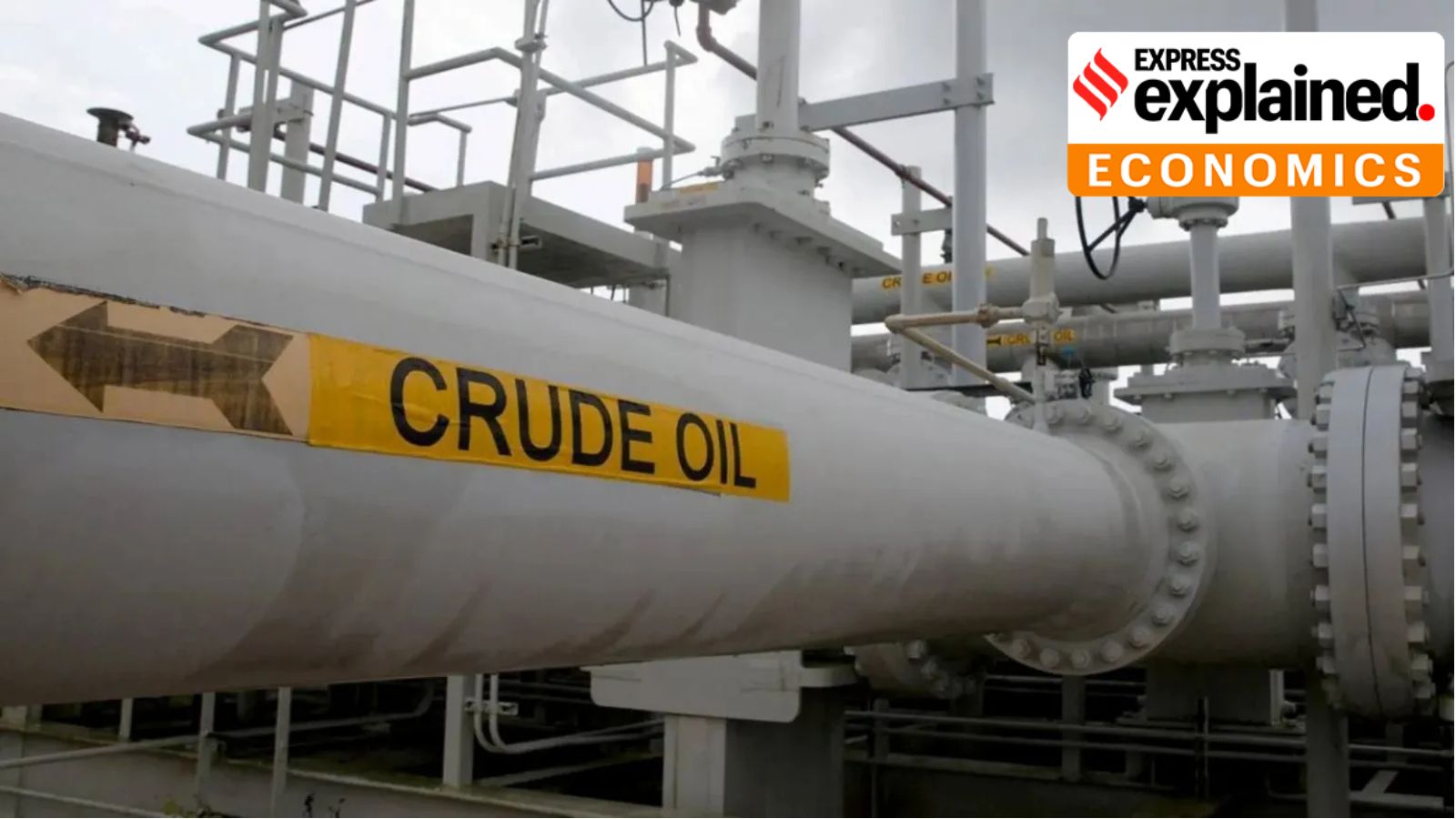
India’s crude oil import bill surged by nearly 54% on a year-on-year (y-o-y) basis in the first seven months of the current financial year even as import volumes rose only slightly amid supply tightness and elevated prices due to West Asia conflict and the consequent Strait of Hormuz crisis, as per provisional data from the Ministry of Petroleum and Natural Gas (MoPNG).
Elevated prices also led to a jump in liquefied natural gas (LNG) import bill and fuel export value. As a result, net oil and gas imports — arrived at by deducting petroleum product exports from oil, natural gas, and petroleum product imports — were higher by almost 40% from the year-ago levels, underscoring the adverse economic impact of the West Asia crisis on energy import-dependent India.
The country depends on imports to meet over 88% of its crude oil requirement and about half of its consumption of natural gas, which is imported as LNG, or super-chilled gas.
Despite depending on imported oil and gas, India is a net exporter of petroleum products due to its massive oil refining capacity, while it also imports some petroleum products like liquefied petroleum gas (LPG).
Prior to the West Asia war, which broke out in late-February, about 40% of India’s crude oil imports, 60% of its LNG imports, and a whopping 90% of its LPG imports came from the Persian Gulf through the Strait of Hormuz.
Although physical supply tightness — a key worry in the first few months of the war — has now eased to a large extent, energy prices remain elevated and volatile amid sky-high freight and insurance costs due to war risk premiums.
After moderating slightly in June-August, oil prices jumped again in September-October as a result of renewed hostility in West Asia and soaring freight costs. In October alone, the country’s oil import bill surged by nearly 88% y-o-y.
Story continues below this ad
India has been forced to import oil and gas at extremely high rates as the country has been prioritising supply security over price considerations, given its extreme reliance on imports and largely inelastic demand.
India’s oil & gas trade math
As per the latest provisional data released by the Petroleum Planning and Analysis Cell (PPAC) of the MoPNG, crude oil imports in April-October jumped 53.5% on-year to $111 billion, even as import volumes rose by just 2.7% to 146.6 million tonnes (mt), or about 1.08 billion barrels.
This translates to about $103.3 per barrel as the average landed price of imported crude oil in the seven-month period, up from around $69 per barrel in corresponding period of last year. The April-October oil import bill is already 88% of the import value for the full financial year 2025-26, and there are still five months to go in current fiscal.
In October, the last month for which data is available, the oil import bill jumped 87.5% on-year to $19.5 billion. The crude oil basket averaged at $116.1 per barrel in September and $119.9 per barrel in October. It stood at $114.48 in April, $106.2 in May, $83.2 in June, $82 in July, and $90.2 in August.
Story continues below this ad
As for LNG imports, while supplies rose 7.4% to 22,175 million standard cubic metres (mscm) in April-October, the LNG import bill rose by 35.8% to $11 billion, reflecting the spurt in prices. Petroleum product imports almost halved in volume terms to 15.1 mt from 29.8 mt, as supply of major petroleum products that India imports — such as LPG — were impacted by war. In value terms, the decline in petroleum product imports was relatively lower, down 25% to $9.9 billion, due to super-normal prices in the international market.
The country’s petroleum product export volumes declined 13.5% to 32.1 mt in April-October as domestic fuel supplies took precedence amid the global supply crunch. Nonetheless, the exports surged 47% in value to $34.1 billion due to the jump in international petroleum fuel prices.
Taking into account the overall oil, LNG, and petroleum product imports as well as fuel exports, the country’s net oil and gas imports rose 39% y-o-y in April-October to $97.7 billion, the PPAC data shows.
Energy imports are a major component of India’s overall imports, and any meaningful increase has ramifications for trade balance, current account, inflation, and the rupee’s exchange rate, among others. For instance, India’s wholesale fuel and power inflation was 32.8% in October, 25.9% in September, and 23.2% in August, as per government data.
KioskNews shows a cleaned-up reading view extracted from the publisher’s page — the original always lives on their site, not ours.