Baby orangutans in India expose scale of trafficking
Five baby orangutans abandoned in an Indian forest have exposed a “massive” exotic wildlife trade, with traffickers smuggling increasingly rare species into the country, experts said.
They warn of a growing multimillion dollar trade in endangered animals, including apes smuggled through war-torn Myanmar to feed demand among wealthy Indians seeking exotic status symbols to flaunt on social media.
“There have been several instances of exotic wild animals being found or seized across the country,” Humane World for Animals India director Sumanth Bindumadhav said. “The scale is massive.”
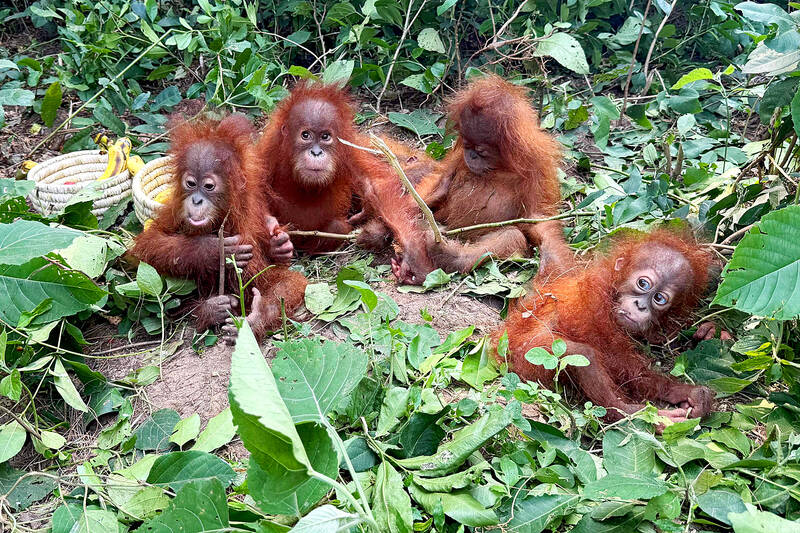
Orangutans sit next to bananas upon their rescue by officials at the Ranakatha Protected Reserved Forest in Balasore District, India, on Monday last week.
Photo: AFP / Odisha Forest Department
Critically endangered orangutans are native only to Indonesia’s Sumatra island and Borneo, which it shares with Malaysia and Brunei.
Yet the five tiny orangutans were found by rangers in Balasore, India.
Aged about one-and-a-half years old, they are being cared for at a zoo.
Indonesia has requested their return.
Humane World in a June report detailed what it called a “rising trade in exotic wildlife,” demonstrated by a “steep increase in seizures” that reflected a “surge in illegal trade.”
The report estimated India’s exotic pet market to be about US$42.6 million in 2024.
Orangutans and gibbons, small apes, were being “increasingly trafficked into India” from Southeast Asia’s rainforests, it added.
A senior official at India’s Wildlife Crime Control Bureau said “thousands of social media influencers” were promoting exotic species as pets online, fueling demand among followers.
“It is a huge market,” the official said on condition of anonymity. “Rich people keep them in their homes.”
Under a government voluntary disclosure scheme, more than 40,000 people had registered exotic animals by February 2021, government data showed.
The figure is likely only a fraction of those in private hands, analysts said.
“The true scale of it is actually quite frightening,” Bindumadhav said.
Former India head of global anti-wildlife-trade group TRAFFIC Shekhar Kumar Niraj said the surge in trafficking was also linked to a “rising number” of animals held in private hands.
“Private zoos have violated laws at a very alarming scale across the country,” Niraj said. “Primates are very popular in zoos because they are very intelligent, like to interact with humans, the kind of thing zoos want.”
The World Wide Fund for Nature-India said it documented 56 seizures involving about 4,000 exotic animals in 2022 alone.
KioskNews shows a cleaned-up reading view extracted from the publisher’s page — the original always lives on their site, not ours.