Justice Vikram Nath applauds Justice Kaul’s candour amid debate over memoir
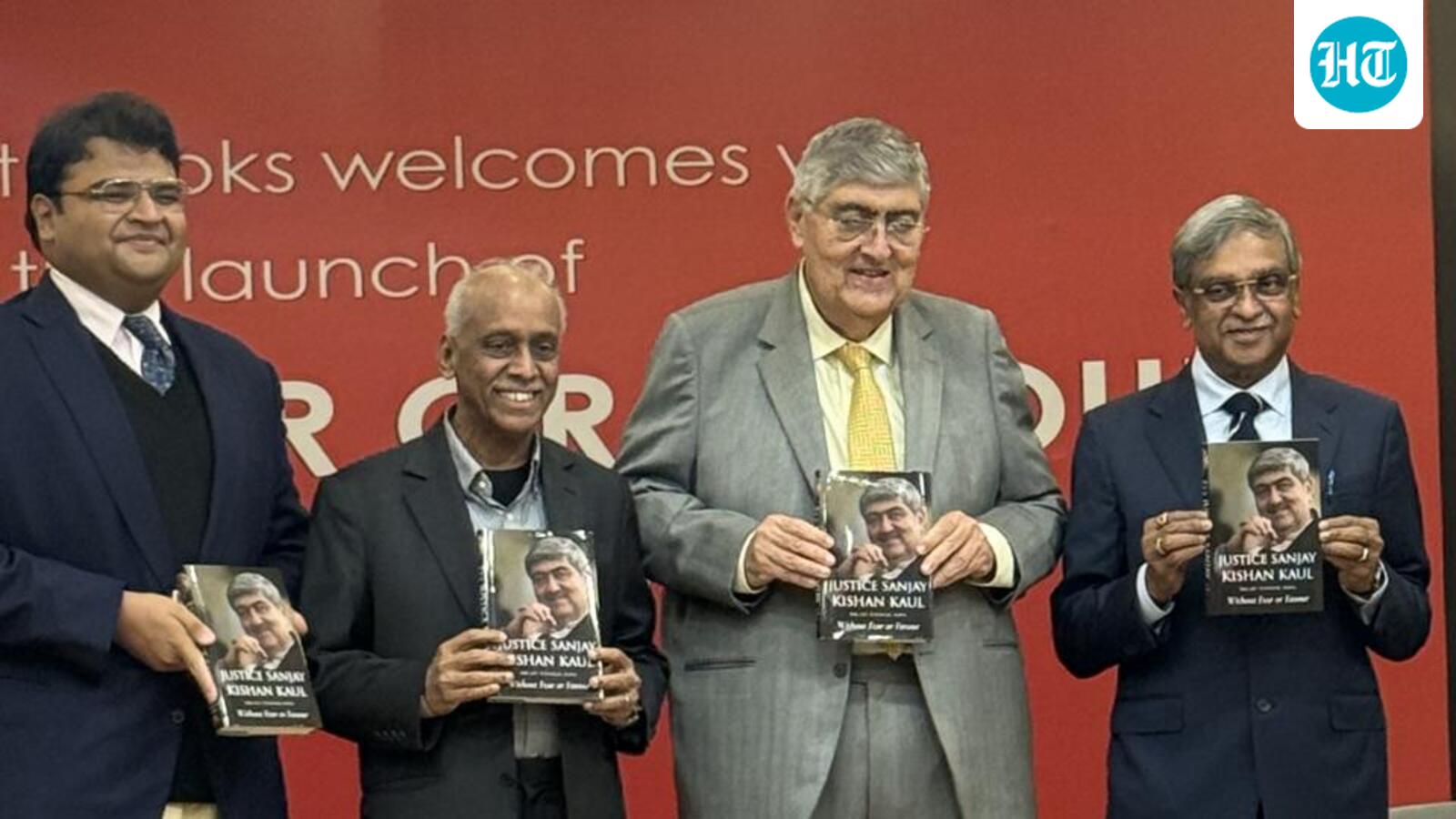
Justice Vikram Nath praised Sanjay Kishan Kaul’s candid memoir but declined to endorse or disagree with his former colleague’s account of the Supreme Court collegium.

Justice Vikram Nath on Wednesday applauded the candour with which former Supreme Court judge Sanjay Kishan Kaul has written his memoir, Without Fear or Favour, but steered clear of endorsing or disagreeing with his former colleague’s observations about the Supreme Court and its functioning, saying he did not intend to turn the book launch into “another hearing”.
Justice Nath, a senior sitting Supreme Court judge, said writing judgments without fear or favour was one thing, but bringing the same candour to a memoir, particularly when many of the people written about were still around to read it, required “a different kind of courage altogether”.
“I do not propose to endorse or disagree with any of those accounts this evening. This is a book launch, not a courtroom, and I have no intention of turning it into another hearing,” he said, while delivering the keynote address at the launch of Kaul’s memoir.
Justice Nath, however, underlined that friendship did not require agreement on every question. “We can value a person’s candour while reserving our right to differ. And that freedom to speak, to question and to disagree is something worth protecting,” he said, referring to his personal association with Kaul and the trust and affection that had developed between them.
The remarks came amid a discussion over Justice Kaul’s account of the Supreme Court collegium, particularly his criticism of the appointment process during the tenure of former chief justice of India Dhananjaya Y Chandrachud. Justice Kaul has maintained that the collegium remains vulnerable to political pressure and that the manner in which some appointments were sought to be made raised concerns.
Justice Chandrachud, in response, has said that the collegium’s formal resolutions were unanimous, that reasons for recommendations were placed in the public domain and that Justice Kaul had not recorded dissent on any of the appointments.
Justice Kaul, during an interactive session with senior advocate Saurabh Kirpal at the book launch, sought to clarify that his account was not intended to portray his differences with Justice Chandrachud as a personal confrontation, nor was he questioning the suitability of those who were eventually appointed.
“All these Supreme Court appointments were of people to whom, after discussion, I gave my consent. There is no discussion on that. So, I did not disagree with the appointments,” Kaul said, adding that he had repeatedly made the distinction between the process and the individuals selected.
“It is the manner of appointment which was an issue, not the persons being appointed,” he said.
Asked whether he had formally recorded dissent because he believed merit was being compromised, Justice Kaul said he would have done so had he disagreed with the candidates themselves. He said the process was the concern, and that discussions within the collegium ultimately resulted in the appointments going through, even when deliberations occasionally became heated.
“In 333 pages, if you take out five or seven pages and try to make it into some kind of a confrontation or battle between two people who happen to occupy positions at number one and two in the Court, that’s not what the book is about,” he said.
There were bound to be differences in an institution where several people were involved in decision-making, said Justice Kaul, adding that disagreement on some issues did not negate agreement on others. “There may be differences. There were things we agreed upon. There were things we did not agree upon. It is logical in a system that people will not agree on everything we are talking about. And that’s what it is about,” he said.
Meanwhile, congratulating Justice Kaul for writing the memoir with candour and humour, Nath said the book was not merely an account of the offices he had held, but of the people, experiences and values that had accompanied him throughout his career.
Several sitting and former judges of the Supreme Court and high courts, along with senior lawyers, also attended the event.
ABOUT THE AUTHOR
Utkarsh Anand is the National Legal Editor at Hindustan Times, where he leads the newspaper's coverage of the Supreme Court, constitutional law, the judiciary and the Union law ministry. He joined Hindustan Times in 2020 after stints at Press Trust of India (PTI), The Indian Express and CNN-News18, and has over two decades of experience reporting on law, governance and public policy. His work has focussed on some of India's most consequential constitutional and legal developments, including the Supreme Court's judgments on Article 370, marriage equality, decriminalisation of homosexuality, the Babri Masjid dispute, electoral reforms and judicial appointments. He specialises in making complex legal proceedings and judgments accessible to readers while examining their wider social and political impact. Beyond daily reportage, Utkarsh has led investigative projects and enterprise reporting that have shaped public debate and prompted institutional responses. His work has received several journalism awards, including the Ramnath Goenka Excellence in Journalism Award. As National Legal Editor, he has also played a key role in expanding Hindustan Times' legal journalism footprint, mentoring reporters and strengthening coverage across platforms. A Chevening South Asia Journalism Programme Fellow, Utkarsh regularly writes analyses on the judiciary and constitutional issues, and his reporting is widely followed by lawyers, judges, policymakers, academics and readers seeking clarity on India's evolving legal landscape.
KioskNews shows a cleaned-up reading view extracted from the publisher’s page — the original always lives on their site, not ours.