China and Netherlands send ‘positive signal’ over global controls on military AI
China and the Netherlands have agreed on the need for international regulations on the military use of AI, a move hailed as an encouraging step forward.
The Netherlands plays a key role in the global tech industry and recently unveiled a plan to avoid over-reliance on one source of AI, an approach analysts said Chinese open-source models could help support.
“The two sides support enhancing multilateral governance of military applications of AI and support the United Nations in fulfilling its due role,” the statement read.
The pair also discussed the importance of maintaining close communications and export control dialogue.
05:04
China creates analogue AI chip said to be 1,000 times faster than Nvidia GPU
Managing risks in the military domain was particularly urgent as AI was already being integrated into active warfare, said Huang Jing, a professor of international relations at Shanghai International Studies University, citing the US military’s use of the technology during its war on Iran.
Dialogue was essential to keeping the military use of AI from spiralling out of control globally, Huang added, describing the inclusion of this point in the joint statement as “a very positive signal”.
“While Europe may not be a major AI player in terms of frontier development, it is a major AI governance player,” John Gong, a professor of economics at the University of International Business and Economics in Beijing, said.
Developing cutting-edge AI required massive investments in capital, talent and energy – conditions Europe currently lacked, Gong added.
With both Washington and Beijing already discussing AI governance, European countries did not want to be left out, particularly given the Dutch strengths in both technology and defence, he said.
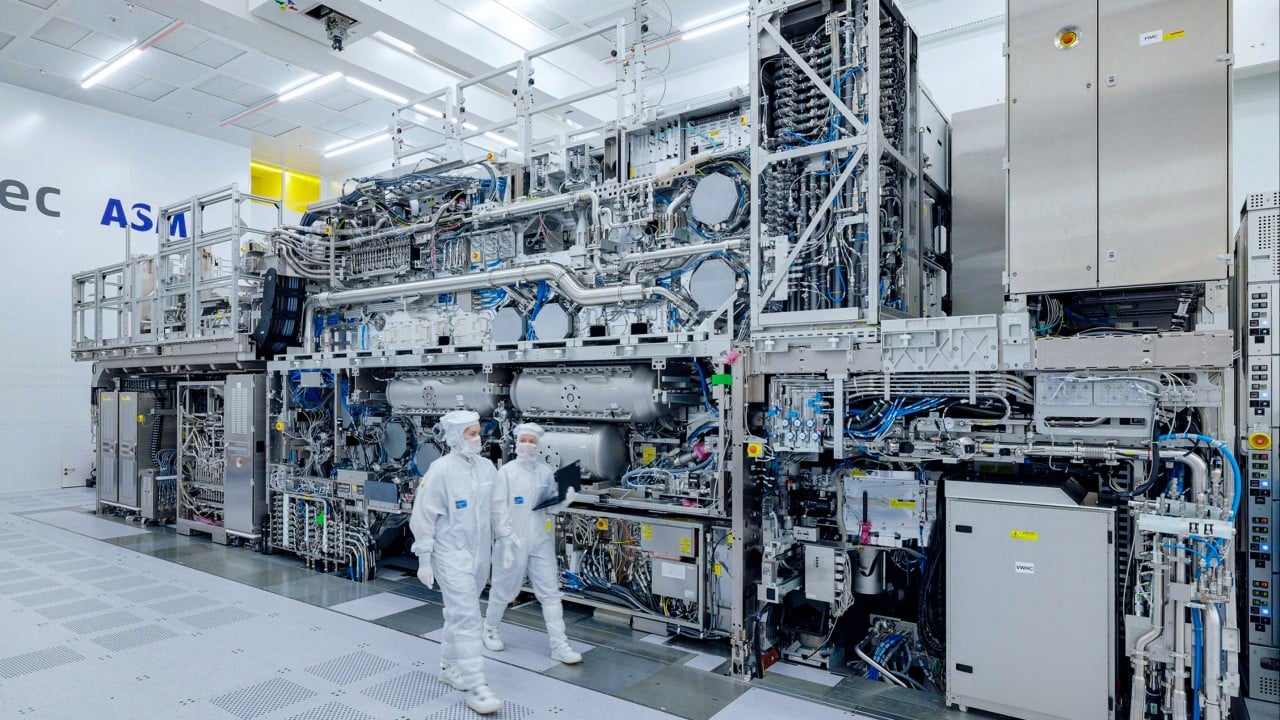
Huang said: “Amid broader turmoil across Europe, the Netherlands stands out as a relatively stable country with strong hi-tech capabilities, including chipmaking equipment giant ASML.”
The country has one of the 10 biggest defence budgets in US dollar terms among European members of Nato, according to data from the alliance.
SCMP Plus is a new premium news platform that gives you an
all-inclusive edge to stay ahead on China news.
To access our exclusive content you’ll need to subscribe.
Already a subscriber?
LOG IN
Earlier this month, the Dutch government unveiled a plan to expand its defence technological and industrial base by 40 per cent by 2030, including targeted investments in unmanned and autonomous systems.
The Dutch government also recently launched a national AI strategy designed to reduce its reliance on both American and Chinese companies.
01:52
Xi says China and US have responsibility to ‘manage AI for good’
“If US closed-source models shut you out, China’s open-source ecosystem remains open,” Huang said. “If the Netherlands can cooperate with China, it can secure a seat at the table. How far that cooperation goes remains to be seen, but it is at least a positive start.”
Gong said: “For European countries, the goal in AI is to avoid being forced to take sides – and China welcomes that approach.”
He said transatlantic relations were undergoing a profound shift, with Europe growing increasingly reluctant to accept unilateral decisions from Washington.
The bipartisan act, which has gained further traction following the scandal over Nvidia chief Jensen Huang’s affair with an alleged Chinese spy, would require US allies to adopt stricter export controls or face unilateral restrictions on their equipment, including ASML’s immersion deep ultraviolet lithography tools.
Berendsen said the act “must not be passed. That is the most important thing”, according to Dutch news agency ANP.
ASML’s advanced lithography equipment is critical to producing cutting-edge chips, and the firm expects China to account for roughly 20 per cent of its sales this year, according to Reuters.
Meanwhile, a dispute over Nexperia, a Dutch semiconductor maker acquired by Chinese firm Wingtech Technology in 2019, has intensified sharply over the past year.
KioskNews shows a cleaned-up reading view extracted from the publisher’s page — the original always lives on their site, not ours.