F1 looks amateurish and incompetent after farcical scenes in Sepang | Giles Richards
Formula One has gone to no little pains this season in insisting the new format is more popular than ever, despite the overwhelming disapproval from the drivers over engine regulations. In short, there is nothing to see here.
Yet the farcical scenes that accompanied the opening to the Bahrain Grand Prix in Malaysia on Sunday left some drivers openly mocking the situation, which fans will not have failed to miss.
Max Verstappen won the race in Sepang, held in Malaysia to replace the cancelled Bahrain GP. It was a dominant drive for his first win of the season, but somewhat overshadowed by the sport, which styles itself as the pinnacle of motor racing, looking at best amateurish and at worst incompetent.
The race had been delayed because of heavy rain and the track was still very wet as the field took to it for the first time this season in such conditions. They ran behind the safety car to conduct two formation laps before the proposed start. As they toured round at low speed in low-grip conditions the software, now an integral part of the application of power in engines using an almost equal split of electrical and combustion energy, found itself in a scenario beyond its parameters. Chaos ensued.
First, Verstappen announced he could no longer accelerate, then Lewis Hamilton slowed and came to a stop before having to do a forced reboot of his car to get moving again. A number of drivers reported the same problem as they crawled around and one Haas and one Cadillac ground to a halt. The field was in disarray, out of order and the start was suspended.
The problem was caused by a combination of low engine speeds, low-grip and the circuit layout coming up against the wet weather management of the power delivery software. An unanticipated bug, as the FIA described it. There was a 53-minute delay while the FIA wrote and applied a software update that, to their credit, did work.
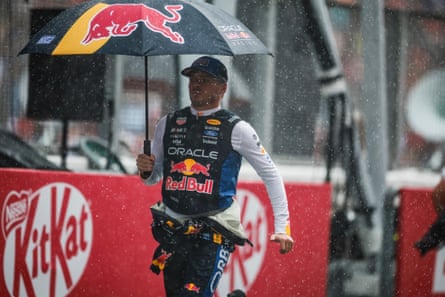
Verstappen and Hamilton mockingly compared it to the time they had driven in Lego cars as part of the pre-race entertainment at Silverstone in July.
“These engines are so complicated and a lot of software is implemented,” said Verstappen. “When there is some kind of error or glitch, that’s the problem. I triggered it first, then I look in my mirror and I just see everyone … I was like wait, are they waiting for me?”
“It was like the Lego race,” said Hamilton. “Yeah, we had the same speed,” said Verstappen. Both drivers were, by now, laughing at the absurdity of the situation.
The FIA said it will conduct a review with the teams and the power unit manufacturers, but the damage has been done, once more highlighting the foibles of these engines and how much has been taken out of drivers’ control.
after newsletter promotion
When addressing complaints about that after the Hungarian GP, F1’s chief executive, Stefano Domenicali, cited a conversation with the Star Wars creator, George Lucas, as evidence that new fans were not interested in the drivers’ dissatisfaction with what was going on under the bonnet. ““He gave us an incredible chance to see how we can really simplify things because the new fans are not understanding … what is behind the scenes. They are fascinated on the fact there is a lot of action.”
F1 clearly believes the force is strong with its product the way it is and will doubtless point to the fact that when the race did get under way in Sepang it was an entertaining affair. Hamilton came back from dropping to 17th to third place. Verstappen was at his imperious best out front, while George Russell’s dramatic late retirement all but put paid to his title hopes.
Yet even the new fans cannot fail to have observed the reality that was laid bare, drivers reduced to being all but passengers, furiously pushing buttons on a steering wheel to no effect on software over which they have no control. Then deriding and condemning the situation afterwards.
Moreover, F1 might also consider it dodged a bullet. Had the race started in the dry then a downpour arrived and the failure happened as the cars circulated mid-race behind the safety car would have made this embarrassment a mere bagatelle.
The finger should not be simply pointed at the FIA. These rules were agreed with full input from F1, the teams and the power unit manufacturers. As Carlos Sainz perceptively asked: “My only question is who, five years ago, decided this was the direction to go?”.
No quick fix is coming, but what happened in Sepang emphasised how misconceived these regulations were, regardless of how they are perceived by fans of every persuasion.
KioskNews shows a cleaned-up reading view extracted from the publisher’s page — the original always lives on their site, not ours.