Country diary: The house martins are gone, but not forgotten | Ed Douglas
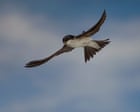
The sudden absence of something, even though you know it’s coming, can dent the heart a little. The Japanese, inevitably, have a phrase for it: mono no aware, the pathos of things – and by things, in this case, I mean house martins.
Last week I had stood in the same spot, looking across the same valley. The weather then was much the same as it was today, low‑angled sunlight through patchy cloud lighting up the yellowing birch leaves and bronzing moors on the north-eastern slopes of Kinder Scout. It had picked out the spread wings of a buzzard a little below my eyeline, along with a haze of large insects, which in fact, I quickly realised, were house martins.
Such fecundity was thrilling to see, especially as dwindling numbers have put house martins on the red list of threatened species. Dozens swooped and turned just in front of me, and dozens more were doing the same in the middle distance, gorging on insects before the long flight south.
Today, though, they were gone, the sky empty save for a kestrel quartering her patch, head dropped between her shoulders like a jeweller over her loupe. I wondered where these brave little travellers were now and how many would survive to return.
The mere fact of such migrations is astounding, made more so by the mystery that still surrounds them. These birds will winter somewhere in sub-Saharan Africa, but exactly where is unknown. Dutch researchers looked at isotopes in the feathers of their returning birds and could only narrow it down to west Africa. Researchers have also found microplastics trapped in house martin feathers, tiny fragments swept up into the air, where they linger among the martin’s insect food.
We blunder through these gossamer systems, brushing them aside almost unseen with every turn around the sun. It’s revealing, too, how those who find it politically expedient to mention natural variation in climate are much less interested in discussing the evolved instinct of many species, including our own, to migrate for survival.
KioskNews shows a cleaned-up reading view extracted from the publisher’s page — the original always lives on their site, not ours.