More Filipino families experienced hunger in 3Q of 2026 -- SWS report
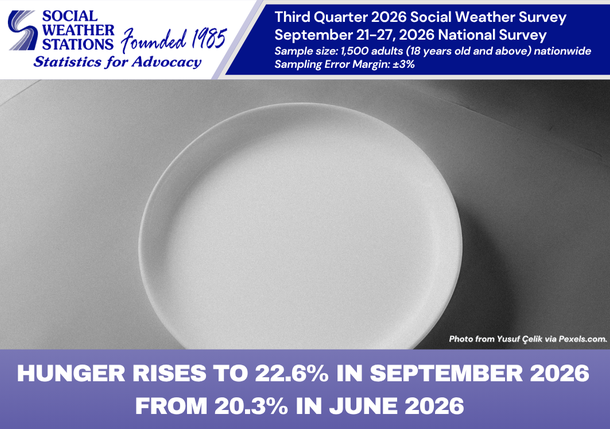
The number of Filipino families who experienced hunger rose in the past three months compared with the second quarter of 2026, according to a Social Weather Stations (SWS) report.
Conducted from Sept. 21-27, the report showed that 22.6% of Filipino families experienced involuntary hunger at least once in the past three months, which is 2.3 percentage points up from 20.3% in June 2026.
Involuntary hunger refers to being hungry and having nothing, according to SWS.
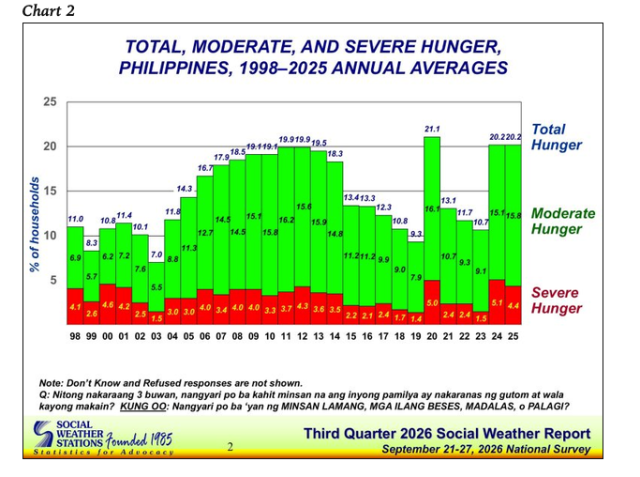
This is also 2.4 points above the 20.2% average of 2025, and 1.5 points above the record-high 21.1% average of 2020 during the COVID-19 pandemic.
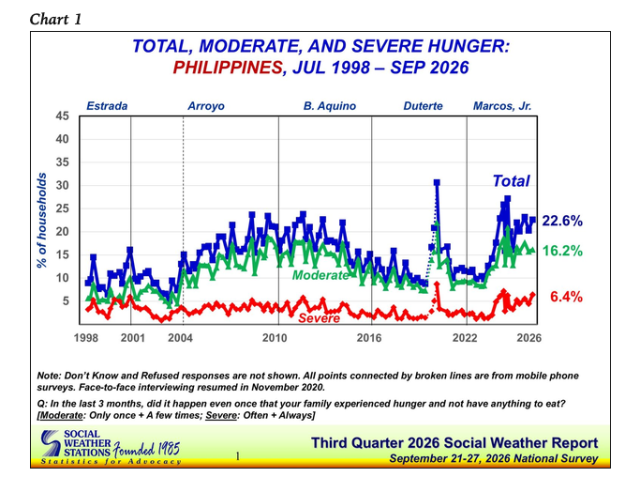
The respondents were asked, “Nitong nakaraang tatlong buwan, nangyari po ba kahit minsan na ang inyong pamilya ay nakaranas ng gutom at wala kayong makain? (OO, HINDI) [In the last three months, did it happen even once that your family experienced hunger and not have anything to eat? (YES, NO)].
“IF EXPERIENCED HUNGER: Nangyari po ba ‘yan ng MINSAN LAMANG, MGA ILANG BESES, MADALAS, o PALAGI? [Did it happen ONLY ONCE, A FEW TIMES, OFTEN, or ALWAYS?].”
Metro Manila recorded the highest rate of hunger at 27.0%, followed by Mindanao at 23.7%, Balance Luzon at 23.6%, and the Visayas at 16.0%.
"The 2.3-point rise in hunger between June 2026 and September 2026 was due to increases in Metro Manila and Balance Luzon, even as hunger fell in the Visayas and was steady in Mindanao," SWS explained.
Compared to June 2026, the incidents of hunger climbed by 6.3 points from 17.3% in Balance Luzon, and by 6.0 points from 21.0% in Metro Manila.
However, it fell by 6.3 points from 22.3% in the Visayas, and was steady in Mindanao, at 23.7% from 24.0%.
Meanwhile, 16.2% of Filipino families experienced moderate hunger and 6.4% experienced severe hunger.
Moderate hunger refers to those who experienced hunger “only once” or “a few times” in the past three months, while Severe Hunger refers to those who experienced it “often” or “always” during the same period.
SWS said compared to June 2026, moderate hunger increased by 0.4 point from 15.8%, while Severe Hunger rose by 1.9 points from 4.5%.
In Balance Luzon, moderate hunger increased by 3.3 points from 13.0% to 16.3%, while Severe Hunger rose by 3.0 points from 4.3% to 7.3%.
In contrast, the Visayas recorded a 6.7-point decline in moderate hunger, from 18.7% to 12.0%, while severe hunger edged up by 0.3 point, from 3.7% to 4.0%.
Moderate hunger also fell by 2.7 points from 20.7% to 18.0% in Mindanao, while severe hunger rose by 2.4 points from 3.3% to 5.7%.
Hunger among the poor and food-poor also increased in the September SWS report, with 55% of Filipino families considering themselves as poor.
Meanwhile, 9% of families rate themselves as borderline, and 36% said they belong to the "not poor."
"Hunger occurs at different rates among the Poor and the Non-Poor. At any given time, hunger is usually higher among the Poor. From quarter to quarter, however, the hunger rates among the Poor and the Non-Poor may change, either upward or downward. Hunger is highest among the Food-Poor," SWS said.
Meanwhile, the rate of total hunger among the self-rated poor increased from 24.5% in June 2026 to 27.9% in September 2026.
The respondents were asked, " “Saan po ninyo ilalagay ang inyong pamilya sa kard na ito?/Tungkol naman sa klase ng pagkain ng pamilya ninyo, saan po ninyo ilalagay ang inyong pamilya sa kard na ito? [Where would you place your family on this card? / Based on the type of food eaten by your family, where would you place your family on this card?].”
The rate of total hunger also rose among the self-rated food-poor from 29.9% to 33.2%, while it fell slightly among the Food-Not-Poor/Food Borderline from 14.7% to 14.3%.
"The rise in hunger was due both to the increase in Self-Rated Poverty and Self-Rated Food Poverty between June and September 2026, and to the fact that hunger also rose among the Poor and the Food-Poor," SWS explained.
The Third Quarter 2026 Social Weather Survey was conducted using face-to-face interviews of 1,500 Filipino adults.
The sampling error margins are ±3% for national percentages, ±4% for Balance Luzon, and ±6% each for Metro Manila, the Visayas, and Mindanao. —VAL, GMA News
KioskNews shows a cleaned-up reading view extracted from the publisher’s page — the original always lives on their site, not ours.