Chinese mathematician Sun Zhiwei proposes 1,000 problems to challenge AI
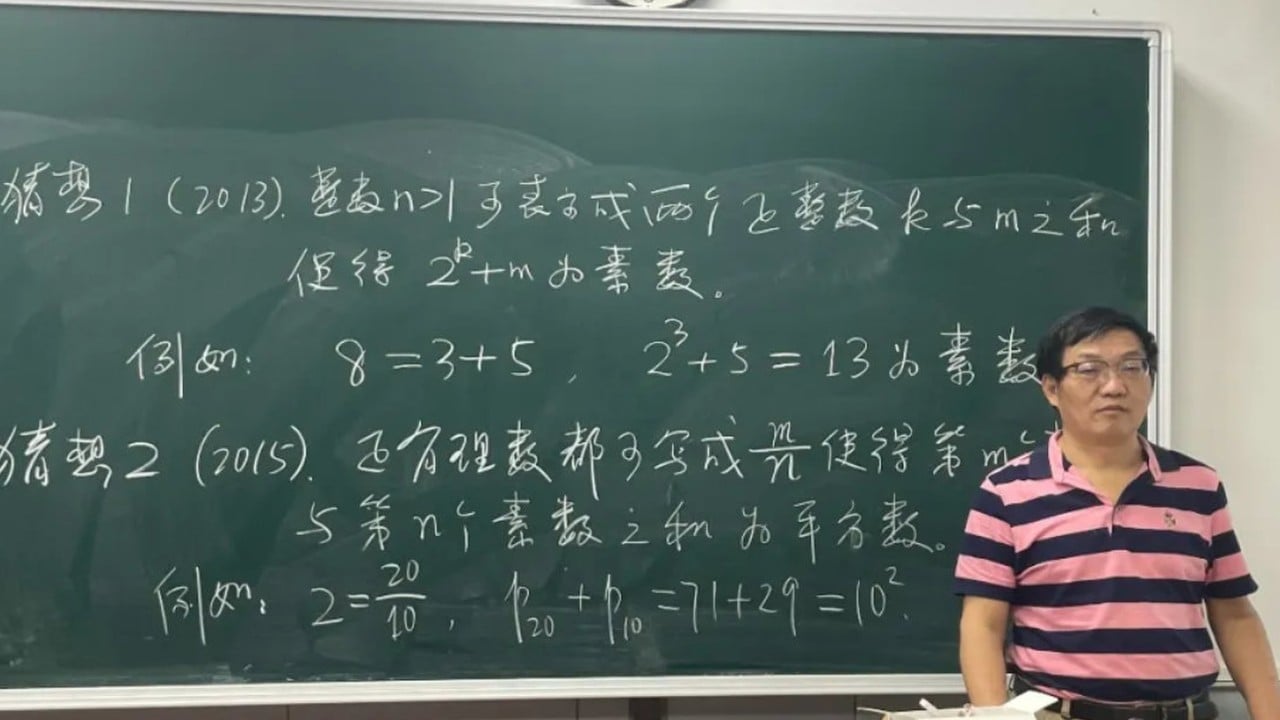
In an age of AI-induced answers to complex mathematical problems, Chinese mathematician Sun Zhiwei maintains that curiosity and asking good questions are more important then ever.
Over a career spent probing the edges of number theory, Sun, a 61-year-old professor at Nanjing University’s department of mathematics, has built a vast landscape of problems – more than 1,000 and counting – for the global research community to tackle.
While traditional mathematical training emphasises mastering existing formulas and proving established theorems, Sun said true progress relied on using intuition to discover new questions and using logic to solve them.
“If a discipline has no conjectures, people no longer know what to do and the field approaches a standstill,” Sun told China Science Daily.
“[Artificial intelligence] cannot solve every mathematical problem. Mathematicians need not panic. Instead, they can free up time to focus on tasks where AI falls short, such as developing new methods and establishing new theories.
“I view AI as a highly knowledgeable, diligent and intelligent graduate student. When setting it to tackle difficult mathematical problems, I provide appropriate guidance and, when necessary, prompt it to adjust its strategy,” he said, adding that he would cut off the AI’s internet search access so it could not discover that the problem remained unsolved and refuse to work on it.
02:36
Chinese mathematicians Wang Hong and Deng Yu win prestigious Fields Medal
Sun said that, in his early career, he was a traditional problem solver and made key advancements on Hilbert’s Tenth Problem posed in 1900.
But a 2005 visiting professorship at the University of California, Irvine, marked a turning point when he met an American professor who was adept at using mathematical software to uncover patterns, a technique that was new to Sun at the time.
After helping the professor resolve a conjecture that had remained unsolved for years, Sun said he realised mathematical tools were undergoing a qualitative leap forward.
In 2009, he started to teach himself how to use the Mathematica program for technical computing. Using computers enabled him to validate thousands of cases, a task that previously demanded painstaking and often unfeasible manual calculations.
“From that year on, I suddenly had an epiphany and all sorts of whimsical ideas started coming to me,” Sun recalled.
This year, Sun compiled a collection of problems more than 400 pages long, containing 1,000 unsolved conjectures that he had proposed.
His academic homepage also features a collection of conjectures paired with cash prizes for their proofs, funded using his salary.
04:43
China’s latest war epics are AI-generated, minutes long and backed by the state
Many of his problems push beyond classical milestones. For example, Sun introduced new constraints to French mathematician Lagrange’s two-century-old four-square theorem, which states that every natural number can be expressed as the sum of four integer squares, to formulate new conjectures.
“We simply state that a given theorem is ‘beautiful’, and once the proof is complete, we consider the matter closed. We never discuss whether the theorem is strong enough or it has limitations,” Sun said.
“Textbooks often only talk about greatness, not flaws.”
As AI reshapes scientific discovery, Sun said the role of AI should be welcomed in advancing mathematics in the pursuit of truth.
“If you pursue mathematics solely for fame and fortune, you might worry about AI taking your job, but if your goal is the pursuit of truth, you should welcome the way AI advances the field,” he said.
He said he dubbed some of his most difficult problems “alien conjectures” – problems that he said “Earthlings definitely cannot solve.”
When asked about the point of proposing unsolvable problems, Sun said: “My motive is not whether you can solve it or not, I am just pursuing the truth. As for whether modern tools are enough, that is another matter.”
KioskNews shows a cleaned-up reading view extracted from the publisher’s page — the original always lives on their site, not ours.