Floating solar panels cause water safety worries
NO TOXIC WASTE: Authorities found no evidence that the solar panels harmed the reservoir’s water quality, an official said, urging people to ‘listen to the science’
By Jonathan Chin / Staff writer, with CNA


Solar panels pose no measurable risk of contaminating drinking water, officials said yesterday amid controversy over a floating photovoltaic system at Tainan’s Wushantou Reservoir (烏山頭水庫).
Minister of Environment Peng Chi-ming (彭啟明) dismissed allegations that the reservoir’s solar panels could leach pollutants into the water, a day after frontrunners in Tainan’s mayoral election decried the installation at Tuesday’s policy presentation.
Democratic Progressive Party (DPP) candidate Chen Ting-fei (陳亭妃) and her main rival, Hsieh Lung-chieh (謝龍介) of the Chinese Nationalist Party (KMT), said they would move to terminate the project if elected.
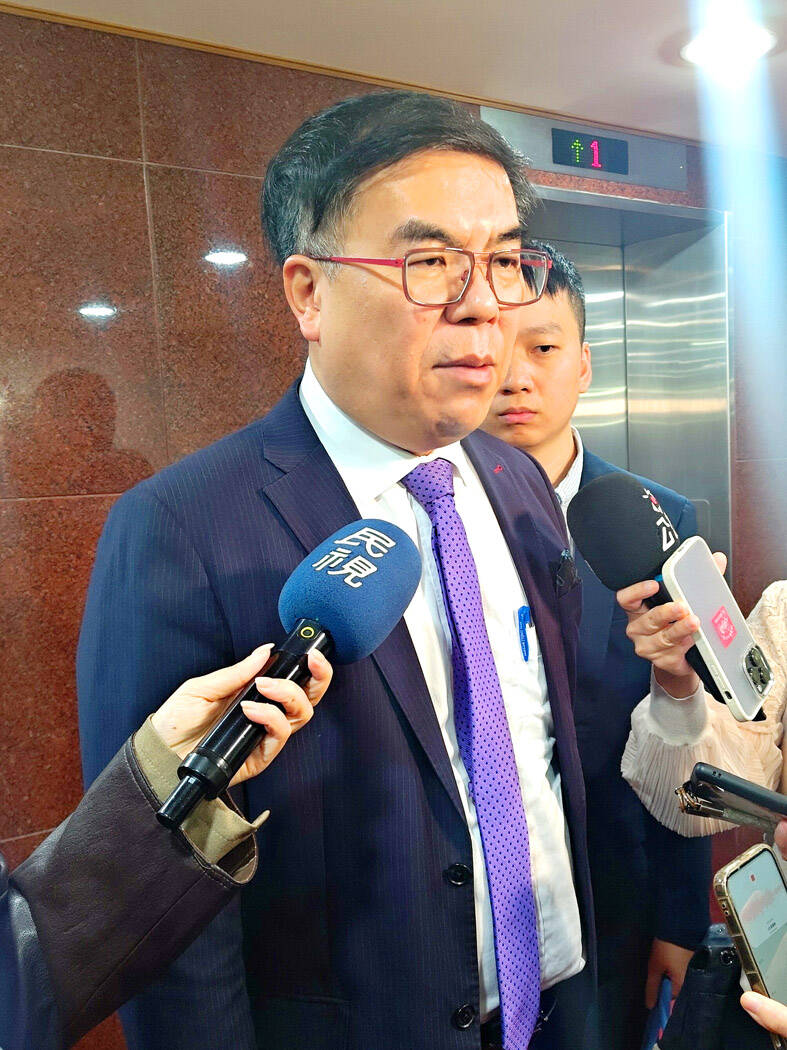
Minister of Environment Peng Chi-ming speaks to reporters at the legislature in Taipei yesterday.
Photo: Wu Po-hsuan, Taipei Times
Peng told reporters that environmental officials found no evidence that the solar panels negatively affected the reservoir’s water quality.
Multiple trials held by the Ministry of Environment, including a test that left broken pieces of solar panels in a body of water, found no traces of toxic waste, Peng said.
The ministry’s stance on solar panels is supported by research in South Korea and Japan, he said, before calling on the public to “listen to the science.”
Separately, Deputy Minister of Agriculture Huang Chao-chin (黃昭欽) said on the sidelines of a legislative meeting that the government would respect local governments in matters that fall under their jurisdiction.
The Ministry of Agriculture has always demanded that the contractor responsible for the floating solar farm carry out the facility’s operations and maintenance in accordance with environmental regulations, he said.
The contract for the Wushantou Reservoir’s photovoltaic plant is valid through April 2032, Irrigation Agency Director-General Tsai Sheng-fu (蔡昇甫) said.
The contractor responsible for the project has passed water quality tests conducted on site, he added.
The Water Resources Agency has repeatedly said that its water quality tests, which are conducted five times a year, showed that the concentration of heavy metals and chemicals in the reservoir remained within safety standards.
Despite the assurances, the Tainan City Government earlier this month announced that plans to expand the solar project have been canceled.
KioskNews shows a cleaned-up reading view extracted from the publisher’s page — the original always lives on their site, not ours.