Democrat Janeese Lewis George Is Washington's Next Mayor
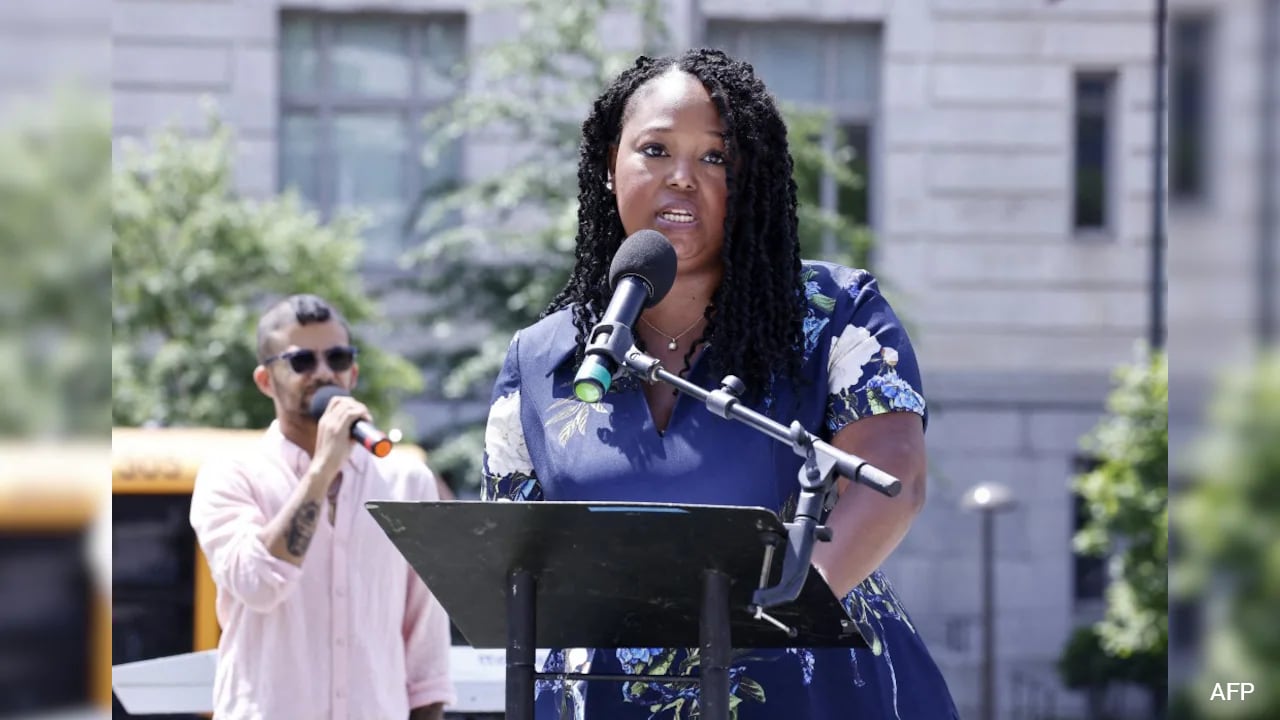
It's official — Janeese Lewis George will be the new mayor of Washington, DC. She practically ran unopposed in Tuesday's general election after winning the Democratic primary earlier this year.
Now the question is what comes next for the 38-year-old politician who joins Zohran Mamdani in New York City and Katie Wilson in Seattle in a small club of democratic socialist municipal leaders.
Winning was easy as Lewis George breezed past an independent, a Statehood Green Party candidate and 11 write-ins lacking political clout. Now she faces her first potential heavyweight hurdles, including President Donald Trump himself, who has inserted himself in local affairs and denounced the incoming mayor as a threat to the capital city.
“We will not let it be destroyed by a Communist adherent who has no intention to, MAKE WASHINGTON GREAT AGAIN!” Trump wrote on social media after her primary victory.
Lewis George, for her part, promised that she would work with anyone to keep the city safe “but I will also stand up to Trump.” Come Jan. 2, she will be sworn in as the city's first new mayor in 12 years.
In an interview earlier this year, she told The Associated Press that her top priority will be addressing “the affordability crisis here in D.C., which the Trump administration has only made worse by unjustly firing federal employees en masse and militarizing our streets.”
Lewis George, who served five years on the city council, will be the District's eighth mayor since its Home Rule law was signed in 1973, giving the city's residents the chance to choose their local officials.
Lewis George will take over a city of nearly 700,000 and face all the usual challenges of a municipality, in charge of revenue, public safety and affordability and even ceremonial duties like ribbon cutting. But the DC mayor faces an added burden. The same 1973 law that allowed her election also preserved Congress' authority over city affairs.
“They can essentially veto any bill we pass here. Two, they can manipulate our budget without our input. And three, they can legislate directly for us if they want to,” said Emily Cassometus, the director of the Legislation Clinic at the University of the District of Columbia's law school.
“The Home Rule Act hasn't changed. It won't be changing with her inauguration,” said Cassometus, who previously worked on Lewis George's staff.
During Trump's first year in office after returning to the White House, Congress blocked the city from spending a billion dollars of its own money by freezing the city at 2024 spending during a federal budget process.
“The fact that a billion dollars of our money was blocked from being spent is huge and has impacts on people's daily lives,” said Alicia Yass, policy advocacy director for the American Civil Liberties Union of the District of Columbia. “We've also seen an exponential increase in the number of bills that Congress is passing or introducing that specifically target the district.”
Key to Lewis George's tenure will be the outcome of House and Senate elections. If Congress falls into Democratic hands, the city has a backstop against Republican efforts to encroach on local authority.
“It's Congress, not the president, who has the power of exclusive legislation over the District,” said George Derek Musgrove, an associate professor of history at the University of Maryland-Baltimore County. “I'm suspecting that Democrats will give the mayor some cover, even if they only get the House.”
Lewis George will need to decide how much to defy Trump, particularly on issues like the National Guard deployment and cooperation of local law enforcement with the federal authorities, especially U.S. Immigration and Customs Enforcement, or ICE.
Outgoing Mayor Muriel Bowser has stayed relatively quiet, even opposing the district council on what role local officers have in holding their federal colleagues accountable. In past discussions she has said her achievements include educational gains and keeping home rule at a time when the district's autonomy has been severely challenged. Bowser decided not to run again once her third four-year term ends in January.
Lewis George could use Mamdani as a model. Despite early tensions between the two, the New York mayor has occasionally bonded with Trump, asking for the president's support on some projects while still criticizing many of his policies.
Musgrove said the question is whether the coalition that gave her the primary win and wants her to “fight the president” allows her to be more low key.
Lewis George has praised Bowser for a number of things but opposed her strategy for dealing with the administration, and she promised to end the local police's cooperation with federal immigration operations.
Lewis George will face other challenges, some created by the capital's relationship with the administration and Congress. The District of Columbia accounted for a fifth of roughly 100,000 job losses in the region in major part because of the Elon Musk-led Department of Government Efficiency overhaul of the federal workforce.
The cuts had a cascading effect, from loss of tax revenue to reduced activity at local businesses and restaurants. The city expects revenue to drop by hundreds of millions of dollars, prompting the district council to consider several tax increase proposals.
The Urban Institute, which is a public policy think tank, estimates that nearly a quarter million families in the DC region will be impacted by safety net cuts that will be kicking in after the election as part of Trump's “big beautiful bill” — a sweeping package of tax breaks, social service cuts and immigration enforcement measures.
There will likely still be National Guard troops on the streets regardless of what Lewis George wants.
The president deployed them in August 2025 and more than 2,900 troops remain. There are plans to keep them there through January 2029.
The legality of that mobilization is now being considered by a three-judge panel with the U.S. Court of Appeals for the District of Columbia Circuit. A lower court judge ruled in November 2025 that the guard presence was illegal but an appeals court panel stayed that ruling, allowing the military personnel to remain until the case can be decided.
(Except for the headline, this story has not been edited by NDTV staff and is published from a syndicated feed.)
KioskNews shows a cleaned-up reading view extracted from the publisher’s page — the original always lives on their site, not ours.