Libya's HoR ratifying Turkey maritime deal 'very troubling' for Israeli security, expert to 'Post'

Turkey and Libya’s maritime boundary deal is a “very troubling” development for Israel, Colonel (res.) Eran Lerman, vice president of the Jerusalem Institute for Strategy and Security and a lecturer in Middle Eastern and Islamic Studies at Shalem College, told The Jerusalem Post on Wednesday.
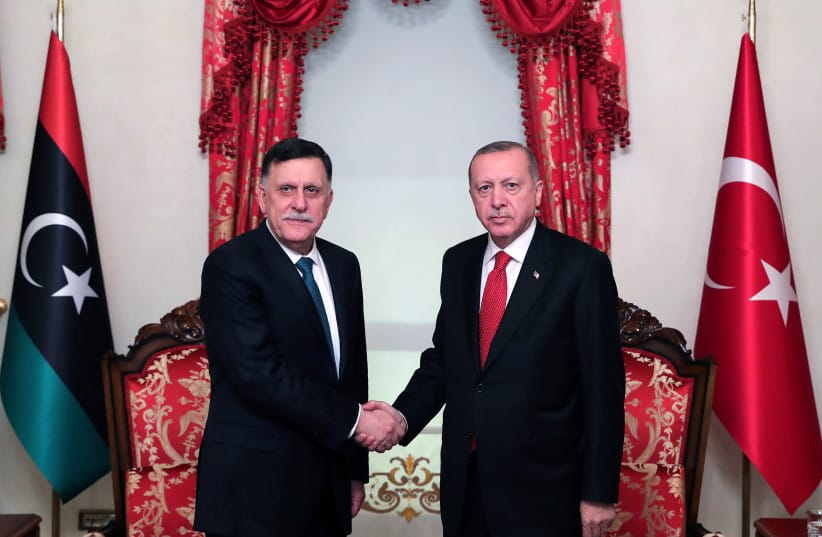
The deal, agreed upon by the Tripoli-based, internationally recognized western Libyan government in 2019, was approved by the eastern Libya's legislature, the House of Representatives (HoR), on Tuesday, drawing criticism from Cyprus, Egypt, Greece and Israel.
Eastern Libyan authorities breaking boycott of Ankara
The move marks a significant shift in regional alignments, with Khalifa Haftar, commander of the Benghazi-based Libyan National Army, breaking with the boycott of Ankara that had been in place since 2020.
While Lerman said he was unsure what prompted HoR to approve the long-delayed agreement, he warned it could threaten Israel’s ability to develop underwater infrastructure connections and create more serious maritime security challenges.
Israel has been working in recent years on an ambitious project to connect its electricity grid to Cyprus and Greece, and from there to mainland Europe. Ankara has opposed the project, disputing the maritime boundaries claimed by Greece under international law.
Turkey, which runs a military occupation of Northern Cyprus, is not a signatory to the Convention on the Continental Shelf or the United Nations Convention on the Law of the Sea, and has sought to claim Greek islands as an extension of its territory.
“I’m not sure the Turks will actually intervene to disrupt the laying of an electricity connector. It is not entirely clear whether they have the authority to do so in their exclusive economic zone, but this is going to be a source of growing tension in the coming years,” Lerman predicted.
Egypt and Greece had previously opposed the Turkish-Libyan alignment, and any fracturing of the established alignment would give Ankara an opportunity to further pursue its neo-Ottoman aspirations, he continued. Egypt’s orientation toward the Mecca defense pact could bring it closer to Turkey, strengthening a country that has already made clear its aspirations to regain the imperial power it once wielded.
“The common interests of Israel, Egypt, Cyprus, and Greece were very much at play against the neo-Ottoman ambitions of Turkish President Recep Tayyip Erdogan, and that created an important commonality. Over the past decade, we saw parallel tripartite summits of Greece, Cyprus, and Israel, and of Greece, Cyprus, and Egypt. We also saw the creation of secretariats in Lefkosia, Cyprus, to manage these parallel tripartite relations,” Lerman said.
“We were looking at this as essentially the emergence of an alignment of interests and forces in the Eastern Mediterranean. If Egypt is sliding out of this alignment, despite the recent summit that Egyptian President Abdel Fattah al-Sisi held with the leaders of Greece and Cyprus at El Alamein, and is increasingly moving toward accepting the Turkish position, that would be highly problematic from an Israeli perspective,” he added.
Israel's maritime security comes under risk
There is also the issue of Israel’s maritime security. The vast majority of Israel's international trade is conducted by sea, and the ports of Haifa, Ashdod and Eilat handle 98% of the country's import and export volume. The Houthis already pose a threat to the Eilat port, Lerman highlighted, and “the last thing we need is a problem also with our Western maritime approaches.”
Turkey maintains a significant naval presence in the Mediterranean and has increasingly asserted its claims under the Mavi Vatan (Blue Homeland) doctrine, which challenges maritime boundaries claimed under UNCLOS. Introduced in 2006, the doctrine seeks to assert Turkish sovereign rights and jurisdiction over a 462,000-square-kilometer maritime area spanning the Black Sea, Aegean Sea, and eastern Mediterranean.
“Of course, they have the naval capacity, the military capacity to back this [strategy] up. Of course, Israel is not without its own capabilities, but nobody, under the circumstances under which we live, nobody is looking for another major front of tension and confrontation,” he continued.
Warning that Israel needed to do what it could to keep Egypt from fully aligning with Turkey, Lerman advised Jerusalem to strengthen cooperation with Athens and Nicosia.
KioskNews shows a cleaned-up reading view extracted from the publisher’s page — the original always lives on their site, not ours.