The exhibition Rome: Empire, Power, People is a tour through our history of looking at ancient Rome
Ancient Rome is very used to being looked at. We see versions of it everywhere: in films and TV series, in school syllabi, and in contemporary politics.
Melbourne Museum’s exhibition Rome: Empire, Power, People holds the promise of a fresh look, with the majority of artefacts, borrowed from the Museo Nazionale Romano (Rome) and the Museo Archeologico Nazionale di Firenze (Florence), not seen previously in Australia.
At first, it feels like business as usual: even though the materials are fresh to our shores, the exhibition mostly sets them up in familiar thematic groupings for this subject: ambition, life, luxury, the divine and eternity. The way these are displayed feels familiar, too.
But the exhibition’s design offers unexpected insights: room to room, the presentation offers a de-facto history of how we have looked at ancient Rome over the years. This design invites us to consider how societies in different eras have framed this complicated culture, and how we frame it now.
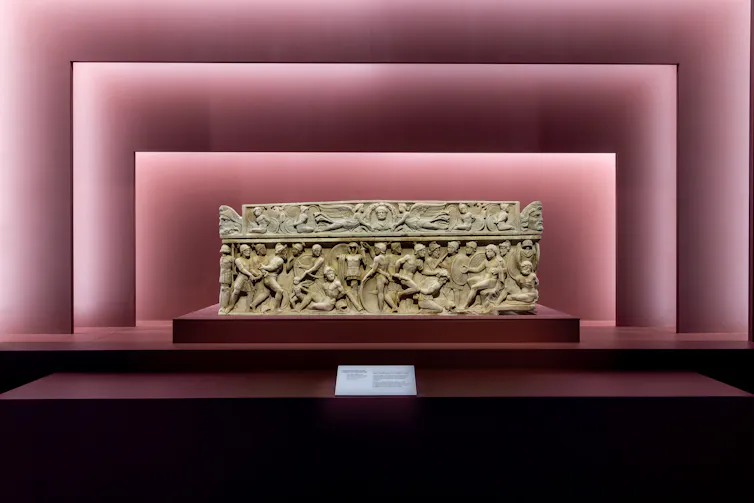
A tour through the history of looking at ancient Rome
We start with the Romans’ own vision of their even more ancient selves: an altar with Romulus and Remus, two characters from the city’s mythological beginnings.
Next, we see the death of Caesar in 44 BCE and the demise of the republic – through the eyes of 16th and 18th-century masters. Paintings by Romano, Camuccini and others are projected onto the walls, including a striking depiction of the assassination.

With Caesar (and the republic) gone, we enter the era of imperial Rome. This next room, filled with sculptures of empresses and emperors adopts an almost Art Deco aesthetic. The ancient marble faces and our own are not quite so sleek, symmetrical, or geometric as the exhibition furniture, and so we notice the objects and notice ourselves wandering and looking.
Though no doubt the visual link is coincidental, this room’s aesthetic echoes the famous 1937 exhibition in Rome, which exemplified how the ancient city and its history were harnessed to the fascist politics of Mussolini’s Italy.
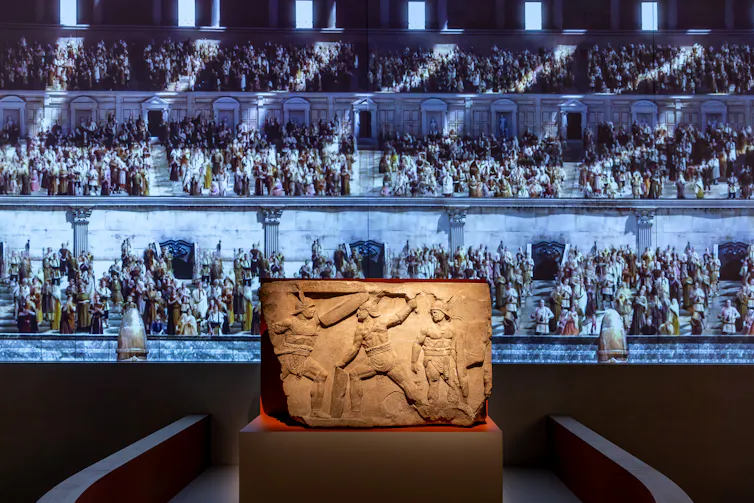
Next, the design shifts to digital reconstruction. We see the Colosseum, Nero’s Golden House and other parts of Rome made whole again via projections on the walls. The label tells us these buildings “look beyond the marks of age”, and indeed, they are crisp and clean and far from the dusty ruins that inspired them.
They are also empty of people.
Reimagining the ancient city digitally dates back to the 1990s, an era full of promises about how the digital would show us what we otherwise cannot see. 3D reconstructions of ancient buildings without the mess of daily life and people go even further back, including models of ruins and models that attempted to remake what was lost.
These examples, digital and not, keep us and Rome’s ancient inhabitants at a distance: it is a city to be seen, not lived.
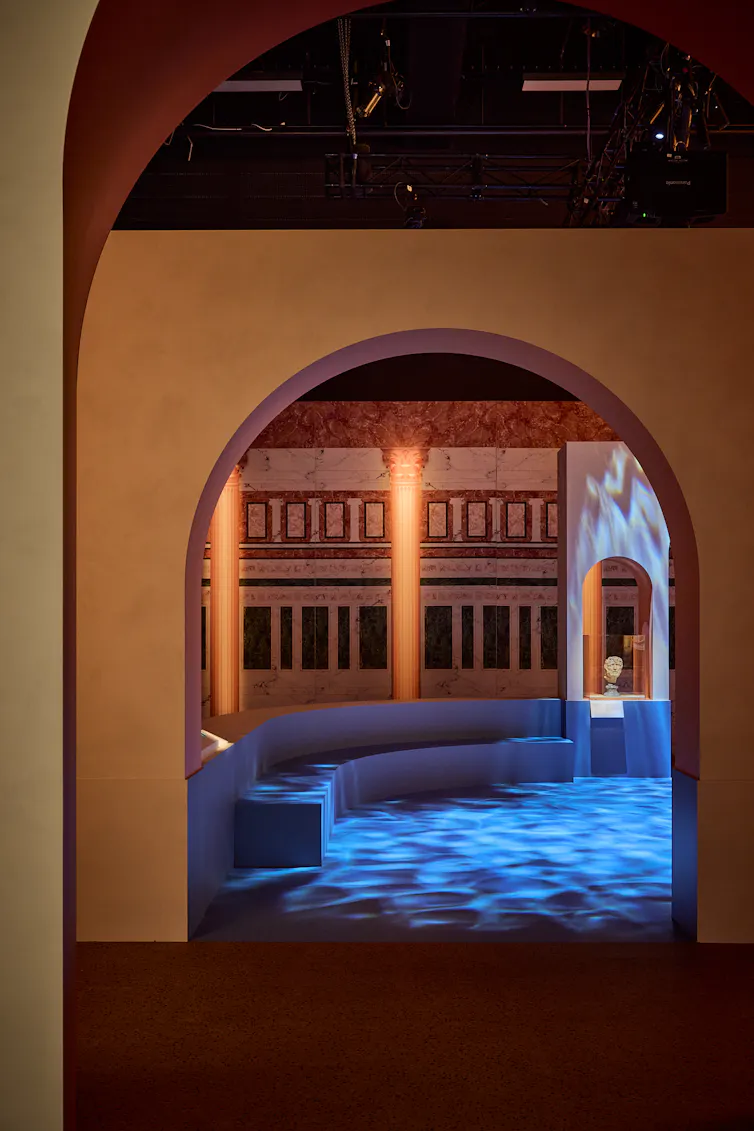
Moving from this version of Rome, we are immersed in another. Here the people return, with objects that tell us about families, workers (enslaved and not), actors, musicians, philosophers and others. We walk through and around loose recreations of an ancient Roman bathhouse, dining room and arena. In the dining room, food is made of plaster, or made to resemble it, evoking the 19-century copies of Roman objects that still line many galleries today.
Similar kinds of immersive, architectural depictions of the ancient Roman world also have a long history, including the full scale recreation of a Pompeian court presented at London’s Crystal Palace in 1854, and a replica Roman villa commissioned by King Ludwig I of Bavaria in the 1840s.
The exhibition ends – in “eternity” – with a rippling white curtain that evokes ancient Roman columns, as well as the 1992 Gianfranco Ferré dress inspired by them.
Embracing plurality
The exhibition’s trove of display methods and styles is a lot to take in. On their own, none of these design approaches are unexpected, and there have been many versions of them before. For the viewer, however, the mix makes for an interesting journey, in which design and display choices are front of mind.
Distinct ways of seeing ancient Rome will appeal to some and not to others. And that is okay, especially in a world where we are otherwise promised everything will always be personalised to our liking. A jumble, rather than a clean narrative, is how the past should be looked at.
The museum should also be commended for its occasional excursions from the well-trodden course for exhibitions about ancient Rome, including welcome invocations to plurality.
“Romans did not believe in a single version of life after death, and ideas varied across religious views,” one panel proclaims. Another rightfully declares: “There were many ways to be ‘Roman’.”
Rome: Empire, Power, People is at Melbourne Museum until October 25.
KioskNews shows a cleaned-up reading view extracted from the publisher’s page — the original always lives on their site, not ours.