Prisons get OK to jam contraband phones. CTIA says nearby phones will be jammed too.
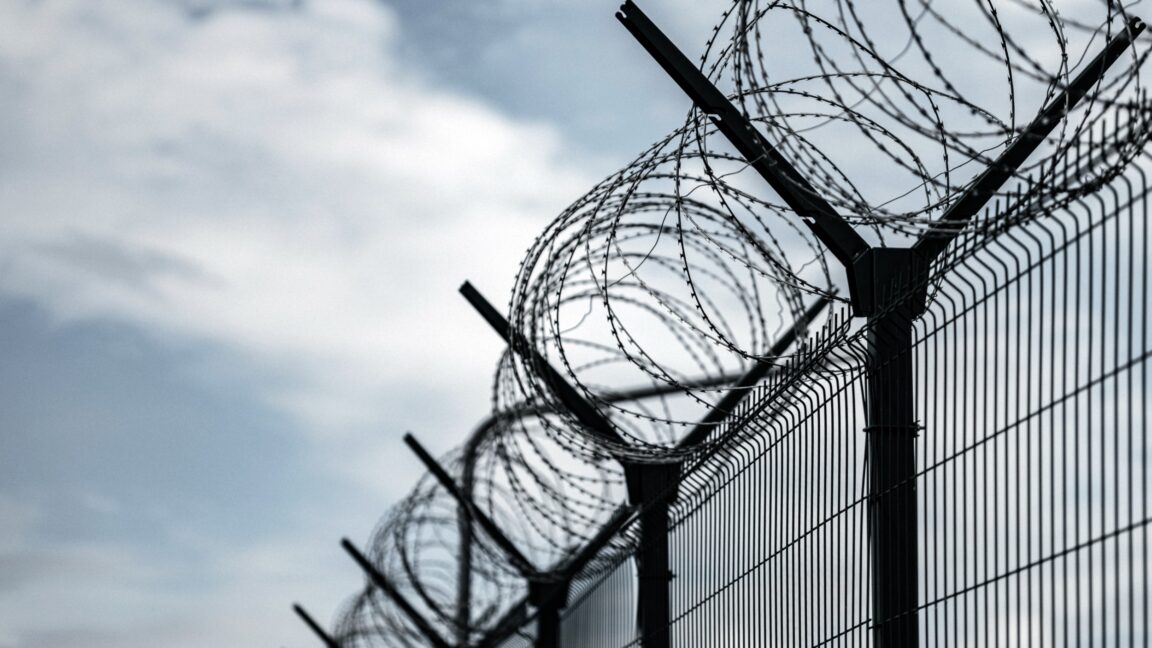
The Federal Communications Commission yesterday voted to let state and local prisons use jamming technology to block contraband cellphones, despite warnings that jammers will also block lawful phone calls outside the prisons.
Wireless industry lobby group CTIA said a recent test it conducted with the Virginia Tech Applied Research Corporation and South Carolina Department of Corrections confirmed concerns that the jammers would block legitimate communications, including 911 calls. CTIA told the FCC in an October 1 filing:
The pilot test was limited in the number of micro-jammers deployed, the spectrum bands they were authorized to jam, and the power levels at which they were permitted to operate. Even with these constraints, the micro-jamming system blocked 911 calls, interfered with public safety and other communications, and caused interference that impacted wireless network infrastructure up to two and a half miles away. At the same time, the pilot results show substantial gaps in jamming the targeted “contraband” devices, with testing scenarios in outdoor inmate recreation areas showing failure rates—meaning “contraband” device call completion—in one-half to two-thirds of call attempts.
CTIA said the pilot test shows “that current jamming technology seems to be both over and underinclusive at once—it risks blocking lawful communications even as it fails to block a significant portion of the targeted contraband device communications.”
The FCC approved the jamming order at its meeting yesterday. “Today, we are finally authorizing state and local prisons and jails to use targeted jamming against contraband cell phones for the first time,” FCC Chairman Brendan Carr said. “The technology has advanced to the point where it can be focused with geographic precision. No facility will be required to do it.”
The Communications Act prohibits willful or malicious interference with licensed or authorized radio communications, and the FCC has previously interpreted this to prohibit non-federal entities from using jamming technology on contraband devices at prisons. Yesterday’s vote provides an exception for state and local correctional facilities. The FCC says its jammer prohibitions do not apply to federal agencies because the federal government’s use of spectrum is not regulated by the agency.
Carr said that “contraband cell phones continue to pour into prisons by the thousands each year,” with “estimates indicat[ing] that as many as 500,000 inmates nationwide have regular access to these devices.” He said the phones have been used to plan scams, drug trafficking, and violent attacks.
“In Georgia, an incarcerated gang leader directed a drive-by shooting that killed two 13-year-old boys at a birthday party,” Carr said, referring to a 2024 shooting.
Chair touts plan to prevent interference
Carr defended the plan against criticism that it will block legitimate communications outside the prisons, saying it includes safeguards to prevent that.
“Those that want to use the technology will apply to the FCC, explain how they plan to deploy it, and show through testing that it stays inside the designated area and doesn’t interfere with lawful communications outside the prison walls,” Carr said. “Communities nearby will receive notice before operations start. We’re also seeking comment on next steps, including ways to close remaining loopholes on other frequencies and the possibility of quiet zones around correctional facilities.”
Freedom of the Press Foundation Chief of Advocacy Seth Stern said the FCC should have considered the benefits of contraband phones being used to document abuses inside prisons.
“Prisons are the most secretive government institutions in the country and people wishing to expose abuses and inhumane conditions from the inside often do not have many options,” Stern wrote in a letter to FCC Commissioner Anna Gomez’s office, which was included on the FCC docket. “Last year’s Oscar-nominated film, The Alabama Solution, used footage incarcerated people captured with contraband cell phones to show Americans some of the awful things that go on in state prisons that they’d have no other way of seeing. The same footage bolstered an ongoing DOJ investigation into Alabama prisons and was crucial evidence in a civil lawsuit by Steven Davis, who was brutally killed by prison guards, that eventually settled.”
Jamming contraband cellphones was supported by prison phone companies ViaPath (aka Global Tel*Link) and NCIC Correctional Services, the National District Attorneys Association, the Correctional Leaders Association, and National Association of Police Organizations.
“Inmates have used these phones to coordinate attacks against correctional officers and their families, as well as inmate violence, strikes, disturbances, and full-scale riots,” the National Association of Police Organizations said. “They also use contraband phones to organize deliveries of illegal drugs and weapons into correctional facilities. These dangers underscore the need to authorize indoor jamming in state and local correctional facilities.”
FCC Democrat has some concerns
Gomez, the only Democrat on the three-member commission, said she’s concerned about potential unintended consequences, but voted with Republicans to allow jamming after safeguards were added to the order.
“For the last 90 years, the Federal Communications Commission has prohibited jamming by non-federal actors and even prohibited jamming equipment to be introduced into the American market,” Gomez said. “That is because jamming devices are specifically designed to interfere with communications devices in order to render them un-usable.”
Gomez said that “jamming can prevent devices from completing 911 and emergency calls as well as interfere with communications networks used by fire, police, Emergency Medical Services, and other public safety entities.” She also said making jamming equipment available in the American market could lead to “unauthorized sale of this hazardous equipment,” and that “the accessibility of jamming equipment can itself motivate criminal enterprise.” Criminals have used “Wi-Fi jammers to disrupt security systems, security cameras, and cellphones to conduct robberies at homes and at stores,” she said.
Gomez said she’s glad the final order includes safeguards “to ensure that jamming is contained to this unique use, to permit jamming by a very limited category of authorized actors, and to take as much care as possible to prevent jamming and jamming equipment from becoming a hazard to safety.”
Gomez partially dissented because she is worried the FCC will let correctional facilities and prison phone companies charge higher prices for inmate calling services that connect inmates with family members. Under US law, the FCC sets limits on those prices and considers prisons’ and jails’ safety and security costs when deciding how much money they can charge, she said.
Gomez said, “While correctional facilities should have safety and security services like jamming to prevent criminal activity, it is not the responsibility of the families of incarcerated people to pay for the costs of these measures… Jamming is specifically designed to block communications and is certainly not necessary to provide phone and video calls for incarcerated individuals. We should have made this clear in today’s order. Because we failed to do so, I dissent in part.”
Wireless carriers warned of problems
The FCC order could be challenged in court. The CTIA has argued that the FCC “has no authority to allow jamming” under the Communications Act, which directs the FCC to prevent interference.
A draft of the FCC order released before the meeting says the commission has “authority to deauthorize subscriber operation of contraband wireless devices and thereby authorize jamming solutions consistent with the Communications Act.” AT&T disputed this in December 2025 comments responding to an earlier version of the proposal, saying that the FCC cannot sidestep the prohibition on jamming by saying it is only deauthorizing certain communications.
AT&T said the FCC’s legal justification “is premised on a fundamental factual error: the assumption that jammers will only block ‘unauthorized’ communications without impacting lawful uses. There is no way to jam some communications on a spectrum band but not others. That is because radio jammers ‘block all wireless communications on affected spectrum bands,’ and, as the FCC has noted in the past, ‘cannot differentiate between contraband devices and legitimate devices.’”
AT&T said that “there is simply no way to limit the reach of jammers to the confines of a given facility. Jammers have been shown to cause interference outside the facilities in which they operate, greatly increasing the risk that someone living or traveling nearby will be impacted.”

Jon is a Senior IT Reporter for Ars Technica. He covers the telecom industry, Federal Communications Commission rulemakings, broadband consumer affairs, court cases, and government regulation of the tech industry.
KioskNews shows a cleaned-up reading view extracted from the publisher’s page — the original always lives on their site, not ours.