Fed chair signals rate hikes might be needed with US inflation still elevated
AP, JACKSON HOLE, Wyoming


US Federal Reserve Chair Kevin Warsh on Friday said inflation is still too high and suggested that the central bank might have to raise interest rates in the coming months to bring it down, a clearer signal than he has previously sent about his economic outlook.
Warsh during the Fed’s annual conference in Jackson Hole, Wyoming, acknowledged that US reports showed that inflation has cooled a bit, but “they do not tell me that underlying trends have meaningfully improved.”
“We must be confident that underlying inflation is moving to our objective, clearly and at sufficient speed,” he said. “Otherwise, we have work to do.”
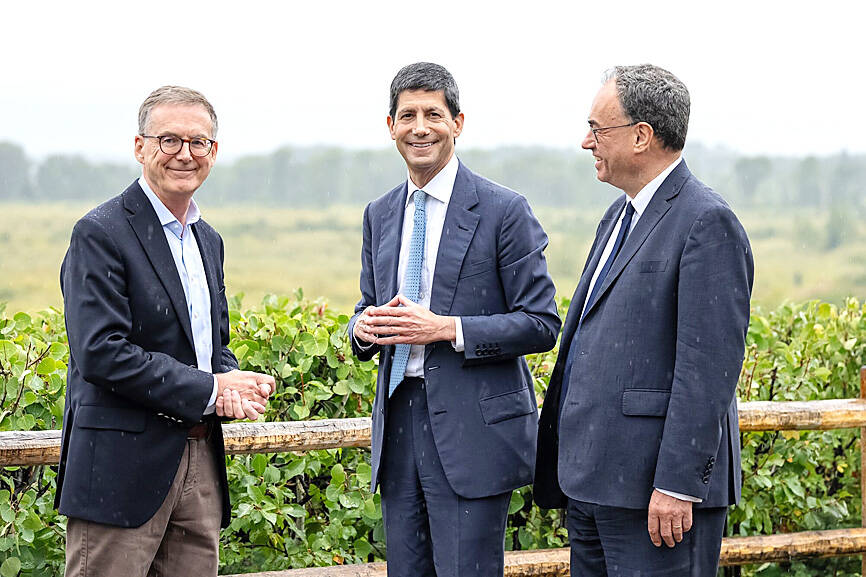
US Federal Reserve Chair Kevin Warsh, center, attends the Kansas City Federal Reserve’s Jackson Hole Economic Policy Symposium in Moran, Wyoming, on Friday.
Photo: Bloomberg
The comments appeared to reassure Wall Street that fighting inflation remains the priority for the central bank.
Warsh did not imply that a rate hike is imminent, but appeared to dismiss perceptions that inflation is no longer a threat.
He pointed to data showing that inflation remains stubbornly above the central bank’s 2 percent target.
Warsh has said he does not want to provide what analysts call “forward guidance” about whether the Fed would hike or cut rates, or stay on hold at its policy meetings.
It limits the Fed’s flexibility by committing it to a specific policy, he said.
Yet some economists said he could say more about his views on Fed policy without tipping his hand about future actions.
Warsh reiterated his skepticism about providing such guidance or even outlining his broad approach to interest rate policy, but did suggest that interest rates are not restricting economic activity, pointing to robust business investment in artificial intelligence equipment and infrastructure, and strong consumer spending.
As a rule of thumb, interest rates often need to be high enough to limit borrowing and spending to cool inflation.
The Fed next meets on Sept. 15 to 16.
Wall Street investors see the chances of a rate hike at the next meeting as basically a coin flip, futures pricing tracked by CME FedWatch showed, up from about one-third before Warsh spoke.
Warsh said that inflation data “are more concerning” than trends in the job market, where the unemployment rate is low, adding that inflation is unlikely to move back to the target on its own.
In the past year, more than half of goods and services tracked by the government have seen price increases of 3 percent or higher, he said.
While that is down from the COVID-19 pandemic peak, it is “well above” the roughly one-third that saw such increases in the two decades before the pandemic, he added.
Inflation cooled in June and last month after spiking in May from soaring gas prices, but remains above the central bank’s target.
According to the Fed’s preferred measure, it was 3.7 percent last month.
Warsh also sought to clear up some areas of confusion that arose after his remarks at the July 29 news conference, when he made vague remarks about what metric the Fed would use to track inflation and whether short-term interest rates were the Fed’s main tool to combat higher prices.
Short-term interest rates are the Fed’s “predominant tool,” he said, adding that the central bank is using the same gauge it has long followed to measure inflation.
KioskNews shows a cleaned-up reading view extracted from the publisher’s page — the original always lives on their site, not ours.