China’s delaying tactics paying off: academics
By Fang Wei-li and Jonathan Chin / Staff reporter, with staff writer


Beijing’s wait-and-see strategy toward the US is paying off and could lead to greater pressure over Taiwan Strait issues, Taiwanese academics said yesterday.
The meeting of US President Donald Trump, Chinese President Xi Jinping (習近平) and Russian President Vladimir Putin on the sidelines of the APEC summit in Shenzhen, China, on Thursday demonstrated the effectiveness of Beijing’s delaying tactics, which have yielded dividends by fending off US tariffs, Institute of National Policy Research vice president Kuo Yu-jen (郭育仁) said at a forum in Taipei.
Beijing, by stalling on negotiating anything substantive regarding the US-China trade dispute, lured Trump into its trap, he said.
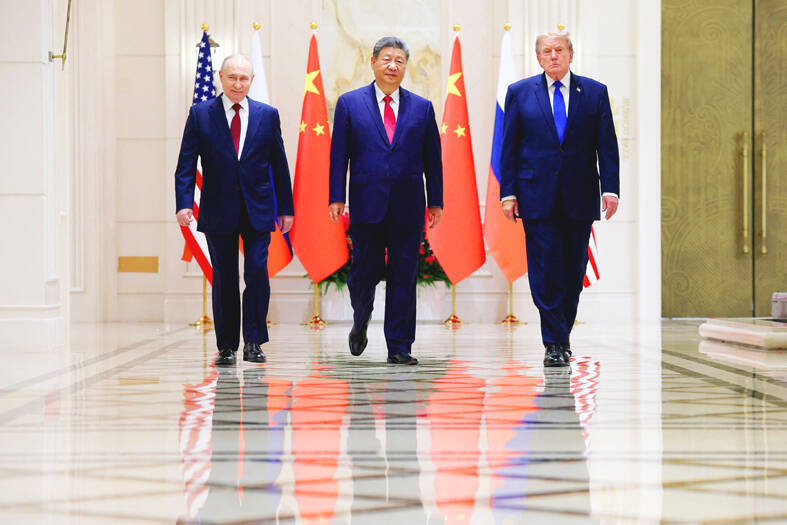
US President Donald Trump, left, Chinese President Xi Jinping, center, and Russian President Vladimir Putin arrive for a trilateral meeting at Kylin Villa in Shenzhen, China, on Thursday.
Photo: Reuters
The meeting also showed a profound disconnect between Trump’s foreign policy conduct and long-standing US policy, he said.
The four-point declaration by the US, China and Russia after the meeting is largely an empty gesture, except for oil, said Lin Cheng-yi (林正義), adjunct research fellow at the Academia Sinica’s Institute of European and American Studies.
US-China strategic stability policy is proceeding by stages, with fairness, mutual benefits and equality being emphasized in May, and respect being added to the formula in September, he said.
Beijing has long wanted the US to agree to respect China’s territorial and sovereign integrity, and Trump’s moves in the trilateral dialogue indicate that Beijing now has an opportunity to push for diplomatic gains in the East and South China seas and the Taiwan Strait, he said.
China has referred to an action plan for strategic stability, which Beijing is likely to pursue energetically during Trump’s remaining term at the White House, Lin said.
National Taiwan Normal University professor of East Asia Studies Fan Shih-ping (范世平) said that Xi garnered much legitimacy and prestige by hosting the APEC summit ahead of his Chinese leadership re-election bid next year, making him the meeting’s biggest winner.
In comparison, Trump took a drubbing in the US midterm elections and arrived at the trilateral talks much diminished compared with his triumphant visit to Beijing in May, he said.
Trump again emphasized that he does not support Taiwanese independence, which is not what Beijing had hoped for, suggesting that the trilateral meeting did not alter US policy on a fundamental level, he said.
Taiwanese should observe whether the Democratic majority in the new US Congress would compel Trump to be less tough on China than he had been during his first presidential term, Fan said.
KioskNews shows a cleaned-up reading view extracted from the publisher’s page — the original always lives on their site, not ours.