Lawmaker urges review of risk to energy supply
CONTINGENCY PLAN: Being prepared would reduce the costs Taiwan could face if countries around the world began competing for energy, an official said
By Hsu Yung-ching and Jake Chung / Staff reporter, and staff writer


Democratic Progressive Party Legislator Chen Kuan-ting (陳冠廷) yesterday urged the government to conduct an early energy risk assessment as Middle East tensions rise.
The Ministry of Economic Affairs, the Energy Administration, CPC Corp, Taiwan and Taiwan Power Co (Taipower) are among the authorities and companies Chen said should prepare.
Such preparations are necessary as the risks of shipping through the Strait of Hormuz increase, while Iran-backed Houthi militants are advancing into and around the Bab el-Mandeb Strait, potentially cutting off access to the Red Sea and Suez Canal, Chen said.
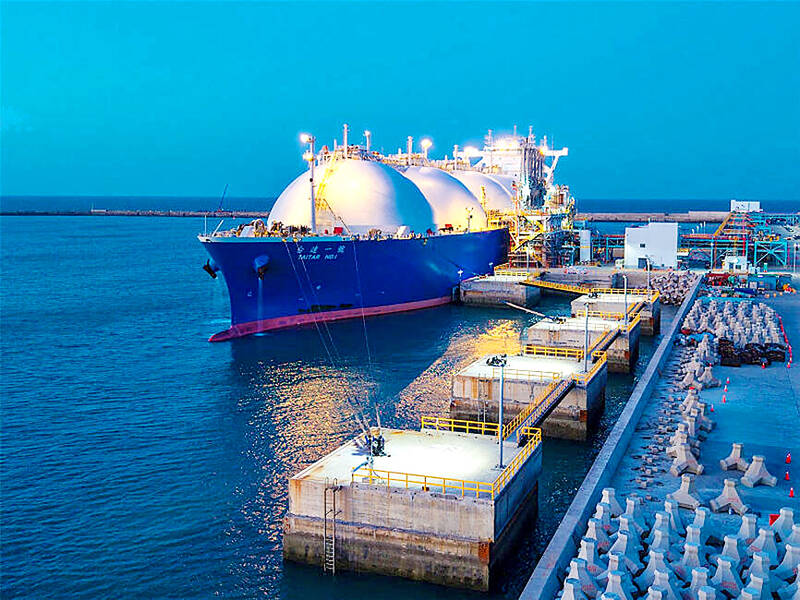
An oil taker is pictured at CPC Corp, Taiwan’s third liquefied natural gas terminal in Taoyuan’s Guanyin District in an undated photograph.
Photo: screen grab from the CPC Corp, Taiwan Web site
If the situation in the Middle East continues to worsen, air and sea freight costs would increase, as would costs for the petrochemical industry, driving up domestic commodity prices, he said.
CPC should compile a list of the dates, origins and routes of oil and natural gas tankers expected to deliver to Taiwan over the next few months, so it can determine which shipments are expected to cross the Strait of Hormuz or pass through the Bab el-Mandeb Strait, Chen said.
The company should also consult its contacts in the US, Australia and other non-Middle Eastern crude-producing countries to arrange possible alternative sources, he added.
Chen also suggested that the ministry conduct an energy-disruption stress test based on a scenario in which maritime shipments of crude oil and liquefied natural gas (LNG) through the Strait of Hormuz and the Bab el-Mandeb Strait are disrupted.
The test should assess how long Taiwan’s reserves would last, priorities for supplying power to civilian and industrial users, and the time required to receive deliveries from alternative sources, he said.
Being prepared would reduce the costs Taiwan could face if countries around the world began competing for energy supplies and shipping capacity, Chen said.
Taiwan should also consider how the US is prioritizing its strategic and military resources, as security concerns in the Middle East, Europe and the Indo-Pacific region are simultaneously placing pressure on its production of air-defense missiles, munitions, ships and logistics, he said.
Taiwan’s preparations for energy, munitions, uncrewed vehicles, communications redundancy and critical goods would afford the nation more choices when responding to future changes in the regional situation, he said.
Chen cited a report by the US think tank Center for Strategic and International Studies, which said that the US military has used large quantities of munitions in its military operations against Iran, with stocks of some air-defense and precision-strike missiles estimated to have fallen by more than half.
Taiwan should also diversify its sources of asymmetric-warfare equipment, Chen said, ensuring that production and replenishment capacity is available domestically and at overseas facilities.
KioskNews shows a cleaned-up reading view extracted from the publisher’s page — the original always lives on their site, not ours.