Google Japan created one of the strangest keyboards ever, and we're dying to try it
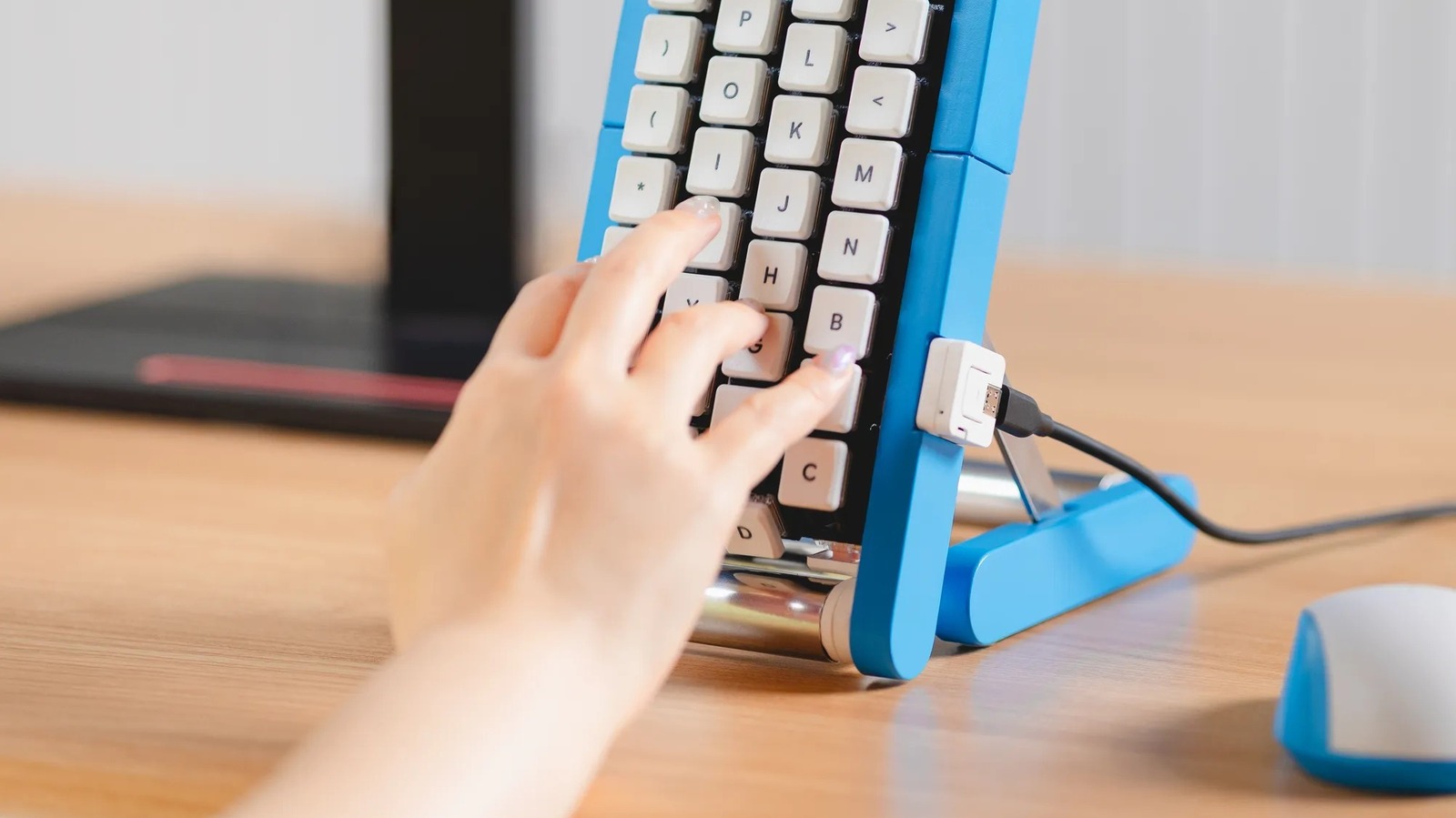
A keyboard that brings the keys to your fingers and brings the ambience of an assembly line to your desk.
Have you ever wished you could combine a mechanical keyboard with the efficiency of a factory production line? If not, you lack the vision of Google Japan, which recently made waves when it showed off a conveyor belt keyboard. The device looks like a Frankensteinian combination of an office keyboard and a treadmill, and an automated translation of the Japanese press release claims that "the keys flow into your hand via the rotating mechanism of the conveyor belt." Sounds like it might be time to update our list of the best keyboards.
The conveyor belt keyboard is, of course, a joke. It's part of an annual tradition intended to draw attention to Gboard, Google's keyboard app for Android. The tradition began on April Fools' Day in 2010, when the regional Googlers "unveiled" a drumset keyboard with hundreds of keys — apparently a riff on the fact that Japanese has thousands of Kanji characters that can't be represented on a standard keyboard layout — and it's quite amusing to watch Google employees whacking it with drum sticks. But the wacky keyboard prototypes become their own convention, and in 2016 the tradition of releasing them on October 1 began.
In the case of this year's conveyor belt keyboard, it might not be available for purchase, but Google has made the plans available on GitHub for anyone handy enough to build and run it as a DIY project. The team has clearly put a lot of work into defending the absurd use case for this product, and the results are amusing. The blog claims that the keyboard is designed for one-handed use, and that it cuts down on fatigue because you simply wait for the correct keys to arrive under your fingertips rather than moving your hand to meet them. It's all very silly, and feels in keeping with the spirit of an older, more playful company culture that hasn't been at the forefront of the company for quite some time, at least in the West.
What other wacky keyboards has Google Japan built?
After the initial drumset keyboard concept in 2010, Google Japan has continued to release a new "suggestion from the Gboard team" each year. There are quite a few at this point, each more amusing than the last.
2012 – A Morse code keyboard consisting of just a single key. The Gboard team claimed it had learned from the drumset keyboard that simplicity is better. Years later, in 2018, Google actually introduced Morse code input to Gboard on Android.
2013 – A flipcard keyboard that forces the user to press a single button, triggering a flipcard that cycles through every character until the right one is reached.
2014 – A joystick-controlled finger on a robotic arm, ostensibly intended to allow people with long or painted nails to type on a touchscreen more easily.
2015 – A party blower keyboard which allegedly uses an infrared sensor to detect how hard you're blowing and uses that force to determine which character you're typing.
2016 – A mechanical flick typing keyboard. Flick typing is a popular form of text entry on Japanese smartphones, allowing users to swipe across just twelve keys for rapid input. The gag here appears to be that the physical keyboard is built with keys mounted on joystick gimbals.
2017 – A bubble wrap keyboard which purports to scan a sheet of bubble wrap and translate popped air cells into characters for input.
2018 – A handwriting keyboard operated by using your finger to draw characters on top of the keyboard keys. No need to rebind your unused keyboard keys ever again.
2019 – A spoon keyboard operated by bending a metal soup spoon, with input based upon the degree to which you bend it.
2021 – After taking a year off for what seem like self-explanatory reasons, Google Japan returned with a traditional Japanese teacup keyboard, which it claimed solves the issue of spilling tea on your keyboard by placing the keys around the exterior of the cup itself.
2022 – The Gboard bar version, a keyboard arranged in one alphabetical row, designed to accommodate users who struggle to remember where keys are placed on a traditional keyboard.
2023 – Perhaps the crowning achievement of Google's Japanese Gboard team, the Gboard hat version is a large hat in the shape of a keycap. The user allegedly rotates it on their skull to select a character for input, then presses down on it to enter that character.
2024 – The Gboard double-sided version is shaped like a Mobius strip, with keys on both sides of its never-ending shape. Google Japan had lofty goals for this keyboard, and claimed that the ability to flip it over makes it perfect for backend development. Not all the jokes translate, but backend development puns are as eternal as this keyboard.
2025 – A rotary phone keyboard on which you select characters to input by dragging them in a circle around a rotary interface. Honestly, the biggest shock here is that it took them this long.
KioskNews shows a cleaned-up reading view extracted from the publisher’s page — the original always lives on their site, not ours.