Hong Kong’s dim sum bond boom reflects China’s growing yuan ambitions

Hong Kong’s bond market has reached a milestone that marks a significant shift.
In the first 10 months of the year, offshore yuan-denominated bonds, commonly known as dim sum bonds, accounted for 42 per cent of Hong Kong’s listed bond issuance, against 30 per cent for US dollar-denominated bonds.
Issuance reached 342 billion yuan (US$51 billion), making the yuan the largest currency segment in Hong Kong’s listed bond market for the first time. The significance goes beyond a change in one financial centre’s currency mix.
It offers a snapshot of Beijing’s effort to give the yuan a larger role in international finance, and of Hong Kong’s importance to that ambition. The city is becoming the principal offshore platform for China to connect its currency and capital markets with global investors.
The expansion of dim sum bonds reflects several forces. Policy support helped build supply, while lower borrowing costs make the yuan attractive. The appeal extends beyond mainland companies to overseas governments, financial institutions and businesses. For borrowers with revenues or commercial exposure in China, raising funds in yuan can also reduce the mismatch between income and debt obligations.
This development is part of a broader effort to make the yuan useful beyond trade settlement.
A currency’s international role depends not only on whether companies use it to pay for goods, but also on whether investors can hold it, deploy it and manage the risks. That requires deep markets in liquid financial assets, transparent pricing and instruments for hedging currency and interest rate exposure.
Hong Kong is central to building that ecosystem. It combines the rule of law, international financial institutions and market infrastructure with direct links to mainland China.
Through channels such as Bond Connect, overseas investors can access mainland bond markets, while the offshore market allows issuers to raise yuan outside mainland capital controls. The city offers Beijing a way to expand international yuan use without immediately opening the mainland financial system to unrestricted capital flows.
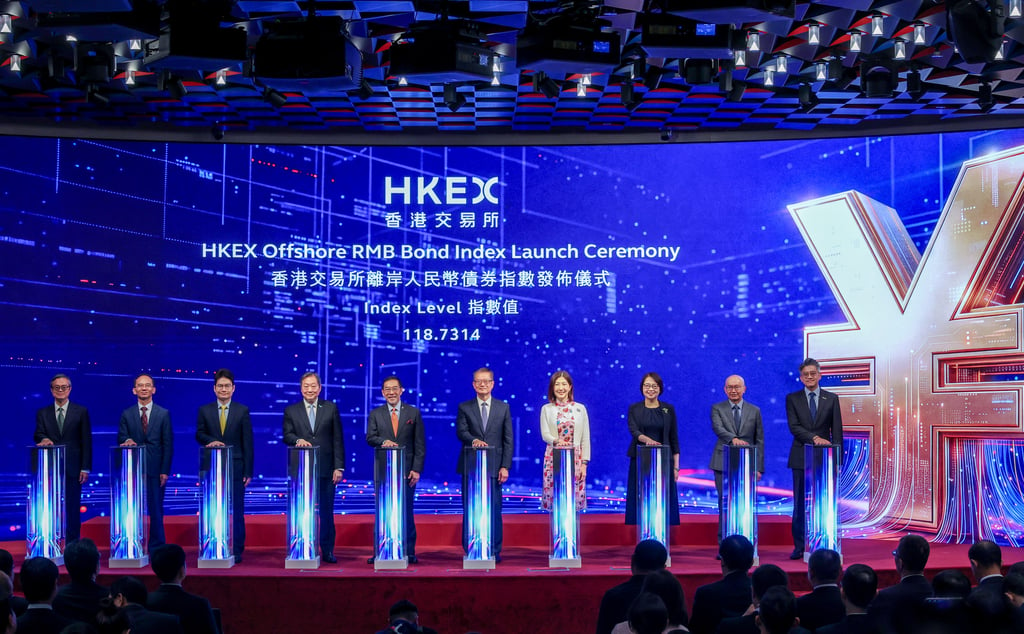
Recent initiatives show an ambition to move beyond bond issuance. Earlier this month, Hong Kong launched its first offshore yuan-denominated bond index, developed with Bloomberg. The benchmark tracks dim sum bonds and is intended to support products such as exchange-traded funds and index funds.
It could help turn a market in which bonds are issued and held into one where investors can compare performance, allocate capital and trade exposure more easily.
That distinction is important because a bond market’s strength depends not only on primary issuance but also on the depth and liquidity of its secondary market, where investors can trade securities without triggering significant price movements.
Regular government bond issuance across a range of maturities would help establish a reliable yield curve, while deeper liquidity, more effective hedging instruments and a broader range of investment products would enhance the international appeal of the yuan.
Yet the milestone should not be mistaken for a breakthrough that puts the yuan on the verge of challenging the US dollar. The comparison concerns the currency composition of bonds listed in Hong Kong, not the global bond market. Nor does it show international investors are ready to treat the yuan as a fully interchangeable store of value.
The dollar’s position rests on advantages beyond the volume of securities issued in one market. It is supported by deep and liquid financial markets, broad convertibility, the scale of US government bonds and confidence in free capital movement.
06:53
‘Hong Kong speed’: treasury chief details city’s gold and yuan ambitions
The yuan still faces constraints from China’s capital controls, limits on convertibility and uncertainty over how policy decisions may affect market access. These factors influence global investors’ willingness to hold yuan assets in the long term.
There is a difference between using a currency and trusting it. Companies may choose yuan financing because it is cheaper or matches their commercial needs.
That’s meaningful progress, but it does not automatically translate into demand for yuan reserves or unrestricted investment in Chinese assets. Internationalisation requires confidence that investors can enter and exit markets, hedge risks and repatriate funds under predictable rules.
For Beijing, the task is not simply to increase dim sum bonds. It is to make the currency more useful across the financial cycle, from trade settlement and borrowing to investment, risk management and savings. Hong Kong can help by deepening liquidity, broadening its issuer and investor base, and strengthening the infrastructure that connects offshore yuan assets to global portfolios.
The latest figures mark a significant step in that direction, as the yuan gains ground in a market where international capital can engage with it under familiar financial arrangements.
The real test will be whether Hong Kong can turn a successful issuance hub into a deep, trusted and investible market. If it can, the city may become not merely an offshore outlet for China’s currency, but the most internationalised component of its financial system.
KioskNews shows a cleaned-up reading view extracted from the publisher’s page — the original always lives on their site, not ours.