Why India’s oil marketing companies are losing over Rs 500 crore daily
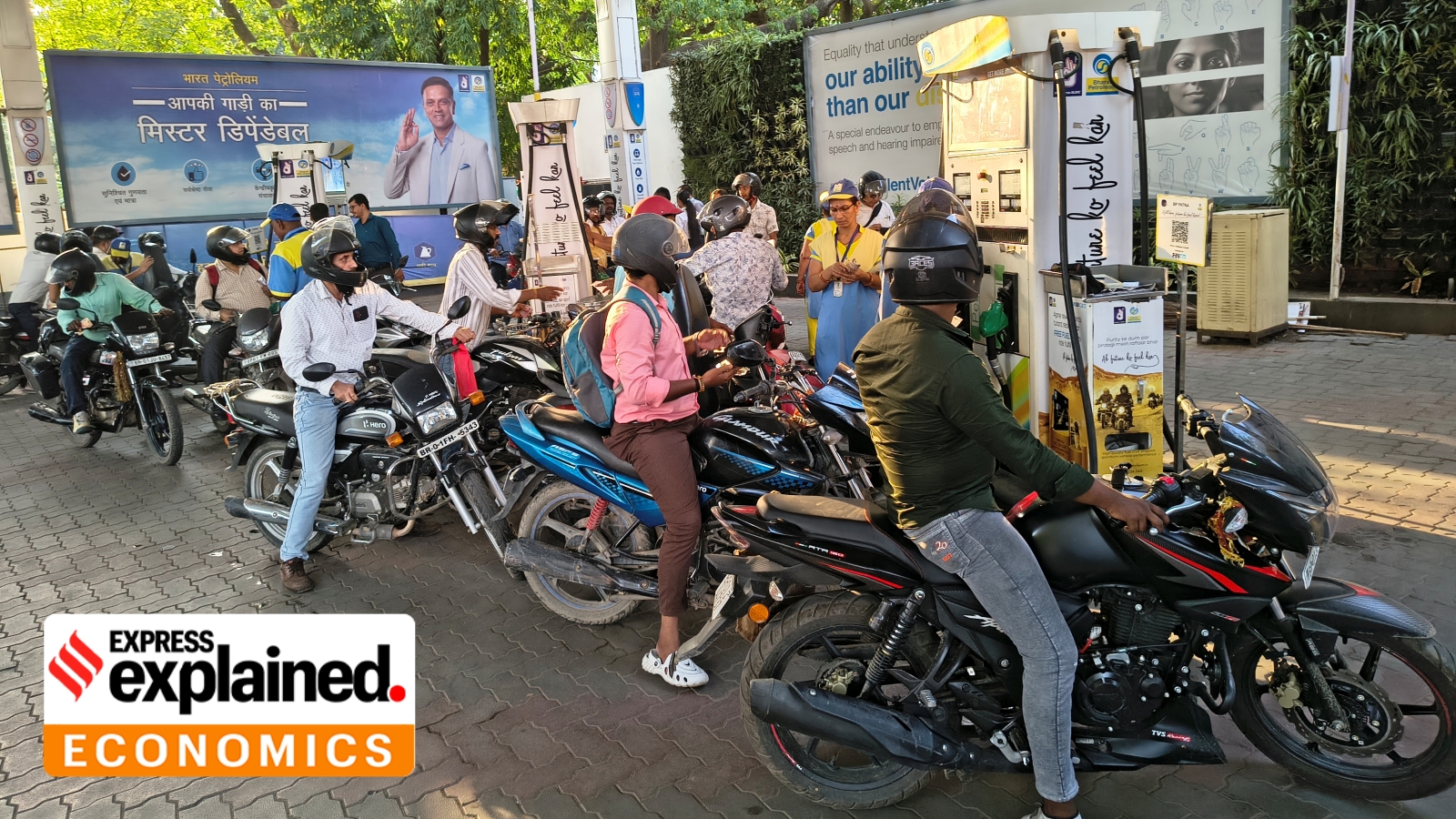
The jump in crude oil and petroleum product prices globally amid the recent flare-ups in the West Asia conflict is leading to significant pain for the three public sector oil marketing companies (OMCs) — Indian Oil, Bharat Petroleum, and Hindustan Petroleum — in the absence of a hike in retail fuel prices. These companies are currently estimated to be losing Rs 9 per litre on diesel sales, Rs 8 per litre on petrol sales, and Rs 300 per cylinder on domestic liquefied petroleum gas (LPG) sales, with their daily fuel marketing losses pegged at about Rs 530 crore, according to calculations by ratings agency ICRA.
Moreover, if oil prices remain elevated beyond $105 per barrel for the second half of the current financial year and petrol and diesel prices are not revised upwards, the OMCs could be facing under-recoveries of over Rs 64,000 crore on the two automobile fuels for 2026-27. Additionally, their combined under-recoveries on LPG sales in the absence of a price hike could be upwards of Rs 1 lakh crore for the full financial year if oil prices sustain beyond $105 per barrel in the October-March period, as per ICRA’s estimates.
Crude oil prices have increased sharply in recent weeks amid escalating geopolitical tensions and supply disruptions in West Asia. The surge was driven by renewed US-Iran conflict, the shutdown of Saudi Arabia’s East-West pipeline, and heightened Houthi threat around the Bab el-Mandeb and the Red Sea region. The Indian crude basket rose to $117.4 per barrel on September 21 from the 2025-26 average of around $66.
While the OMCs are benefitting from high gross refining margins (GRMs) in their refinery operations owing to a surge in fuel margins globally, these gains are likely to provide only a partial cushion to the companies’ overall financials. This is primarily because the OMCs retail higher volumes of fuels than they produce by buying them from other refiners, including standalone refiners that don’t have much of a retail network of their own. The three public sector OMCs account for about 90% of India’s petrol and diesel retail network, and are the only players in LPG retail to households.
Fuel retailers’ finances under pressure
India is the world’s third-largest consumer of crude oil and depends on imports to meet over 88% of its requirement. Amid the West Asia conflict, which has been ongoing for over six months now, the OMCs only partially passed on to retail consumers the international price increase in fuels like petrol, diesel, and LPG, resulting in heavy losses to the companies.
After narrowing over the past two-three months, marketing losses on fuel sales are now widening again amid the recent spurt in global prices and margins, increasing pressure on the OMCs’ finances. The three companies collectively reported a net loss of over Rs 18,000 crore for the April-June quarter. For over three months now, retail petrol and diesel prices haven’t changed. Prices were last revised in May by a total of Rs 7.35 per litre for petrol and Rs 7.53 per litre for diesel in four rounds. Despite these hikes, the OMCs continued to incur losses on retail fuel sales.
“Elevated crude prices and unchanged domestic fuel prices would put pressure on profitability and cash flows of OMCs. The same would also elevate their short-term borrowings for increased working capital requirements. The impact on OMCs’ earnings in 2026-27 will depend on crude prices, product cracks, retail price revisions and government support for LPG under-recoveries,” said Prashant Vasisht, senior vice president and co-group head of corporate sector ratings at ICRA.
Story continues below this ad
The government usually refrains from compensating the OMCs for losses on sale of petrol and diesel, which are officially deregulated. In the case of domestic LPG, which remains a regulated fuel, the government has over the past few years stepped in to help the OMCs with special financial grants to cover their losses.
The cumulative negative LPG buffer increased sharply to Rs 61,940 crore as on June 30, 2026, as the rise in international LPG prices following the West Asian supply disruptions was not fully passed on to consumers, ICRA noted. The estimated loss per cylinder stood at about Rs 500 in the June quarter and was at around Rs 300 in September 2026. LPG under-recoveries are likely to rise further if elevated international prices persist without a commensurate increase in domestic selling prices or additional compensation from the government.
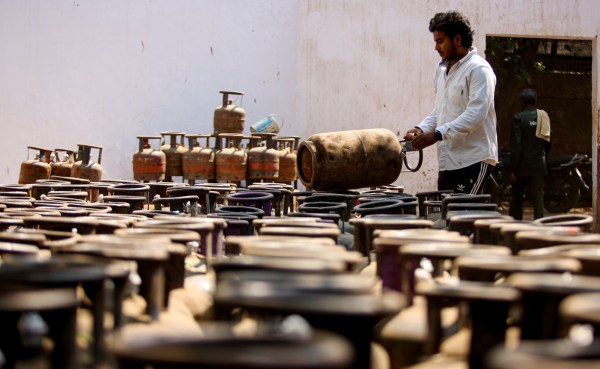 The estimated loss per cylinder stood at about Rs 500 in the June quarter and was at around Rs 300 in September 2026. Photo: Praveen Khanna
ICRA analysts noted that the combined refining and marketing operations of OMCs only break even when crude prices remain in the range of $85 to $90 per barrel. Beyond that price range, and in the absence of retail fuel price hikes, the OMCs are expected to incur marketing losses that can’t be fully offset by gains in the refinery operations, they said. It is worth noting that the West Asia crisis has not only led to a surge in crude oil prices, but has also led to a significant expansion in cracks spreads or margins of petroleum fuels in the international market.
Benchmark Singapore gross refining margins have remained above $10 per barrel since the start of the West Asia crisis, supported by refinery and product supply disruptions, inventory drawdowns and outages across West Asian refining capacity, ICRA said, adding that the additional supply shortages arising from damage to Russian refineries further tightened product markets, supporting elevated refining margins. Put simply, GRM is the difference between the total value of petroleum products produced by an oil refinery and the cost of the crude oil used to make them.
OMC under-recoveries in different price scenarios
Story continues below this ad
The ratings agency’s analysis shows that if the benchmark Brent crude averages between $105 and $115 per barrel for the remainder of the financial year and domestic retail fuel prices are not increased, OMCs face projected under-recoveries of around Rs 64,000 crore on petrol and diesel for the full financial year 2026-27. In these two scenarios, marketing losses would be neutralised if retail auto fuel prices are hiked by Rs 4-6 per litre.
If the price of Brent averages in a higher band of $130–$140 per barrel, under-recoveries on auto fuels could escalate to around Rs 1.9 lakh crore. In this oil price band, even a price increase of Rs 6 per litre is unlikely to cover the losses, the projections show. However, if Brent averages in the range of $85-$95 per barrel, the OMCs fuel retail operations are expected to be profitable even without any price hike.
In the case of LPG sold to households, the OMCs are expected to incur under-recoveries even if the price is hiked by up to Rs 90 per cylinder. If oil price averages between $85 and $95 per barrel, the annualised under-recovery on LPG is estimated at Rs 70,000 crore on an annualised basis if there is no price hike. If the price is hiked by Rs 90 per cylinder, the annualised under-recovery is pegged at around Rs 52,000 crore.
In the oil price band of $95-$105 per barrel, LPG under-recovery is pegged at Rs 87,000 crore in a no-price-hike scenario and Rs 69,000 crore if cylinder prices are hiked by Rs 90. If oil prices average at $105-$115, ICRA estimates the annualised under-recovery at Rs 1.03 lakh crore if there is no price hike, and Rs 87,000 crore in case of Rs 90-per-cylinder increase.
Story continues below this ad
Similarly if the oil price of $115-$125 is considered, the LPG under-recovery would be Rs 1.21 lakh crore if domestic LPG prices stay where they are. Even if LPG prices are hiked by Rs 90 per cylinder, the under-recovery would still be Rs 1.03 lakh crore, according to the analysis by the ratings agency.
KioskNews shows a cleaned-up reading view extracted from the publisher’s page — the original always lives on their site, not ours.