The villain in this show will make your blood boil. But it’s not a person
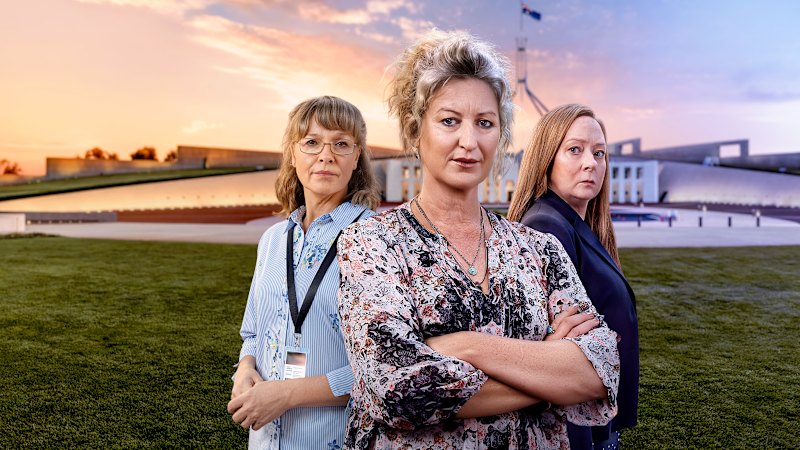
There’s a dreadful villain in Shakedown, the ABC’s new four-part drama series about robo-debt. The challenge is identifying who, exactly, occupies that role.
Is it the faceless bureaucrat who first came up with income averaging? Is it Scott Morrison or Christian Porter or Alan Tudge, the Coalition ministers who enthusiastically embraced it as a way of clamping down on the vast swaths of “welfare cheats” they imagined were ripping off the system? Or is it the frontline Centrelink workers who willingly put their humanity aside as they implemented the error-laden program, resorting in their defence to the line favoured by apparatchiks through the ages – I was only following orders?
In truth, it’s all of them, which is what makes Shakedown so frustrating. It’s not an individual, or even a group of individuals. It’s the system, man. And while that’s historically accurate, it works against an audience’s need to find someone to be angry at over a program that ultimately resulted in the government paying more than $1.2 billion in compensation, and over which no one has ever faced criminal charges. One largely sacrificial public servant aside (we’ll come to her in a moment), Shakedown can’t quite offer that up.
There’s an unmistakable echo in this series from Lingo Pictures (Lambs of God, Upright) of last year’s three-part SBS documentary series The People Vs Robodebt. It has many of the same victims, the same narrative threads – overstated or incorrectly assessed debt, a lack of due process, intimidation and harassment of the most vulnerable – and the inevitable collapse of a poorly designed and inhumane scheme.
It’s at its strongest when the focus is on the victims and their families, and it’s at its weakest when it sits with the investigators preparing for the royal commission. Their role in the drama is to try to make the complex details of the case comprehensible to the audience, but the dialogue in these sequences is risible. “Goodness, and then what happened in May 2016?” “Well, the legal advice stated…”
Much better is virtually any scene in which Kate Box holds centre stage as Jenny Miller, mother of Rhys Cauzzo, a young man living with anxiety who took his own life after being hounded by government-employed debt collectors. She is by turns supportive, solution-focused, tenacious, bewildered, furious, justice-seeking. It’s a masterclass in the various stages of grief, and of finding a sad sense of purpose in the campaign for justice that can never bring her son back but may help prevent others enduring the same loss.
Justine Clarke is good as Colleen Taylor, a Centrelink worker who genuinely believes in the notion of public service but finds that ideal increasingly pushed to the fringes of an organisation dominated by debt-recovery leaderboards and the squashing of dissent.
The showiest performance belongs to Mandy McElhinney as Malisa Golightly, a high-ranking career bureaucrat who effectively takes charge of implementing the online compliance intervention despite her occasional misgivings. She’s a bully, a liar, a terrible boss, a crippling sycophant, and every inch a product of a dreadful workplace culture. She’s also dead, which makes her an incredibly convenient scapegoat.
Golightly is portrayed as almost comically hysterical, except that there’s nothing funny about how she behaves, what she demands of her staff or the ends to which all that effort is put. Everything about it reeks of a lack of compassion, empathy, decency. She is awful, but in a strange way, she’s exactly what Shakedown needs – a human on whom we can project our loathing of a system utterly lacking in humanity. It’s almost enough.
Shakedown premieres at 8.20pm Sunday, November 22 on the ABC; all episodes will stream on ABC iview.
Want more TV? We’ve got you.
- Newsletter: Find out the next TV, streaming series and movies to add to your must-sees. Get The Watchlist delivered every Thursday.
- November streaming picks: A guide to the best new shows this month.
- Catch and kill: Why Australian networks and local streamers are banking big on crime in prime time.
- The Diplomat: How this series became TV’s slickest, most addictive thriller.
- 2.6 Seconds: Death in the Outback review: The best Australian documentary we’ve ever produced, plus director Darren Dale on how he pulled it all together.
- Death in Paradise: Anna Samson loves being a spiky and difficult detective.
- Watch (below): Deputy TV editor Meg Watson talks to Separated at Birth creator and star Nazeem Hussain.
KioskNews shows a cleaned-up reading view extracted from the publisher’s page — the original always lives on their site, not ours.