Netherlands plans to fight rollout of proposed US curbs on ASML
The Dutch government said it will resist US plans to further restrict ASML Holding NV’s sales to China, calling the proposed rules a threat to Europe’s most valuable company.
The US’ Multilateral Alignment of Technology Controls on Hardware (MATCH) Act, which aims to keep semiconductor components away from China, would force the Netherlands and other allies to strengthen export controls on advanced equipment, including Veldhoven, Netherlands-based ASML’s chipmaking machines.
The Dutch government is opposed to the extraterritorial scope of the bill, Dutch Minister of Foreign Trade and Development Cooperation Sjoerd Sjoerdsma said in parliament yesterday.
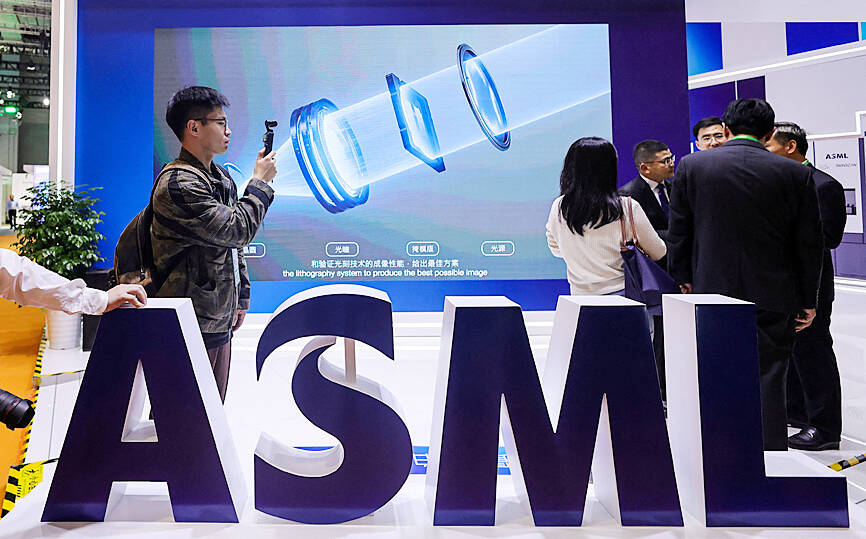
People gather at the ASML Holding NV booth at the 8th China International Import Expo in Shanghai on Nov. 5 last year.
Photo: Maxim Shemetov, Reuters
“The US is not the boss of Veldhoven,” Sjoerdsma said. “The US has a certain amount of jealousy of the capacities that the Netherlands and ASML have here — they would really like to have that within their own borders, but they don’t. In a good partnership, we would both be able to profit from that, but it’s not an equal partnership now.”
Sjoerdsma’s comments mark an escalation in rhetoric after months of Dutch efforts to prevent the MATCH Act from passing. The Dutch government is lobbying to make sure the act isn’t attached to an upcoming US defense bill, because the act would be less likely to pass on its own. ASML is the only company that makes the lithography machines used to manufacture cutting-edge semiconductors for artificial intelligence data centers and advanced smartphones.
While ASML has never been allowed to ship its most advanced extreme ultraviolet (EUV) machines to China, the Match Act is expected to expand those restrictions to impact sales and servicing of ASML’s immersion lithography, or immersion deep ultraviolet (DUV), machines to China. China is one of the chip-equipment maker’s biggest markets and is expected to account for about a fifth of revenue this year.
“If it does get passed, we’ll do everything we can to prevent it from being implemented,” Sjoerdsma said, declining to be specific about the Dutch government’s potential response. “And if it is implemented, we’ll really have to consider how we’re going to respond. But there’s a lot on the table for the Dutch cabinet.”
Sjoerdsma also said the detrimental effects would not be felt in the Netherlands alone, and other European countries’ semiconductor industries would also be hit.
“The consequences will be felt throughout the European Union, also as it will create a strong precedent,” Sjoerdsma said.
“Europe can’t afford to fall behind,” he said in a reference to the importance of the semiconductor industry and the rapid developments in AI.
Sjoerdsma said he was working with the European Commission, Germany and France in an effort to prevent the MATCH Act from being attached to the defense bill.
In case that lobbying fails, the Netherlands and the EU will weigh their options to limit the consequences, he said.
KioskNews shows a cleaned-up reading view extracted from the publisher’s page — the original always lives on their site, not ours.