3 myths about the weather

Breakthroughs, discoveries, and DIY tips sent six days a week.
By signing up, you confirm you are 16+, will receive newsletters and promotional content and agree to our Terms of Use and acknowledge the data practices in our Privacy Policy. You may unsubscribe at any time.
Everyone complains about the weather, the old line goes, but nobody ever does anything about it. But it’s not exactly true, is it? People have always done something about the weather—mostly by trying to predict it, then arranging our lives around the forecast.
It makes sense, then, that we’ve picked up a few ideas about outside conditions that don’t quite hold up. From cold weather making you sick to red skies in the morning, here are some common beliefs about the weather that aren’t entirely true.
Cold weather doesn’t cause colds
You’ve heard someone say it, or maybe you’ve said it yourself: “Put on a jacket—you’ll catch a cold.” The problem is that cold weather doesn’t cause colds—at least, not directly.
Manal Mohammed, a Senior Lecturer in Medical Microbiology at the University of Westminster, wrote about this for The Conversation. “Cold temperatures do not cause infections by themselves,” she concludes. “Instead, they shape the biological, environmental and social conditions that allow respiratory viruses to thrive.”
For example: People spend more time inside during cold weather, which can help viruses spread. These indoor spaces tend to be heated, meaning the humidity is low, meaning nasal passages are dry. This makes it more likely that you’ll catch a virus. And, according to Johns Hopkins Medicine, the fact that school is in session during the winter is also a factor.
There are physiological factors as well, according to Mohammed. “Breathing in cold air lowers the temperature inside the nose and airways, which can trigger vasoconstriction,” she writes. She adds that this can weaken the local immune defenses in the lining of your nose and airways. But that’s not the same as a direct causal link.
So, while it’s true that you’re more likely to catch a cold or the flu during the winter, that isn’t directly caused by your failure to wear a jacket. It’s the viruses, not the temperature, that make you sick.
Lightning can strike the same place twice
“Lightning hitting the same place twice” is a cultural shorthand for something unlikely happening. But is it accurate? Kind of. It’s true that, all things being equal, it’s unlikely for lightning to strike the same place twice. But all things aren’t equal.
Lightning tends to hit the highest nearby object, which is why it’s a bad idea to go under a tree during a lightning storm. In big cities this means the largest buildings are hit frequently. New York City’s Empire State Building is hit, on average, 25 times per year, according to New York City Emergency Management. The CN Tower, north of the border in Toronto, is hit three times as often—75 times per year according to the tower’s website. This isn’t to say these buildings are unsafe—both have lightning rods, which give the current a safe path to the ground. It’s just that they’re hit multiple times a year.
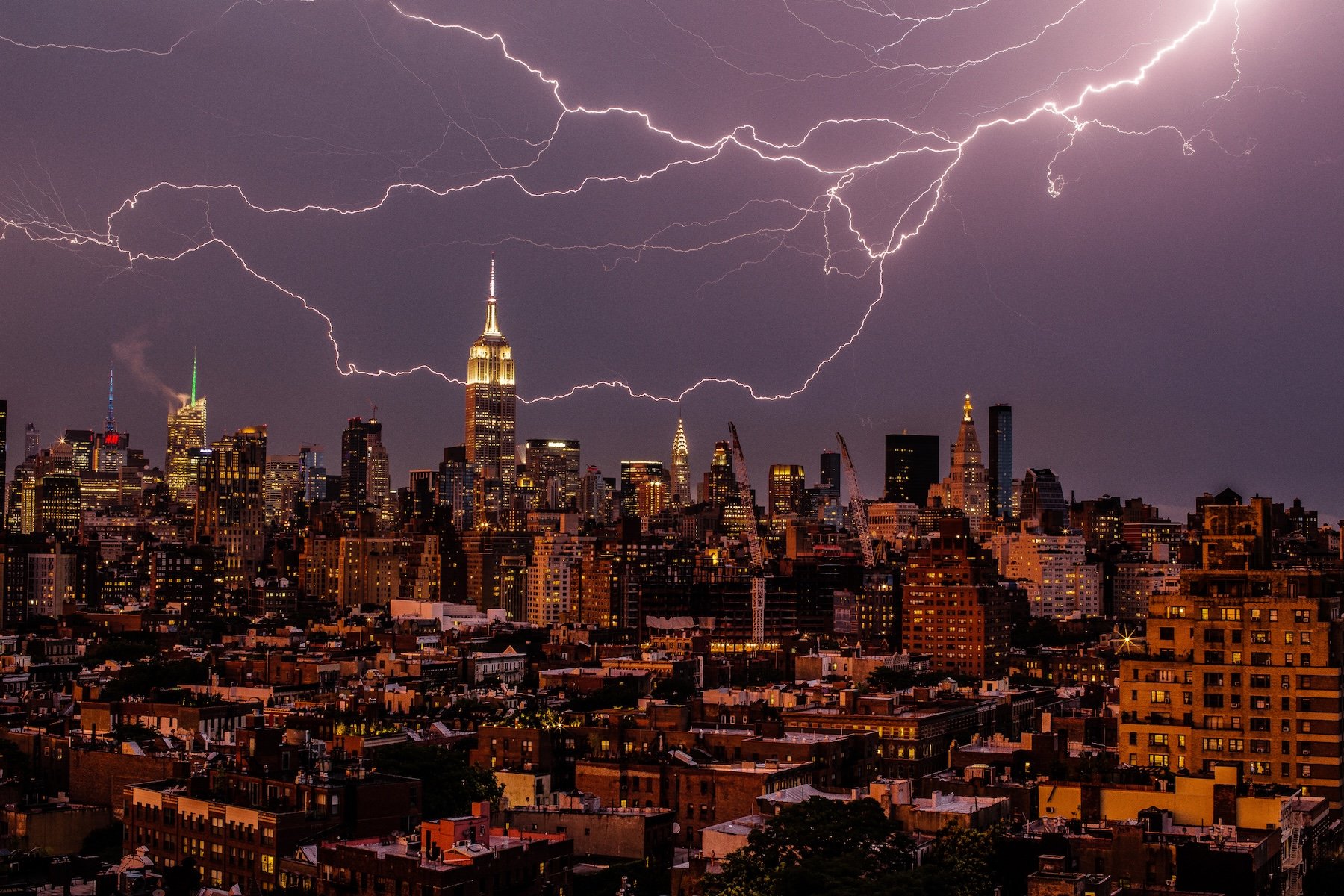
So lightning not only can hit the same place twice, but does so pretty often. Although, according to NOAA, it doesn’t always hit the highest point—so there’s truth to the idea that lightning is hard to predict.
Red skies really can predict the weather
You’ve heard it: “Red sky at night, sailor’s delight; red sky in the morning, sailors take warning.” The idea that the color of the sky can predict the weather is really old—it’s referred to in the Bible (Matthew 16:2-3, if you want to look it up). But is there any science behind this?
Yes, it turns out, but it doesn’t work everywhere. To understand why, we need to explain a few things. First: What causes red skies? “A red sky appears when dust and small particles are trapped in the atmosphere by high pressure,” according to the UK Met Office. “This scatters blue light leaving only red light to give the sky its notable appearance.”
A red sky means there’s high pressure between you and the direction of the sun. The sun sets in the west and rises in the east. So, a red sky at night generally means there’s high pressure to your west; a red sky in the morning means there’s high pressure to the east of you.

But why does that predict the weather? Because, in the mid-latitudes, the wind generally blows from the west—this is called the prevailing westerlies. High pressure means stable, dry weather. A red sky at night means the high pressure is to your west, which the westerlies will bring to you; a red sky in the morning means the high pressure is to your east, and the wind will blow it away from you.
But, again, that only works in the mid-latitudes, where the prevailing westerlies are the norm. This region is between 30 and 60 degrees in both the southern and northern hemispheres, a region that includes most of Europe, the continental United States, southern Australia, and Japan, among other places. So, if you’re in one of those places, a red sky in the morning actually does point to a change in the weather. If you’re in the tropics, though, the weather tends to build up locally rather than arriving from somewhere upwind, meaning the colors at sunrise and sunset aren’t as useful for predicting it.
So this isn’t entirely a myth—there’s truth to the saying. It just doesn’t work everywhere on Earth.
KioskNews shows a cleaned-up reading view extracted from the publisher’s page — the original always lives on their site, not ours.