Military to restructure on tech, firepower: source
TRANSFORMATION: The reorganization includes expanded artillery, which would result in personnel savings, and integration of systems such as the NASAMS and the PAC-3 MSE
By Lo Tien-pin and Jonathan Chin / Staff reporter, with staff writer


Taiwan is beginning reorganization and restructuring centered on using firepower and technology to reduce the dependence on troop numbers, a source said yesterday.
The next step in the force transformation plan would focus on new artillery, coastal defense, uncrewed aerial vehicles (UAVs) and counter-UAVs, a defense official said on condition of anonymity.
The reorganization followed the establishment of the air force’s 7th Flight Training Wing; the navy’s Littoral Combat Command and the Naval Anti-Submarine Aviation Command; the army’s Uncrewed Systems Training Command; marine security, fires and drone battalions; and the scattering of drone units across services.
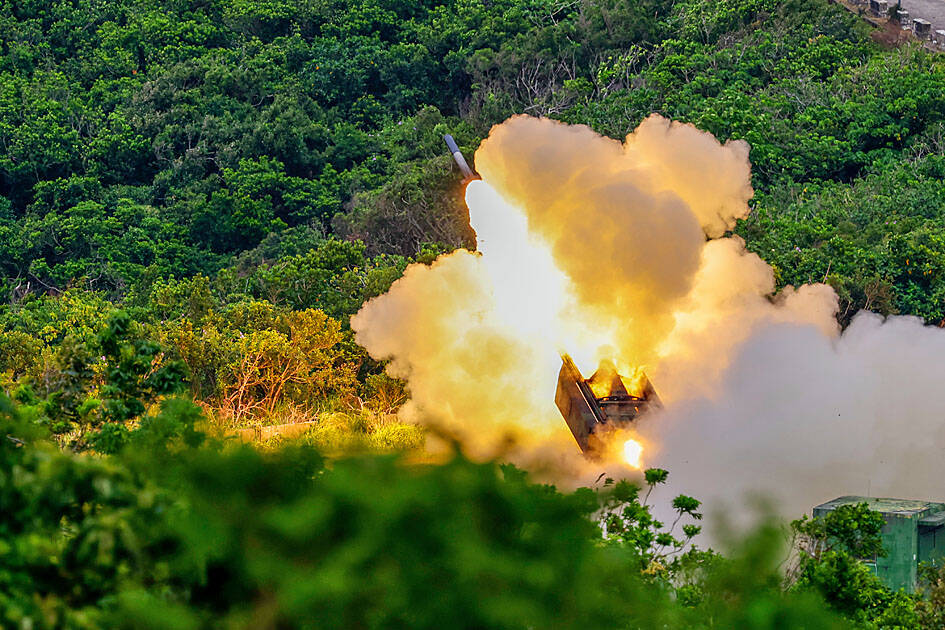
A missile is fired from a High Mobility Artillery Rocket System during a drill in Pingtung on May 12 last year.
Photo: Ritchie B. Tongo, EPA-EFE
For the incoming stage, the armed forces would reorganize and expand artillery following the introduction of the High Mobility Artillery Rocket System and the M109 self-propelled howitzer in the 6th, 8th and 10th army corps, the official said.
The modern artillery platforms require a three-soldier crew per vehicle, down from the nine to 11 soldiers per towed artillery piece, resulting in significant personnel savings, they said.
The surplus personnel would be utilized to form rocket artillery battalions from the nuclei of extant rocket artillery companies, boosting the artillery arm’s mobility and long-range precision-strike capabilities, the source said.
UAV units would be integrated under army corps-level artillery headquarters, as the artillery branch views the role of drones as analogous to guns, they added.
Army UAV battalions are to be equipped with the National Chungshan Institute of Science and Technology’s first-person-view attack drones and reconnaissance drones, as well as the Altius-600M loitering munition, they said, adding that the army is also placing an order for 2,000 Altius-700M anti-armor drones and Altius-600ISR drones.
Artillery headquarters would use reconnaissance drones, attack drones, tube artillery and rocket systems to form a digitized kill chain capable of destroying enemy forces upon detection, the official said.
The Littoral Combat Command is to create a 4th Littoral Combat Group, and dedicated UAV units under each group would operate the vertical take-off and landing drones they are to receive, the source said.
The Air Force Security Guards would be expanded into a brigade-sized unit to defend radar stations, air bases and other key installations against Chinese UAVs and special operations forces, they said, adding that it would be composed of a mix of conscripts and professional soldiers armed with Stinger missiles, Kestrel anti-armor rockets and other weapons.
The air force would establish units to operate Patriot Advanced Capability-3 Missile Segment Enhancement (PAC-3 MSE) interceptors and National Advanced Surface-to-Air Missile Systems (NASAMS), contingent on Washington’s approval of a US$14 billion arms package to Taiwan, the official said.
Integrating these weapon systems would result in significant changes to the organization of the Air Force Air Defense and Missile Command, they added.
The military’s restructuring would also enhance counter-UAV tactics and asymmetric weapon handling training for draftees, as infantry battalions of conscripts would furnish a vital part of frontline combat strength, the official said.
KioskNews shows a cleaned-up reading view extracted from the publisher’s page — the original always lives on their site, not ours.