[Korea travels] Everything old is cool again at Seoul’s Dapsimni Antique Art Street
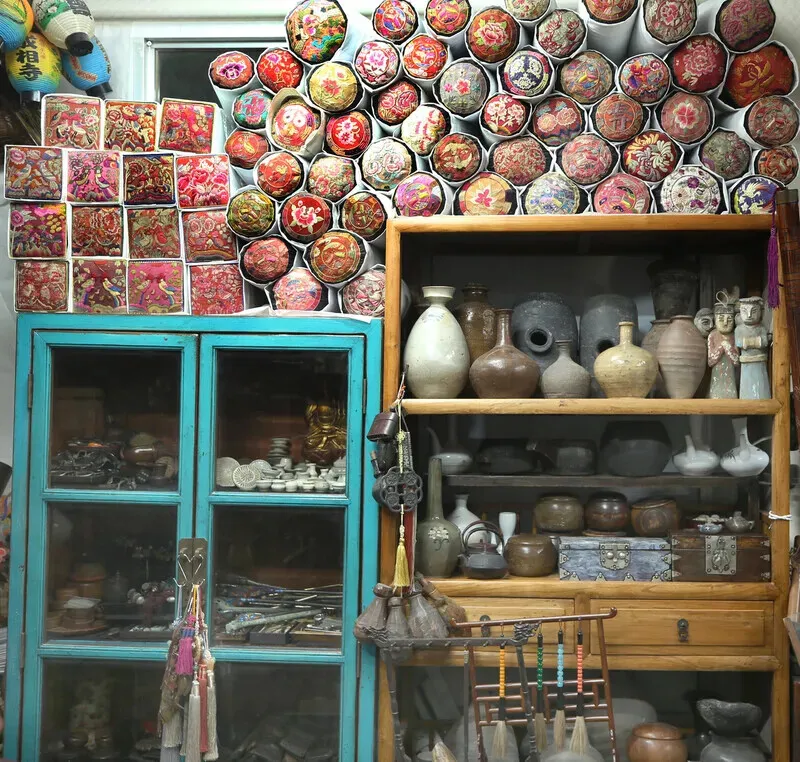
The interior of Manbok-dang. (Park Mee-hyang/Hankyoreh)
These days, nothing says cool quite like “Gungjungbak,” the Korean shorthand for the National Museum of Korea — a cultural hotspot whose appeal blends sophistication, introspection and a healthy dose of humor.
In the past, museum exhibition halls displaying artifacts were considered dull spaces visited mainly by senior citizens or students as part of their history classes.
That is no longer the case, as cultural artifacts seem to be at the peak of hip, as shown by the resounding success of the museum’s annual “Dress Like a Museum Exhibit” contest, whose winners were announced on Sept. 19. The event’s subtitle was “Time to Awaken the Artifact Sleeping Within You.”
Another spot in Seoul offers to awaken the antique enthusiast within: the Dapsimni Antique Art Street. Catching the eye of millennials and Gen Z, the area is “bustling not only with young people but also with foreign tourists. Joining the mix are cafe entrepreneurs, exhibition planners, fashion professionals and cultural space designers.
Visiting the Antique Art Street was a “must,” says German tourist
Dapsimni Antique Art Street refers to the Samhee Apartment shopping complex in Seoul’s Dongdaemun District. All you have to do is leave Line 5’s Dapsimni Station through Exit 1 and you’re there.
The shopping complexes in the apartment’s second, third, fifth, and sixth buildings comprise the Antique Art Street. When I stepped into the second building, its narrow hall was lined with shops selling antiques.
Each shop was packed with an eclectic array of objects, each with its own history. Among them were rare finds and precious pieces that would make prized additions to any collection.
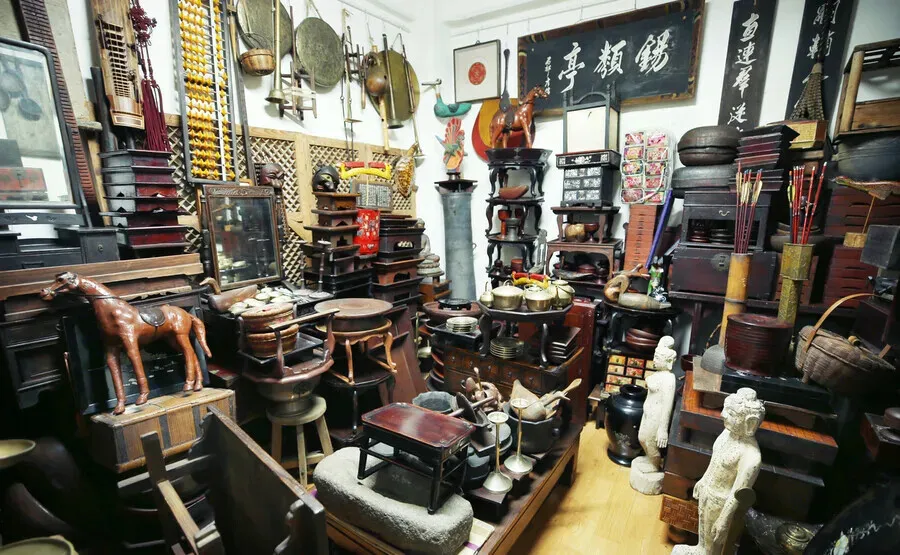
The interior of Jangmi-bang in the Dapsimni Antique Art Street. (Park Mee-hyang/Hankyoreh)
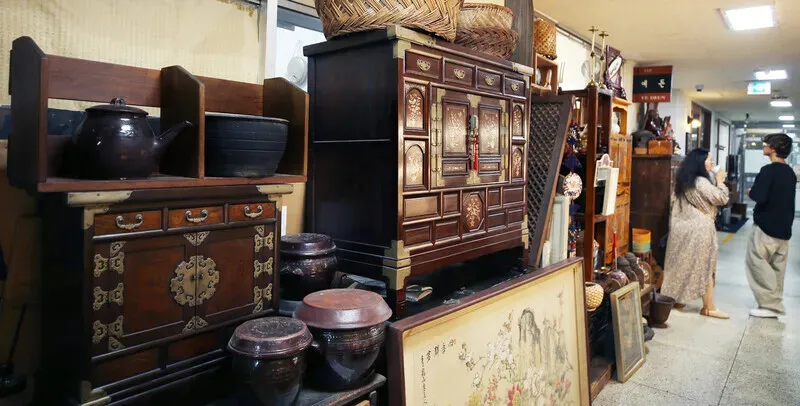
Antiques overflow into the hallways in the complex. (Park Mee-hyang/Hankyoreh)
“There’s something really beautiful about objects that carry so much history and tradition,” said Till Spurný, a German tourist who was visiting the area with a friend.
After watching a video about the street on social media, he immediately added it to his list of spots he needed to visit during his trip to Korea. He noted that he was not the only tourist to do so.
Once considered a shabby, rickety old space, the neighborhood is now ready to spread its wings as a global tourist attraction.
Spurný entered Jangmi-bang, a shop he had been eyeing. This shop was teeming with everything from small bric-a-brac, such as wooden figurines depicting Joseon-era nobles, water droppers, porcelain and brass teapots, to heftier items like stationery chests and vanity desks, which were once used to store stationery, letters and books.
Lee Jeom-sook, 71, has been the proprietor of Jangmi-bang for 30 years. Her husband, Yoon Gap-yeong, 74, operates a store with the same name in a different building in the complex. Yoon opened his own shop after 40 years of collecting antiques as a hobby.
“We visited places all around the country to buy antiques,” Lee said, reminiscing. “Following the COVID-19 pandemic, we began procuring more objects through auctions.”
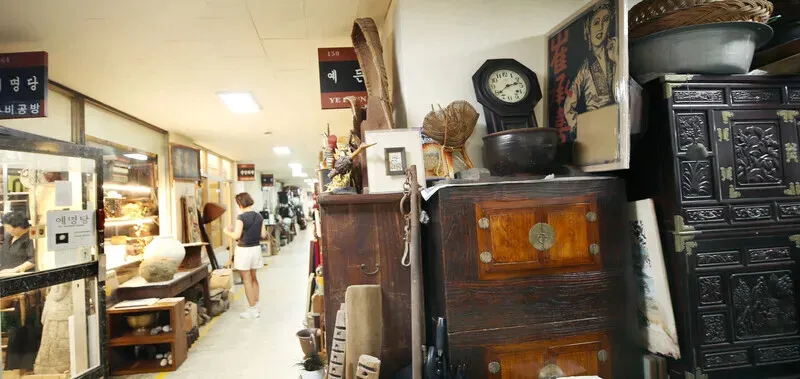
Antiques overflow into the hallways in the complex. (Park Mee-hyang/Hankyoreh)
I asked about the history of this shopping complex.
“From the ’70s to the early ’80s, antique dealers were scattered around the Hwanghak and Sinseol neighborhoods. Some were also in Insadong, but they practically evacuated from the neighborhood after rent spiked. That’s when Insadong began shifting toward food, fashion and souvenirs. There were a few dealers around Cheonggye Stream, but they had to leave after construction began. In the early ’80s, everyone swarmed toward this building,” Lee said.
Records provided by Dongdaemun District say that this complex, which began to take shape in the early 1980s, houses a collection of approximately 250,000 antique art pieces, making it the largest antique art street in Korea.
Not only does the complex overflow with antique paintings, calligraphy pieces and furniture, but it also has miscellanea like wooden candlesticks and pendulum clocks. Today, around 140 shops are clustered in the complex.
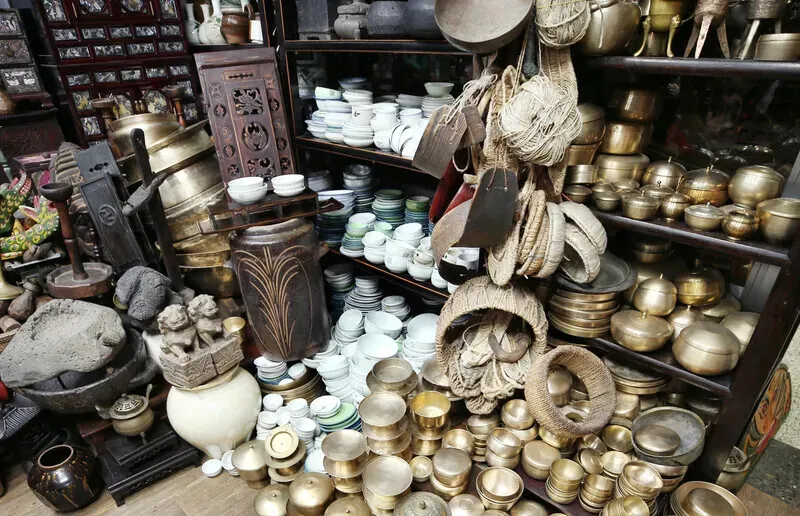
There’s no shortage of antiques and more to browse at the Dapsimni Antique Art Street. (Park Mee-hyang/Hankyoreh)
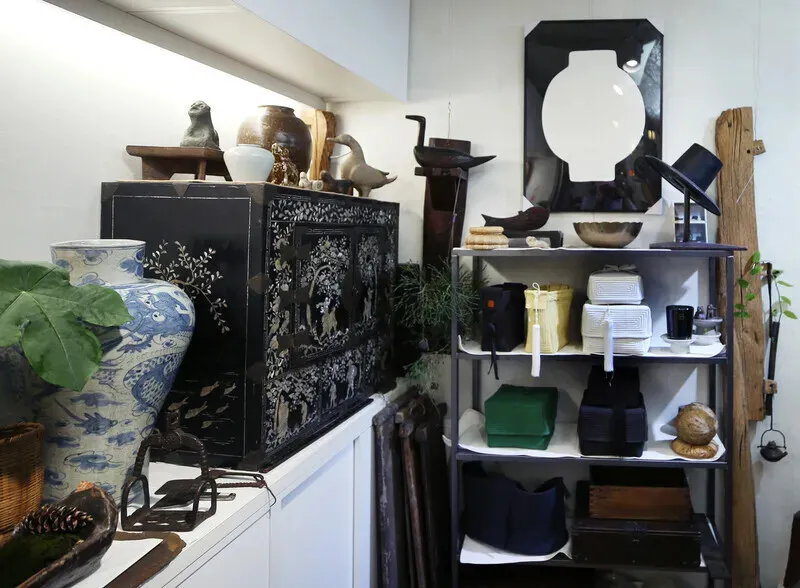
The interior of Yemyung-dang in the Dapsimni Antique Art Street. (Park Mee-hyang/Hankyoreh)
Some provide more specific accounts of how this complex came to be. Jeong Young-seop, 67, the owner of the 26-year-old Yemyungdang, mentioned how the building was built as an apartment complex with loans from the Asian Development Bank — a venture that the government promoted in the ’70s and ’80s to increase housing supply.
“Originally, this was a two-story small-scale manufacturing factory built on loans from the Asian Development Bank, but, as it wasn’t selling, the design was changed to create the nine-story shopping complex we see today. It was cheap to buy or rent with a lump-sum deposit, so many people from Ahyeon, Hwanghak and other areas moved here.”
A global antique hotspot spreading through social media
When did the complex become so popular?
“In the past, people working in interior design and soldiers planning on returning to the US came by. A lot of overseas salespersons from the US, Japan and other countries also dropped by to buy many of our wares. The general public hadn’t shown a lot of interest, but we’re seeing a wave of younger people since 2025,” Lee said.
Many factors contribute to that phenomenon. As evidenced by the popularity of the National Museum of Korea, perceptions surrounding traditional Korean items have changed. The rediscovery of Korean antiques, characterized by their unique aesthetic that features elegant curves and refined forms difficult to find in artifacts in other countries, has caused their value to rise.
Younger generations, armed with social media and a fresh perspective, have driven a renewed appreciation for these pieces, finding new ways to look at and value Korean antiques.
Gobokii and Hobak Folk Art Gallery, which entered the complex in 2025, and OF, an antique art curation shop, have also played vital roles in this comeback. The owners of these shops appear to have accurately gauged what appeals to the younger generations.
Choi Won-seok, the CEO of OF, is a renowned spatial creative director who has also published a book on that particular subject. He is also the CEO of Project Rent, a company labeled as the pioneer of pop-up store marketing in Seoul’s Seongsu neighborhood. As an avid antique collector, he used to be a regular at this shopping complex.
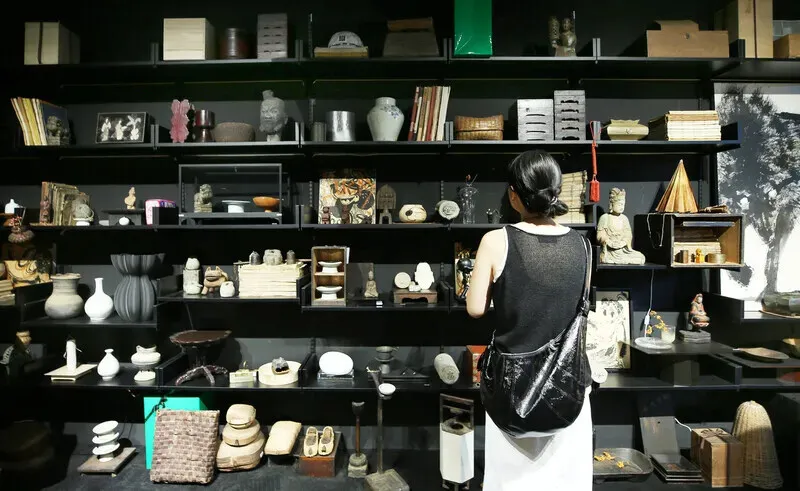
A visitor peruses the items at OF, a shop in the Dapsimni Antique Art Street. (Park Mee-hyang/Hankyoreh)
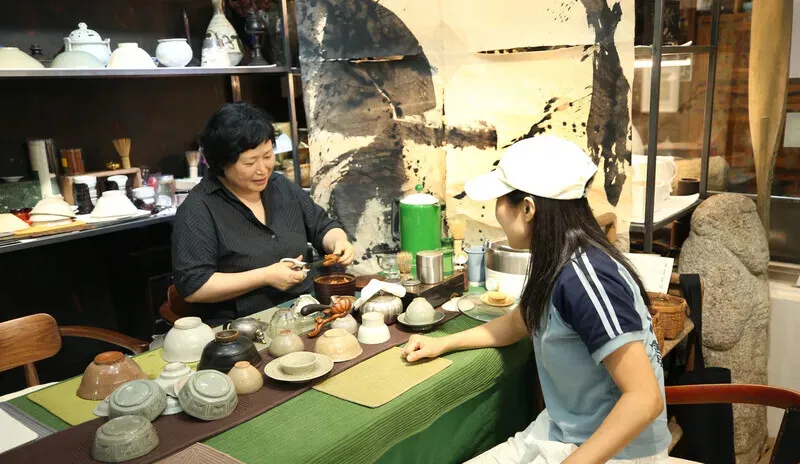
Chang Ok-sun prepares tea for a customer at her shop, Yemyung-dang. (Park Mee-hyang/Hankyoreh)
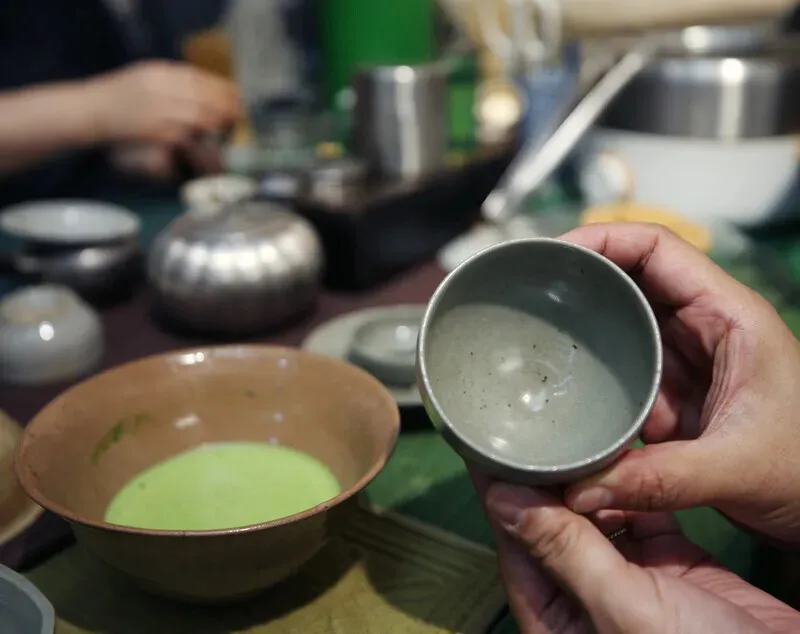
Chang’s matcha comes served in cups that date back to the Goryeo period, more than 600 years ago. (Park Mee-hyang/Hankyoreh)
What happens when a 1,000-year-old cup breaks? “It’s fulfilled its purpose”
Chang Ok-soon, 61, Jeong’s wife, makes traditional Korean quilted boxes in the mornings and prepares matcha in her shop from 1 pm. The cups the matcha are served in are antiques from the late Goryeo dynasty, making them 600 years old.
A video of her performing a tea ceremony while using a cup that had been made 600 to 1,000 years ago to serve matcha to guests has spread through YouTube.
Antique objects rode the wave of traditional tea ceremonies, which the younger generation considers to be a sophisticated, trendy art.
“I’ve always felt strongly about how our traditions were being overlooked, and it felt very serious to me,” Chang said. She began to brew tea with the intent to revive traditional culinary customs.
Guests do not pay extra to participate in Chang’s tea ceremonies. It is, rather, an impromptu event that happens by chance, when someone who happens to drop by runs into her. On multiple occasions, she has had conversations with complete strangers over a cup of tea.
“Some people talk about more depressing subjects, then say that they feel that these conversations helped them to heal,” she said.
Ryu, a 42-year-old tour guide who has worked in Europe for 18 years, said that Chang’s tea harbors special powers.
“I planned an entire itinerary for a friend visiting Korea, and they said they had been recommended this place by a different foreign tourist at his guesthouse in Myeongdong. That stranger said that the tea he tasted here was the best experience of his entire trip in Korea. Hearing that, I felt ashamed that I hadn’t been, so I came over.”
As I sipped the deep green matcha, scenes from the Goryeo dynasty 600 years ago seemed to flicker in front of my eyes. Jeong handed me a piece of pottery made 1,000 years ago. “My hands shook; I knew it would have been a disaster if I broke it.
“No guest has ever broken a piece, but if something breaks, I like to think that it’s fulfilled its purpose,” Jeong said.
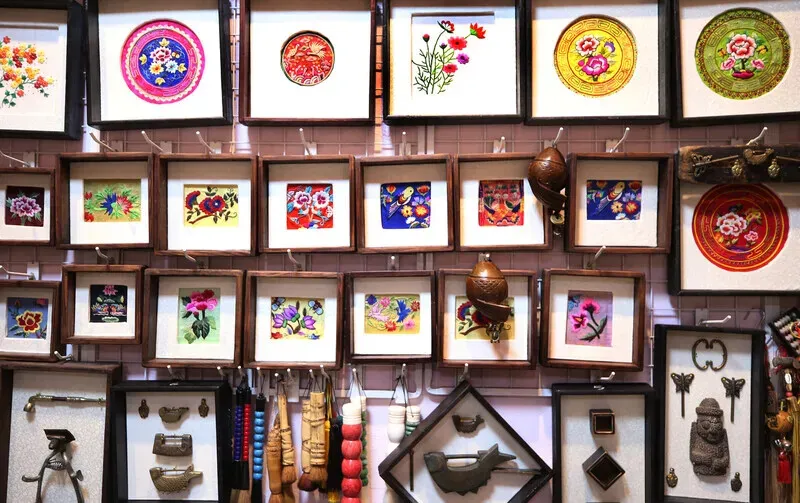
Some of the embroidery that is for sale at Manbok-dang, the oldest shop in the neighborhood. (Park Mee-hyang/Hankyoreh)
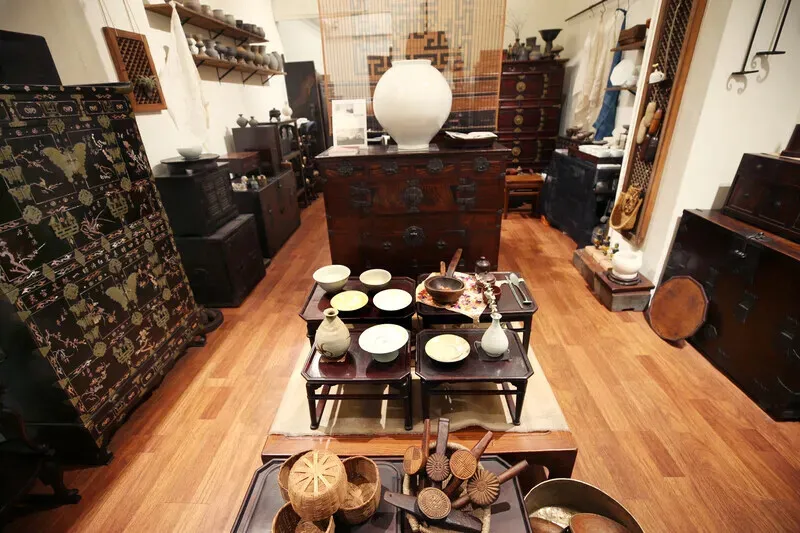
Stepping into Gahwa feels like stepping into a museum. (Park Mee-hyang/Hankyoreh)
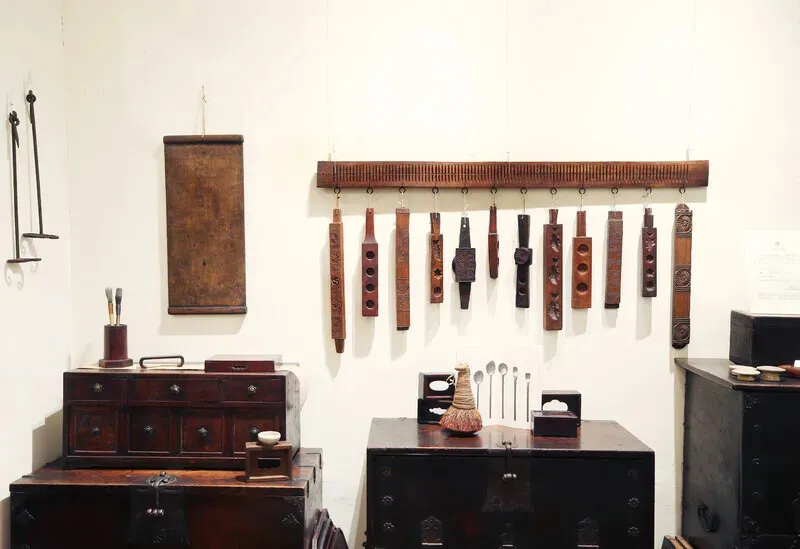
Stepping into Gahwa feels like stepping into a museum. (Park Mee-hyang/Hankyoreh)
The farther you venture into the complex’s second building, the deeper you step into history. The oldest shops on this street are Dongin-bang and Manbok-dang. Once you enter Manbok-dang, your eyes are drawn to the antique embroidered pieces that adorn an entire wall, resplendent in their many colors.
It is as if you have stepped right into a period drama set in a royal palace.
The owner of this shop is 70-year-old Cha Soon-rye. The generosity of someone who has preserved Korea’s craft heritage radiates from her face as she cuts and trims fabric.
“So few know the art of embroidery nowadays. Isn’t it a shame?” she said, her voice dripping with melancholy.
As its name suggests — “Man” is the Korean word for 10,000 — Manbok-dang is full of more than 10,000 antiques. One cannot help but be mesmerized.
Gahwa, the shop directly opposite Manbok-dang, is a place that “beautifully curates quintessentially Korean antique artworks.”
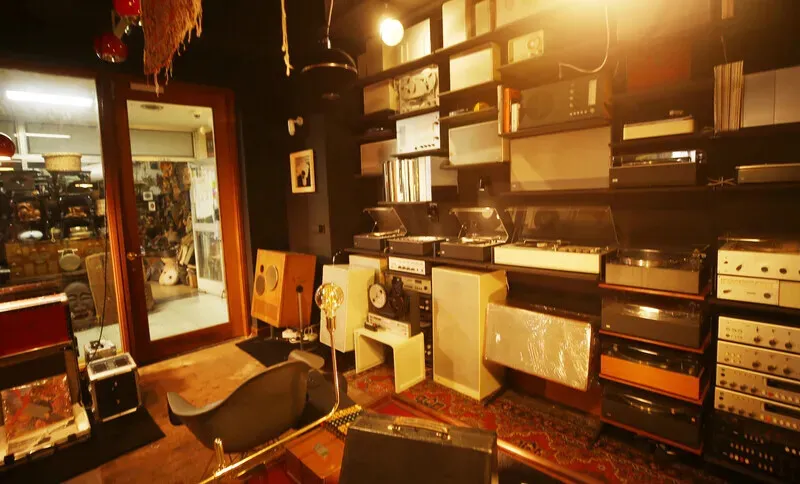
Jenpa Sanghoe, a vintage audio shop, is a new addition to the art street. (Park Mee-hyang/Hankyoreh)
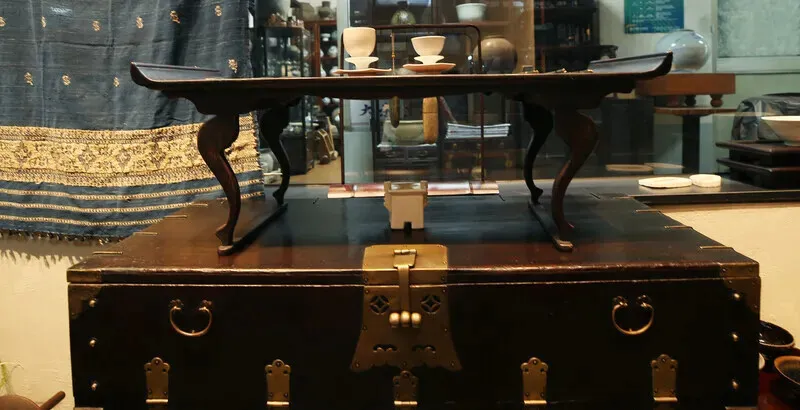
A place called ddd Space serves as both a cultural and exhibition space featuring tea ceremonies. (Park Mee-hyang/Hankyoreh)
In recent years, two new shops have joined the neighborhood’s eclectic mix.
Soyo Salon describes its mission as promoting “a cultured life through craft.” Visitors can stop in for a simple cup of tea and light refreshments.
Jenpa Sanghoe specializes in vintage audio equipment. The space was curated by Lee Jeong-yeop, an interior designer and head of TIS Gallery who has collected audio equipment for more than 20 years. Even those unfamiliar with high-end audio will find themselves marveling at the impressive array of equipment packed into the shop. Visits are by reservation, which can be requested through the shop’s Instagram account.
A more unexpected addition to the alley is Eham Editions, a showroom and retail shop for European vintage furniture operated by Eham Campus, a cultural complex in Yangpyeong, Gyeonggi Province.
The fifth building is also home to ddd Space, a cultural venue that combines tea ceremonies with exhibitions. Its inaugural exhibition featured pieces from the collection of Yoon Sam-ung, a tea ceremony and tea-ware collector.
You could spend an entire day wandering through this complex without noticing the hours slip by. Here, history seems to run in reverse. Immersing yourself in traditional Korean objects brings a sense of calm, while the lives of those who came before us seem to linger in the antiques they left behind.
In recent years, however, Chinese antiques have also begun appearing in the shops. Visitors hoping to focus exclusively on Korean antiques should therefore browse carefully.
KioskNews shows a cleaned-up reading view extracted from the publisher’s page — the original always lives on their site, not ours.