Public comments flood US government websites over proposed H-1B, OPT fee hikes

Kana Liu, a Chinese Canadian living in the US on a work visa, felt compelled to speak up.
Faced with a Department of Homeland Security proposal to charge up to US$100,000 in fees for international students to work in the US after graduation under Optional Practical Training (OPT), she rushed to the government’s public comment portal.
“I firmly oppose the proposed $70,000 initial OPT fee and $30,000 subsequent fee,” she wrote on the federal comment site on October 12. “They create undue barriers for legitimate students and educational institutions while failing to effectively address the stated goals of preventing immigration fraud and protecting American workers.”
Liu is among thousands weighing in on two contentious proposals that could sharply raise fees for international students and employers of skilled foreign workers, fuelling debate and adding uncertainty for those hoping to study, work or remain in the US.
Nearly 62,000 Chinese students took part in OPT in the 2024-2025 academic year, according to the Institute of International Education’s Open Doors report.
The OPT proposal, published on October 8, has drawn more than 2,000 comments since its publication. It would charge US$70,000 for a student’s first OPT authorisation and US$30,000 for each subsequent one. Schools would pay the fees but could pass the costs on to students or employers, according to DHS. The comment period runs until November 9.
Another proposal concerning H-1B visas for skilled foreign workers has drawn about 11,700 comments. Unveiled in late August, the proposal would charge employers US$103,265 for each new H-1B petition subject to the annual cap of 85,000 visas. The comment period has closed, and a final decision is pending.
Public comments can influence a final rule by requiring agencies to address concerns, but agencies are not obliged to adopt commenters’ recommendations. How much weight DHS will give the feedback remains unclear.
Both proposals have sparked debate worldwide over their potential impact on international students. OPT generally allows graduates to work in the US for up to a year, with extensions available for those in science, technology, engineering and mathematics (STEM) fields. Many later seek H-1B visas, which can provide a pathway to permanent residency.
The proposals come amid the Trump administration’s broader immigration crackdown. Last year, President Donald Trump ordered a US$100,000 fee on new H-1B petitions, causing widespread uncertainty. Federal judges have since struck down versions of the measure. DHS’s proposed US$103,265 fee would instead be introduced through formal rule making by the agency.
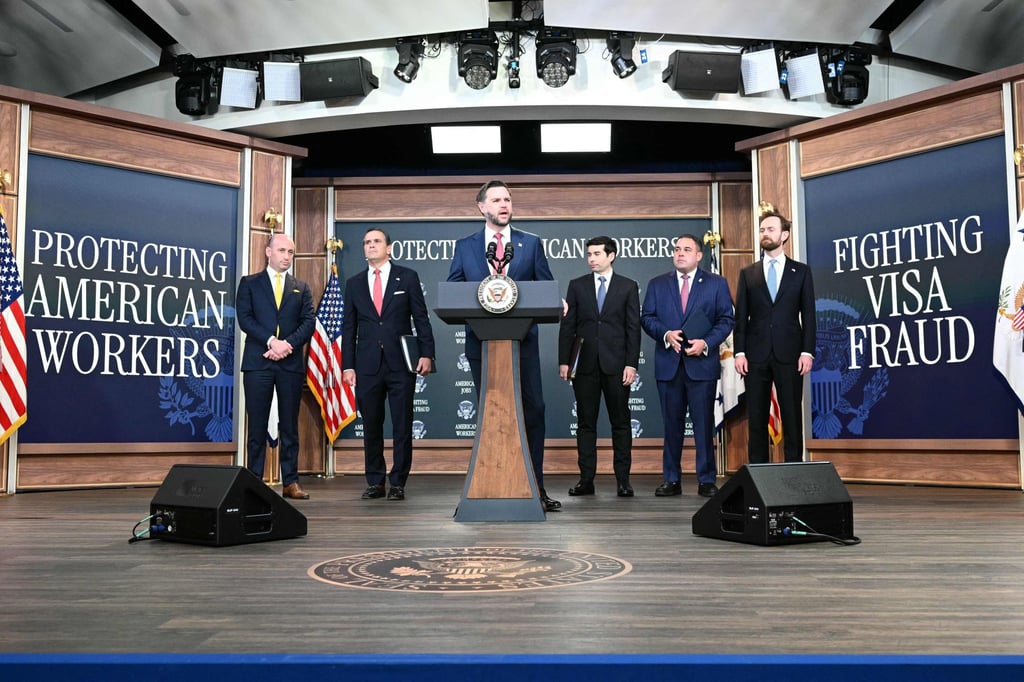
Last week, Vice-President J.D. Vance also announced an investigation into alleged J-1 visa fraud at nine universities, including Harvard, Yale, Stanford and MIT.
DHS did not immediately respond to a request for comment on when it might decide on the H-1B proposal.
Speaking up
Liu was on OPT but said she had to switch in August to a work visa available to Canadian citizens to maintain her legal status in the US. Many of her Chinese friends ended up on O-1 visas and are struggling to find work or maintain legal status.
SCMP Plus is a new premium news platform that gives you an
all-inclusive edge to stay ahead on China news.
To access our exclusive content you’ll need to subscribe.
Already a subscriber?
LOG IN
“It really sucks,” she told the South China Morning Post in Mandarin. “As international students, we really have to band together, speak up for this group and voice our concerns.”
The proposal could significantly affect Chinese students, who make up one of the largest groups of international students in the US. Many commenters on the OPT proposal have Chinese surnames, though their nationalities are not always clear.
“Fraud should be addressed through investigations, employer verification and enforcement against actual offenders, not by imposing collective financial penalties on law-abiding graduates,” a commenter named Hang Deng wrote on October 9.
The proposals have drawn divided responses. Professional groups have raised concerns, including the American Hospital Association, which asked DHS to exempt healthcare workers from the proposed H-1B fee.
Others support the fee, arguing it would protect American workers. Among them is the US Society of Software Engineers, which describes itself as an organisation dedicated to protecting American jobs.
The group said it did not seek to eliminate skilled immigration but wanted reforms to ensure “the best minds get to work for American companies without causing wage pressure and lay-offs for Americans”. The US$103,265 fee was a “positive step” towards that goal, it said.
“We believe that H-1B is ripe with fraud and employers seek to drive down wages,” the group said.
Larissa Liao, a Chinese student who graduated with a master’s degree at the University of Michigan in Ann Arbor this summer, is now looking for a job on OPT. She called both proposals ridiculous and said they left her speechless, but she was more hopeful that they would never become reality.
“It feels like a mind game that leaves international students and employers overwhelmed,” she said in Mandarin, “but I don’t actually believe it will really come into effect.”
KioskNews shows a cleaned-up reading view extracted from the publisher’s page — the original always lives on their site, not ours.