‘Armed to the teeth’: Syria buildup, Ankara involvement necessitated Israeli strikes - experts say

Israel’s strikes on the Abu al-Duhur military airfield in the Idlib province in northwestern Syria on Tuesday were necessary to avoid a direct clash with Turkish forces on its borders, two experts on the region told The Jerusalem Post on Wednesday.
Dr. Hay Eytan Cohen Yanarocak, an expert on Turkey at the Moshe Dayan Center for Middle Eastern and African Studies at Tel Aviv University, explained to The Post that Jerusalem was “not interested” in clashing with Turkey, and was therefore “doing everything possible to keep Turkey away from its borders.”
Ankara rejected allegations made by Jerusalem that the deployment of Turkish forces violated the “status quo” and posed a threat to Israel’s security. Turkey’s Presidency said Netanyahu’s remarks stemmed from his intention to pursue “expansionist and destabilizing policies” ahead of elections, adding that lasting regional peace could only be achieved if Jerusalem abandoned its “aggressive and coercive policies.”
"The untenable allegations put forward by the Israeli Prime Minister’s Office are intended to legitimize Israel’s unlawful airstrikes targeting Syria’s sovereignty and territorial integrity," it said on X/Twitter.
"Turkey will resolutely continue to cooperate with the Syrian Government on a legitimate basis for the establishment of peace, stability, and prosperity in Syria, and will never allow the destabilization of Syria."
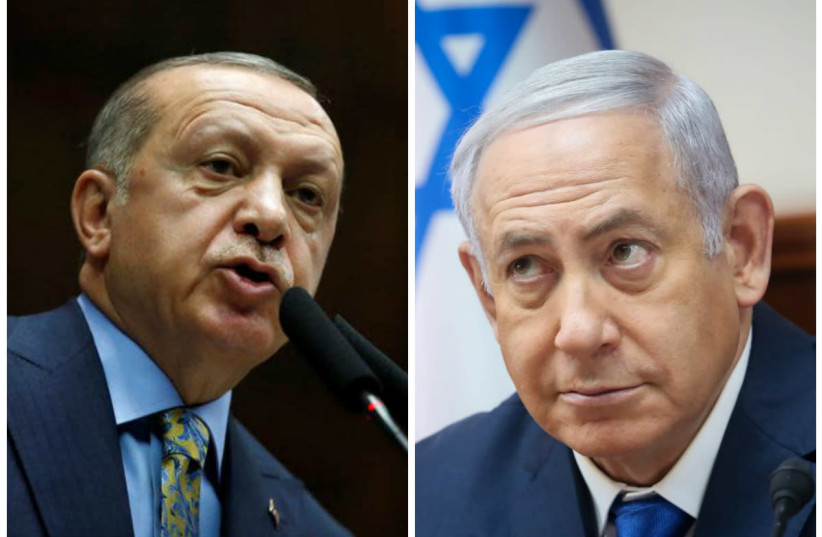
Yanarocak said that “the geographical contiguity between Turkey and Syria” makes it harder for Israel to avoid a direct clash with Turkey.
“So long as Turkish forces remain in their current positions in the north and do not seek to gradually penetrate southward…Israel can feel secure,” he assured.
Turkish influence extends beyond military presence in Syria
Jonathan Hessen, a senior fellow at the Jerusalem Institute for Strategy and Security, said Turkish influence was far more deeply embedded in Syria and that the threat from Syria, even if it is a “country in creation,” was not limited to Ankara’s presence alone.
Israel has faced numerous attacks from Islamist forces in Syria under the Assad regime, while many members of the new Syrian Transitional Government (STG) have yet to sever their ties with groups that have also expressed hostility toward the Jewish state.
“If we focus on the emergence of the new government in Damascus, which was essentially installed with Turkish backing in December [2024], we also need to take into account the developments that have taken place from a geostrategic perspective, including efforts by Turkish forces, or Turkey specifically, to establish a military presence beyond the security belt it had established over the course of the past several years to defend itself against potential threats emanating from Syria during the Assad regime,” he advised.
Claiming that Damascus’s Defense Ministry is controlled “in many respects” by Turkey, Hessen noted that it was strange for such a newly established regime to be “armed to the teeth” and to have built up its military so rapidly, particularly given the economic challenges in Syria that might have demanded another government’s attention at the expense of the military.
“It is investing heavily in its military buildup, despite the fact that many people within its military are clearly still maintaining their jihadist pasts in both vocal form as well as indicating their unruliness in areas of friction with minorities and other aspects,” he said.
The National reported in June 2025 that Syria had recruited around 100,000 personnel into its new army, half of its planned 200,000-strong force, including 30,000 members of the Turkish-backed Syrian National Army.
The new military also incorporated foreign fighters, including a 3,500-member brigade composed mostly of Uighurs, many of whom belong to the Al-Qaeda-linked Turkistan Islamic Party. The fighters were reportedly promised Syrian citizenship in exchange for their service.
Israel signals limits on Turkish military expansion
Hessen said that Israel’s use of military force must be understood in the context that it is being utilized in a region marred by years of violence and where there are evident threats in addition to “concrete intelligence of malign intentions towards Israel.”
“We’re also talking about Turkey’s proactive and deliberate effort to establish a military presence in Syria, with a number of bases already established in northern Syria and efforts to expand that presence, particularly its aerial presence, into areas such as the T4 airbase,” he continued. “Turkey attempted to rehabilitate the base to its own advantage, which Israel, in a decisive signal as part of its messaging, essentially struck on March 21-22, 2025.”
Though Israel had previously targeted the base to prevent Iranian and Assad-era forces from using it to transfer equipment to Hezbollah, Israel’s March strike specifically targeted T4’s runways after Turkey sought to convert the base into a Turkish drone base following the fall of Bashar Assad, as previously reported by The Post.
Despite the strikes, and condemnation from Syrian and Turkish leadership, Hessen maintained that there was likely some degree of diplomacy behind-the-scenes and reporting on the attack “might be framed differently than what actually is happening on the ground.”
US seeks to prevent Israel-Turkey escalation
US Ambassador to Turkey and the Trump administration’s special envoy to Syria Tom Barrack told The Post’s Amichai Stein that the Israeli attack was “serious” and could have resulted in a military escalation. However, Hessen said he “wouldn’t necessarily say” that Washington was seriously at odds with Jerusalem over the incident.
Hessen argued that the United States understood Israel’s “new realm of more assertive doctrine,” but that there were also competing interests within Washington, with some officials more concerned about the fiscal benefits of a stable Syria than Israel’s security interests.
“Ambassador Tom Barrack, who is essentially the point man for Syria, has, I think, projected a lot more pro-Turkish sentiment through his role as ambassador to Turkey, at the expense of Israel in Syria, in a manner that does not necessarily align with the national security interests of the State of Israel or the United States,” he accused. “Washington has been very coherent and very clear about the necessity for Damascus to prove itself on the ground and the need to de-escalate the situation. The reality on the ground is very different from what many people try to project or sell, so to speak, to the international community. There are clear interests in Europe in seeing stability in Syria consolidate into an environment that would once again give European nations the opportunity to repatriate all those Syrians who entered continental Europe illegally.”
KioskNews shows a cleaned-up reading view extracted from the publisher’s page — the original always lives on their site, not ours.