Sangita Srivastava gets second term as Allahabad University VC; experts divided
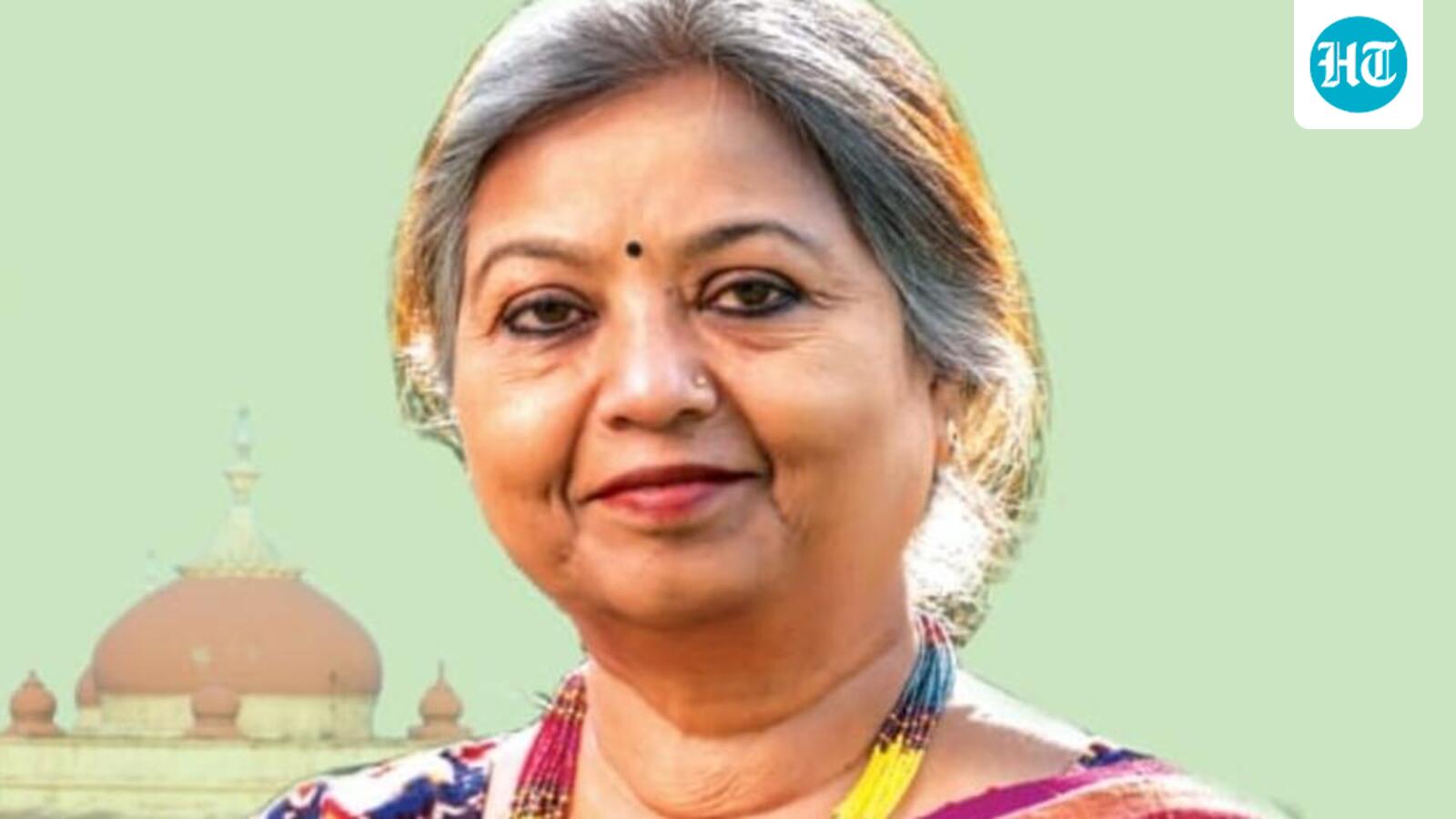
Allahabad University vice-chancellor (VC) Prof Sangita Srivastava has been reappointed for a second full five-year term, making her the first woman vice-chancellor of a central university to receive such a reappointment. President Droupadi Murmu, the university’s Visitor, issued the order on September 22, with the fresh term taking effect from September 16, 2026.
Her extended first tenure from November 2020 till reappointment was marked by student protests over a steep fee hike, a controversy over her complaint about the loudspeaker use for azaan at a nearby mosque, criticism over restrictions on staff speaking to the media, and questions raised in Parliament about her eligibility for the VC’s post.
Academics and experts are divided over the reappointment, with some arguing that “continuity can benefit” a university when an incumbent has performed well and prevent administrative gaps, while others have questioned the desirability of keeping the same academic leader for ten years, given the wider pool of experienced academics available for such positions.
Srivastava, 62, was appointed AU’s vice-chancellor in November 2020 and assumed office on November 30 in that year, becoming the university’s first woman VC. Her five-year term was due to end on November 29, 2025, but the education ministry extended it “until further orders” on November 19– 10 days before the term ended, pending appointment of her successor. The university had advertised the post on September 1, 2025.
Importantly, Srivastava herself had applied for the post after it was advertised. On October 13, 2025, HT reported that three senior faculty members had applied for the position — the then incumbent Srivastava, Dean of Arts Prof VK Rai and Dean of Commerce Prof RS Singh.
Also Read: Prof Sangita Srivastava reappointed as Allahabad University VC for second term
She has now been given a fresh five-year term, or until she turns 70, whichever is earlier. She is also the second permanent VC of Allahabad University to complete a full term since the institution became a central university in 2005. The first was Prof Rajen Harshe. She was the first VC of AU to get service extension since Allahabad University became a Central University in 2005.
Prof. Sangita Srivastava reappointment as the Vice-Chancellor of the University of Allahabad, marks first for the university to have a re-appointment. It was made possible due to an amendment in university’s rules in 2012.
With the reappointment, Srivastava is the second vice-chancellor to receive a full second five-year term within three months, after Delhi University VC Prof Yogesh Singh, who was reappointed for a full five-year term in July.
Reacting to her reappointment, Srivastava said, “I will continue my efforts to make the university a centre of excellence in all fields of education. The NAAC A+ grade is only a beginning, and we must keep striving to help students realise their potential and achieve academic and professional excellence.”
The university said that during her first term it secured an A+ NAAC grade, appointed around 400 teachers and 636 non-teaching staff, and promoted more than 280 faculty members under the Career Advancement Scheme.
It also introduced four-year undergraduate programmes under the National Education Policy (NEP 2020), with certificate, diploma, double-major and honours-with-research options, besides skill-based courses.
Queries sent to the education ministry seeking details of the search-cum-selection panel and reasons for Srivastava’s reappointment did not elicit a response. The copy will be updated whenever it is received.
A section of academics also alleged that her reappointment was influenced by her political leanings.
The university, when asked for its response, said, “The subjects of the queries you have raised do not fall under the purview of the university hence we will not be able to provide you any relevant information regarding the same.”
Controversies in first tenure
One of the earliest controversies of Srivastava’s tenure came in March 2021, when she wrote to Prayagraj officials complaining that the early-morning azaan from a nearby mosque was disturbing her sleep. She cited an Allahabad High Court ruling concerning the use of loudspeakers. The mosque subsequently reduced the volume and changed the direction of a loudspeaker.
The university later faced a major confrontation over a fee hike. After the UGC reduced its recurring non-salary grant by 40%, Srivastava said in September 2021 that the university would need to generate its own resources and revise its fee structure.
The Executive Council of the varsity approved a fee increase on August 31, 2022, triggering months of student protests including torchlight marches and hunger strikes. The administration did not roll back the fee hike.
Between September and October 2022 Srivastava and the Executive Council maintained that the additional revenue was necessary for infrastructure, teacher recruitment and implementation of the National Education Policy. The university instead offered relief to students from extremely impoverished backgrounds and those orphaned during the Covid-19 pandemic.
The fee protests subsequently expanded to allegations concerning Srivastava’s appointment. In November 2022, students alleged irregularities in her appointment and blocked her car when she left her office.
In November 2022, defamatory posters also appeared on the university campus carrying photographs, names and phone numbers of Srivastava and other officials involved in recruitment. The posters alleged that money could be paid through QR codes to obtain jobs. The university termed the posters an attempt to malign the reputation of officials; the allegations in the posters were not established as findings of corruption.
On December 20, 2022, then Congress MP Rajmani Patel raised the issue of the “Appointment of Vice-Chancellor of Allahabad University” in Parliament. Referring to the eligibility requirement, Patel said Srivastava “does not have 10 years of experience”.
“Professor Sangeeta Srivastava is the wife of High Court Justice Vikram Nath. For this reason, she was not removed despite being ineligible. The students of Allahabad University are continuously agitating for this and for the restoration of the student union. She should be immediately removed from the post of Vice-Chancellor and the cases against the students should be withdrawn and the student union should be restored,” he added.
Justice Vikram Nath is currently a Supreme Court judge and is in line to become the next Chief Justice of India (CJI) in February 2027. He is due to retire in September 2027.
In March 2023, the university constructed a nine-foot wall to block an entrance to the Science Faculty, citing security concerns and repeated unauthorised use of the gate. Student leaders opposed the move and protested. Srivastava reached the site while the wall was being constructed. The wall was later demolished by student protesters while police were present.
In October 2024, the Executive Council, chaired by Srivastava, approved an advisory restricting teachers and non-teaching employees from providing inputs to the media without VC approval and from writing about the university on social media without approval. The meeting also dealt with disciplinary proceedings against faculty members and approved a policy under which staff facing certain charges could be denied gratuity upon retirement.
The administration also initiated disciplinary proceedings against Economics assistant professor Deepshikha Sonkar. In October 2024, the Executive Council issued her a notice over alleged attempts to tarnish the reputation of senior professors through complaints and lawsuits. In March 2025, the Executive Council decided to terminate her services, with the university alleging deliberate insubordination and prolonged absence after maternity leave.
Experts differ on reappointment
Prof Furqan Qamar, VC of Integral University, Lucknow, and a former VC of Central University of Himachal Pradesh (CUHP), said reappointment is legally permissible where the university statutes allow it and the incumbent goes through the prescribed selection process.
“If the VC has been performing and you want to appoint through the search process, let that be done. The incumbent can participate as one of the equals and, if selected, be reappointed,” he said.
He also stressed the administrative value of continuity, particularly when the alternative is a prolonged vacancy.
“There should be no gap between two vice-chancellors. Continuity is better than a situation where it takes a long time to appoint a VC and the university remains headless,” he said.
The Association of Indian Universities (AIU) secretary general Pankaj Mittal said the government’s assessment of an incumbent could change during the selection process.
“A change of mind is possible. Initially, they may have thought there was a need for a fresh appointment, but later they may have felt that the existing VCs were doing a good job and could be continued,” she said.
She said both continuity and fresh leadership could have advantages.
“There can be two perspectives. Continuity is one benefit, because in five years you accomplish a lot. But a fresh person can also bring a new way of looking at things. Both have their uses,” he said.
Navneet Sharma, faculty member in the education department at CUHP, questioned whether repeated appointments were necessary given the size of the academic talent pool.
“Do we really have such a shortage of academic leaders that we have to give the same person two terms in a Central University? There are a number of professors with extensive experience. It is not as if there is a shortage of people. The academic talent pool is large,” Sharma said. He also argued that the selection of vice-chancellors should be “insulated from political considerations.”
Former UGC chairman Sukhdeo Thorat drew a distinction between whether reappointment is legally permissible and whether a 10-year tenure is desirable.
“Legally, they are right. If there is a provision for reappointment in the statutes, it is as per the rules.
However morally and ethically it should not be done,” Thorat said. However, he added: “Ten years is too long. The person can begin to develop self-interest.”
The education ministry did not respond to queries on the composition of the search-cum-selection panel or the reasons for Srivastava’s reappointment.
KioskNews shows a cleaned-up reading view extracted from the publisher’s page — the original always lives on their site, not ours.