First Northern Metropolis Marathon trips up as runners hit out at poor arrangements
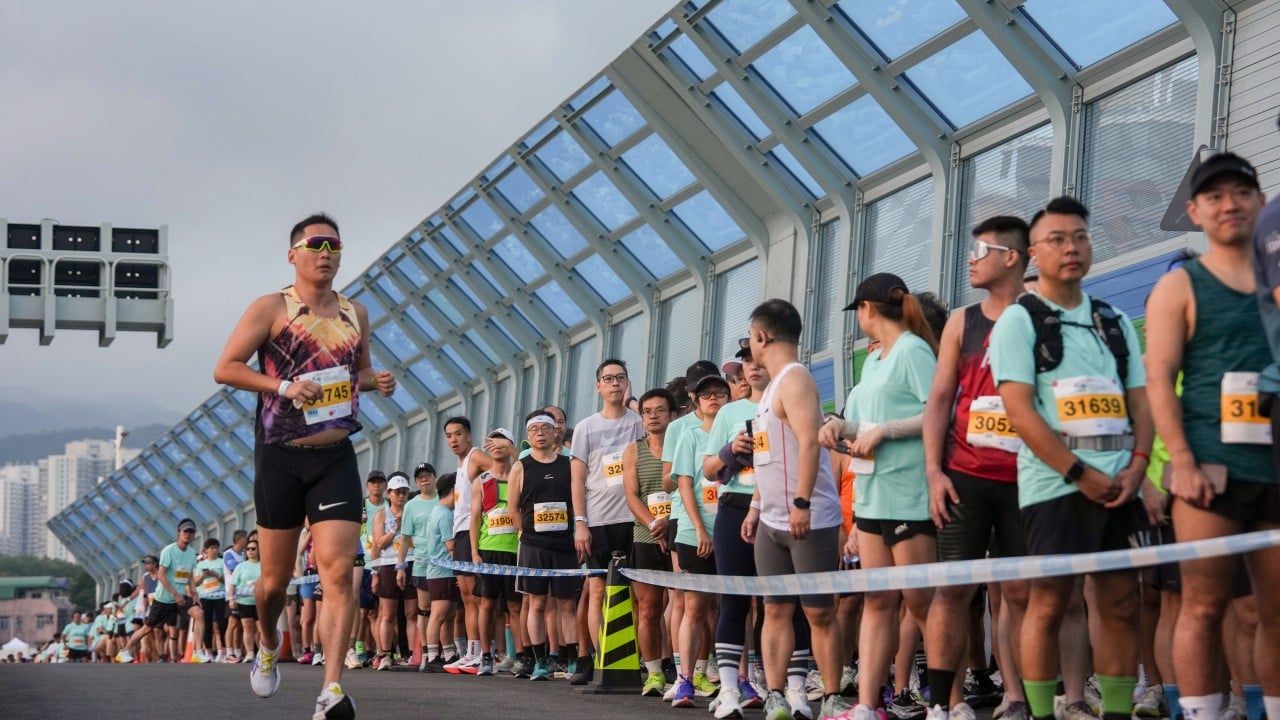
Water shortages, gruelling course conditions and a lengthy post-race walk marred Hong Kong’s inaugural Northern Metropolis Marathon on Sunday, participants have said, prompting calls for organisers to overhaul arrangements if the event is to return.
As the city seeks to establish itself as a premier hub for mega-events, experts warned the problems went beyond teething issues. They urged organisers to ensure they had the professional expertise required to host similar events in future.
Organised by the New Territories’ Heung Yee Kuk to mark the rural body’s centenary, the inaugural event drew about 15,000 registered runners across four race categories. The organisers had pitched the marathon as a showcase for the region’s development.
But runners pointed to hilly and uneven roads, shortages at water stations, unseasonal heat that raised questions over the event’s timing, and an exhausting post-race walk to retrieve baggage.
“After the water station behind the petrol station in Tong Hang, it was a long way to the next one,” a runner said.
“Along the 8km [5 mile] stretch of the Fanling Bypass in both directions, there was no water supply,” another added.
“After finishing the full marathon, we still had to walk another 2km to reach the baggage collection area, and then another 15 minutes to get to the MTR station,” another runner said.
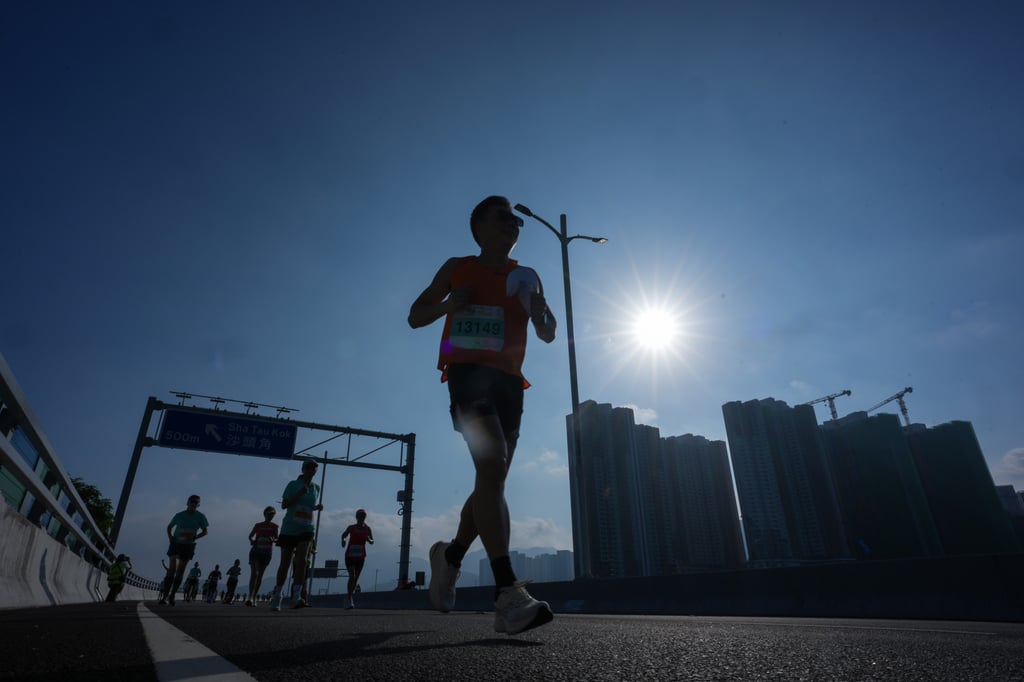
There were also complaints about the route itself. “The course required crossing more than one bridge with stairs,” one runner said. Another described a stretch of more than 8km through the Lung Shan Tunnel as “stuffy and windless”.
One runner shared a video of police stopping more than a dozen others at a crossing near Tin Ping Estate in Sheung Shui. The runners were ordered to stand by the roadside and give way to vehicles for about 40 seconds before police let them continue.
Lai Ho-ki, a long-distance runner and running coach who took part in the half-marathon, suggested that “the race could be held about two weeks later, when the weather would be cooler”.
“The weather was hot, but our half-marathon group started at around 6am and finished before 8am, so it was not too hot yet,” Lai said. “But full-marathon runners, who started at 6.30am, would face hotter conditions if they took more than three hours to finish.”
Veteran runner Chan Ka-ho, who finished fourth in the full marathon, said the race was “a bit harder” compared with major marathons in Hong Kong.
Chan added that the final stretch was especially challenging. “For the last 10-plus kilometres, we weren’t running on the road, but on pedestrian footpaths. Some tree roots protruded from the footpaths, causing runners’ footwork to twist and turn a bit.”
He also said the more than 10-minute walk to collect his bags after the race was exhausting, suggesting “it would be better if it were closer”.
Chung Ho-yin, a specialist in emergency medicine, said heat-related illness was the biggest health threat to marathon runners, even though the race was held in early November.
“November is already autumn or early winter, but with temperatures rising in recent years, heat remains a major health risk for runners even in cooler seasons,” Chung said.
“By the heatstroke stage, core body temperature can exceed 40 to 41 degrees Celsius [104-105.8 Fahrenheit], and patients may no longer be able to make the right judgments or stop on their own.
“Dehydration makes runners tire more quickly and increases the risk of heatstroke.”
Chung noted that runners were already exhausted and dehydrated after a marathon and should not be made to expend further energy.
“In an ideal marathon design, the start and finish areas should have enough space for crowd management, allowing runners to rest after the race and retrieve their belongings more conveniently,” he said.
“If there is limited space near the finish line, there should at least be shuttle transport so runners can take a vehicle to collect their bags, rather than walking for 10 to 20 minutes.”
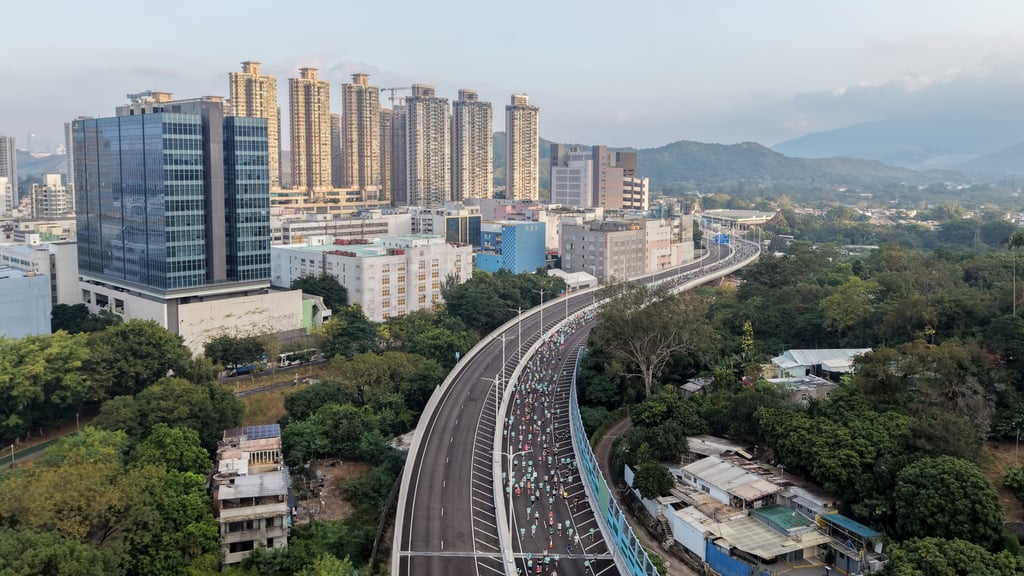
Lobo Louie Hung-tak, senior lecturer of health and physical education at the Education University of Hong Kong, said the organiser could be a problem.
“First of all, Heung Yee Kuk is not a professional sports event organiser, and the race appeared to be positioned more as a running carnival to promote the Northern Metropolis than as a professional competitive marathon.”
Louie compared it with the Standard Chartered Hong Kong Marathon organised by the Hong Kong, China Association of Athletics Affiliates, the governing body for athletics in the city.
He said that roads in the New Territories were winding and narrow in places, creating greater challenges for safety support, whereas the Standard Chartered Hong Kong Marathon was held on main roads.
“Such a course was more suitable for experiential or participation-focused events of less than 10km, not competitive races.”
On reports that police even asked some runners to stop at a traffic light to let vehicles pass, Louie said this was highly unusual in a marathon.
“From the perspective of sportsmanship and fairness, it is not reasonable for runners to be stopped at traffic lights,” he said. “It reflects problems with the organiser’s road management.”
He urged organisers to clarify at registration whether an event was competitive or carnival-style and focused on participation and experience, as the preparation, expectations and management required were completely different.
“Safety comes first, and race management must be thorough,” Louie said. “That is the most important lesson to learn.”
KioskNews shows a cleaned-up reading view extracted from the publisher’s page — the original always lives on their site, not ours.