Asian Games open with glitzy ceremony
REPUTATION UNDER SCRUTINY: The opening ceremony followed a troubled buildup as some delegations complained about accommodation and registration arrangements
The 20th Asian Games on Saturday opened in Nagoya with a glittering ceremony of dance and fireworks following a buildup marred by operational gaffes and logistical problems.
Five years after the Tokyo Olympics played out at empty venues due to COVID-19 restrictions, Japan welcomed fans to the Mizuho Park Athletic Stadium for a curtain-raiser that was initially subdued before bursting into a festival of color and sound.
Japanese Emperor Naruhito declared the Games open after watching the parade of 45 nations and regions at a dignitaries’ table along with International Olympic Committee president Kirsty Coventry.
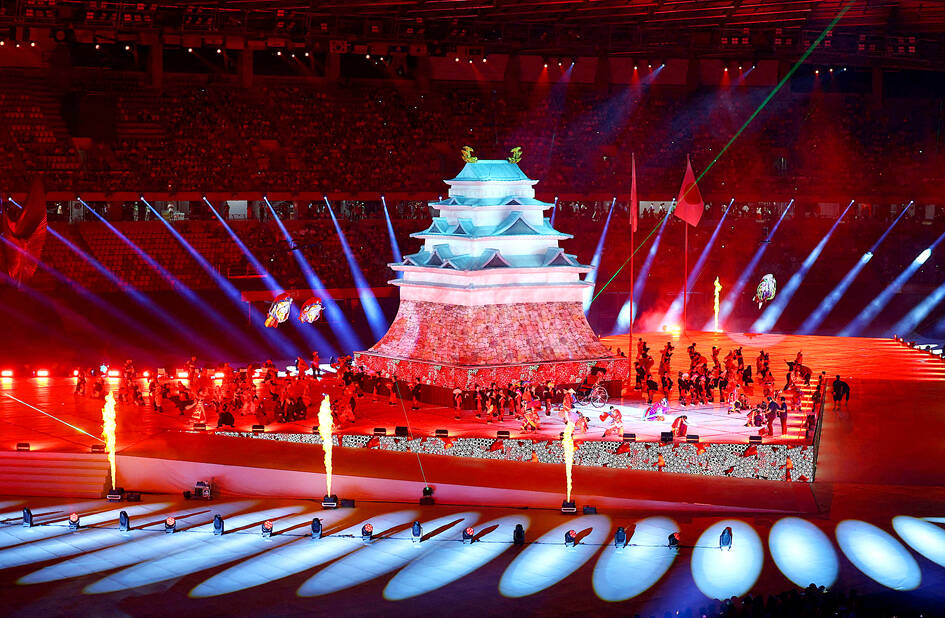
Dancers perform during the opening ceremony of the Asian Games in Nagoya, Japan, on Saturday.
Photo: Reuters
Naruhito’s visit with royal family members was accompanied by a heavy security operation. Organizers had said up to 10,000 police were deployed for the ceremony.
“While the world is too often divided by conflict, they [the Asiad athletes] remind us that sport remains a powerful force for peace, understanding and friendship among nations,” Olympic Council of Asia President Sheikh Joaan bin Hamad al-Thani said in a speech.
Japan’s father-and-son duo of Shigenobu and Koji Murofushi, former Asian Games champions in hammer throw, jointly lit the cauldron after climbing a set of stairs at the end of the torch relay.
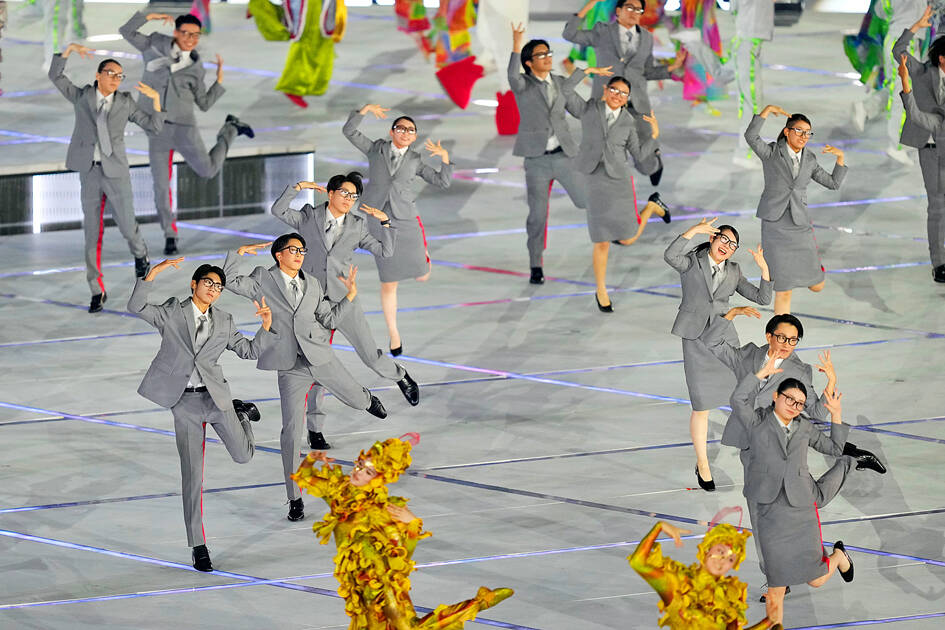
Dancers perform during the opening ceremony for the Asian Games in Nagoya, Japan, on Saturday.
Photo: AP
Organizers would hope the ceremony can draw a line under a rocky buildup laden with complaints from athletes and officials involving accommodation and transport.
Japan’s reputation for precision and efficiency has been under scrutiny as the nation welcomes more than 11,000 athletes competing for 369 gold medals in a whopping 43-sport program.
Instead of building a dedicated Games village, organizers have housed the athletes and officials in a mix of hotel rooms, temporary wooden containers and a cruise ship docked in the bay as a cost-cutting measure.
Several national team delegations, including hosts Japan, have found the arrangements below par, complaining of mix-ups and double-bookings, while South Korea said the containers at Garden Pier were too cramped for their basketballers.
India’s powerful cricket board took matters into their own hands, arranging for the men’s star-studded cricket team to stay in a separate hotel due to a tight allocation of beds from organizers.
Delegations have also lamented long waits for the athletes registering on arrival and have found buses turning up late or sending their athletes to the wrong venues.
The Olympic Council of Asia, which runs the quadrennial Games, on Saturday acknowledged the problems, but played them down as teething difficulties.
Directed by Yukihiko Tsutsumi, the opening ceremony made a low-key start, with classical music and dance on a heart-shaped stage before the parade of nations which featured a delegation from reclusive North Korea.
The spectacle ramped up later though, with dancers in boiler suits marking Nagoya’s manufacturing tradition and a fireworks display closing the night.
The ceremony’s theme was “Harmonic Heart Beat” -- intended to communicate Asian solidarity at an event often riven by geopolitical tension and historic grudges.
However, hopes for a peaceful Games have already been undermined by several incidents.
Taiwan’s delegation temporarily refused to participate in their welcoming ceremony on Friday after Minister of Sports and former Olympic champion Lee Yang was blocked from attending it.
The South Korean men’s hockey team were upset when North Korea’s national anthem was played at the stadium before a match instead of their own.
KioskNews shows a cleaned-up reading view extracted from the publisher’s page — the original always lives on their site, not ours.