Why three-peat Hawks and another super side have Fagan’s Heroes covered
Updated ,first published
It is a strange quirk of the 21st century AFL that three teams have achieved what the equalised system is supposed to prevent and taken three premierships consecutively.
When the Brisbane Lions team coached by Leigh Matthews won the 2003 grand final, demolishing a much less talented Collingwood team, they were the first club since the 1950s Melbourne side – who trotted around before colour television in a quasi-amateur sport in a Victorian-only competition – to complete what became known as the three-peat.
Geelong of 2007-2011 had the capacity to equal that record, but stumbled in 2008 (on grand final day) and 2010 (game style overtaken/hunger, didn’t make the grand final). Hawthorn, a beneficiary of the AFL’s expansion, would be the next three-peater under the command of Alastair Clarkson, their super team claiming the 2013, 2014 and 2015 flags against a treble of non-Victorian opponents.
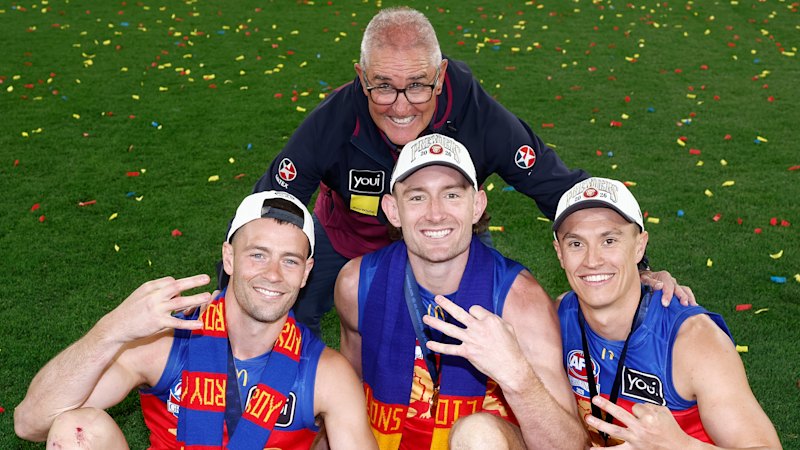
Now Chris Fagan’s Lions have matched the Lethal Lions and Clarkson’s Commandos by snatching the flag from Fremantle in the most extraordinary manner. Fagan’s Heroes almost defied the formula of their club’s first premiership coach, Matthews, who had calculated that a lead was only safe when the number of goals needed exceeded the number of minutes left on the clock.
One curious parallel of the three three-peat teams since 2000 is that each of them played in four grand finals on the trot. The Lions fell to Port Adelaide in 2004 when they were banged up and had to “host” a preliminary final against Geelong, on a Saturday night, at the MCG.
The Hawks lost in 2012, when they were at the beginning of their run; they were solid favourites to beat the committed Swans in that fabled grand final and, as with Geelong in 2008 and Freo this year, the failure to convert from many more entries was behind the defeat. Lance Franklin booted 3.5 and one out of bounds on an unusually gusty afternoon.
The Fagan team will have the opportunity to win a fourth in a row, as the Matthews team attempted, even if they chase that record (Collingwood’s machine of 1927-30) with a different senior coach next year, as Fagan ponders retirement.
They are a freakish team on a number of levels, not least in their Houdini-like qualities to wipe off leads and get over the line, as they did against the shattered Hawks in the prelim, and going back further, against the Giants in the 2024 semi-final.
But how do Fagan’s Heroes compare to the 2001-03 Lions and the Hawthorn 2013-15 side in which Fagan was an important cog as Clarkson’s lieutenant (head of football and director of coaching)?
The quick answer is that this triple flag team isn’t on the same level as either of those dynasties, based on personnel, records during the season and the margin between them and their rivals.
I would rank them as follows:
1. The Lethal Lions (2001-03)
Had three Brownlow medallists in the centre square (Michael Voss, Simon Black and Jason Akermanis) plus Nigel Lappin. They were kicking to Jonathan Brown and Alastair Lynch, and Daniel Bradshaw in 2001 and 2003, with Justin Leppitsch and Mal Michael holding down the key defensive posts. Chris Johnson was a super small back, Luke Power a handy extra mid.
And they had a nasty streak, which was both more necessary and permissible in that era – a couple of Scott brothers adding to a potent cocktail of extreme talent and aggression.
Unlike the Clarkson sides, they had an onerous travel load. One could contend that getting on planes every second week (and not from Sydney or Adelaide) compounds the difficulty of finishing first or second.
The case against? They were not minor premiers in any of those flags (2nd, 2nd and 3rd in regular season) and while they conquered a formidable Essendon in 2001 (“if it bleeds, you can kill it” was Matthews’ invocation of Predator), the Mick Malthouse Magpies, heroic in 2002, were several lengths off in pure talent.
2. Clarkson’s Commandos (2013-15)
Not far from the Brisbane team that preceded it. They had Luke Hodge, Sam Mitchell and Shaun Burgoyne (and Jordan Lewis) kicking to Franklin (until 2014), Jarryd Roughead and Jack Gunston. The astonishing Cyril Rioli and Luke Breust were at those key forwards’ feet. A hole in defence was plugged by the mercurial key back Brian Lake.
Clarkson’s team had what was termed an “unsociable” streak, and were superbly coached, with Clarkson supported by Luke Beveridge, Adam Simpson and Fagan in some flag years. Their ball use by foot – Grant Birchall another with a laser left boot – was exceptional, and would be a template for the West Coast team that Simpson coached to the 2018 flag.
These Hawks were not quite as powerful as the Lions in the middle and while Hodge and Mitchell were hard-nosed, they were less physically imposing.
The case for: They were superbly skilled and could score so easily, even after Franklin’s exit, which likely saved the Hawks from jettisoning other players.
3. Fagan’s Heroes
This team is competing in a far more equalised competition, and they do not have the number of A-plus players as either the Matthews sides or the Hawthorn three-peaters.
Their midfield, headlined by Lachie Neale, young superstar Will Ashcroft (whose dad played in the Lethal teams) and classy Hugh McCluggage, was balanced by possibly the AFL’s most under-appreciated gun Josh Dunkley, whose selfless desperation and defensive efforts allow the likes of Ashcroft and Neale to chase the footy and run into space.
This team’s array of small and medium forwards is among the greatest seen in the AFL this century, as Charlie Cameron, Zac Bailey, Kai Lohmann and (less so on Saturday) Cam Rayner have reminded us during the finals. Logan Morris is a wonderful footballer, defined by clever positioning and nerveless finishing.
Harris Andrews is a superior tall back to anyone from either the Lethal team or the Hawthorn three peat side, but they are, collectively, without as many walk-up Hall of Famers.
This incarnation of Brisbane’s success has been in a competition that is far more equalised – there were five genuine flag chances in 2026, and it is another telling fact that they did not win a qualifying final in any of their flag years, much less finish first.
But they must be the most admirable team, in terms of defying the scoreboard (and Wharfie Time). Not the best, they have provided the most entertainment and goose bumps, and with or without Fagan, they still have contention prospects ahead.
KioskNews shows a cleaned-up reading view extracted from the publisher’s page — the original always lives on their site, not ours.