Mostly sunny, stable weather expected for elections
By Shelley Shan / Staff reporter


Mostly sunny and stable weather is expected across Taiwan on election day tomorrow, while scattered showers are possible along the east coast, the Central Weather Administration (CWA) said yesterday.
The northeast monsoon is expected to strengthen tomorrow, bringing cooler and drier air, CWA forecaster Lin Po-tung (林伯東) said.
Temperatures in northern Taiwan and Hualien County early tomorrow are forecast to drop to between 16°C and 17°C, while central and southern Taiwan are expected to have lows of 18°C to 19°C, Lin said, advising people heading out to vote to dress warmly and prepare for significant temperature differences between day and night.
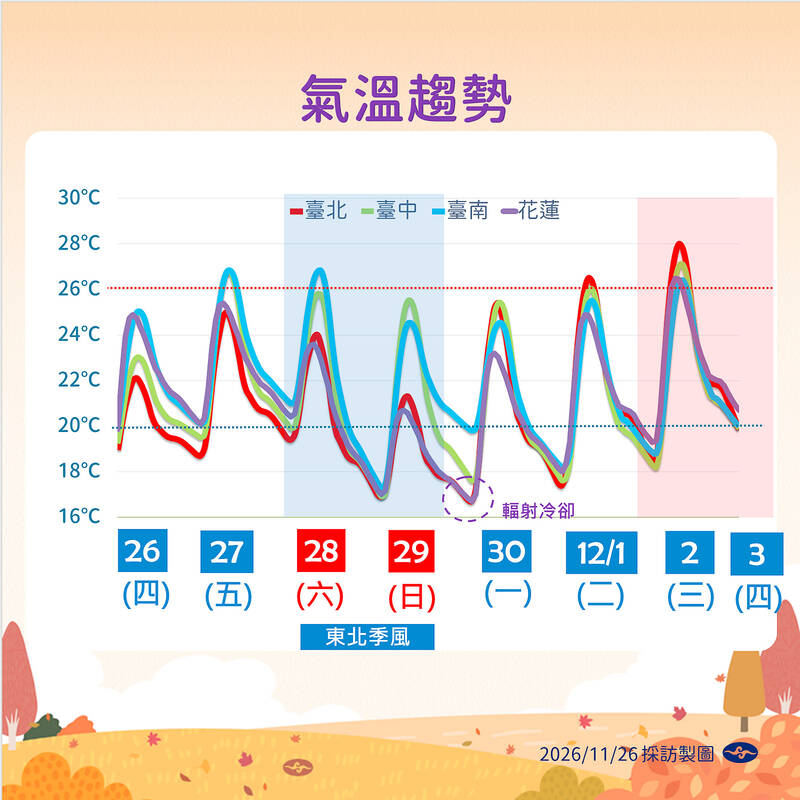
A graphic provided by the Central Weather Administration shows the weather forecast for this week. The red line shows the forecast for Taipei, the green line is for Taichung, the blue line is for Tainan and the purple line is for Hualien County.
Photo provided by the Central Weather Administration
The weather has been affected by a low-pressure system over southern China, which brought intermittent showers across Taiwan from Wednesday evening, with heavier rainfall in mountainous areas, he said.
Rainfall was forecast to start easing last night.
Drier conditions are expected today, with temperatures gradually recovering, Lin said.
The drier northeast monsoon air is expected to arrive tomorrow and persist through Sunday, bringing cooler temperatures, but generally stable weather nationwide. Only occasional scattered showers are forecast in eastern Taiwan, he said.
Sunny and stable weather is expected to continue through Wednesday next week, although radiative cooling could cause temperatures in some inland and open areas to drop early on Monday, resulting in a wider day-night temperature gap, Lin added.
Meanwhile, a strong El Nino is expected to bring a warmer and wetter winter this year, with the possibility of extreme rainfall, the CWA said yesterday.
The Oceanic Nino Index classifies an El Nino event as very strong when the sea-surface temperature anomaly reaches or exceeds 2°C.
CWA Weather Forecast Center Director Huang Treng-shi (黃椿喜) said that temperatures in the central and eastern Pacific are warmer than normal.
The sea-surface temperature anomaly in the El Nino 3.4 region of the Pacific Ocean has exceeded 3°C, indicating an exceptionally strong El Nino event, he said.
Nine typhoons formed in the northwestern Pacific this fall, slightly fewer than the climatological average of 10.8, Huang said.
Four of the five typhoons that formed last month reached super typhoon intensity, the highest number for October in 30 years, he said.
Rainfall this fall accounted for only 60 percent of the climatological average, with significantly less rain recorded in northeastern Taiwan, he said.
The number of rainy days also hit a record low for the fall since 1951, he said.
As the El Nino phenomenon is expected to peak this winter and persist until next spring, the northeast monsoon is forecast to weaken, increasing the likelihood of a warmer-than-average winter, Huang said.
Rainfall in the west of Taiwan is also expected to increase this winter, he said.
The stratosphere warmed unusually early this year, which could intensify weather variability during an otherwise warmer-than-average El Nino winter, he said.
“People should beware of extreme temperature changes and rainfall caused by a very strong El Nino,” he said.
Residents of western Taiwan should prepare for increased rainfall next spring, he added.
Fluctuations between warm and cold weather could become more pronounced due to moisture-laden air from the south, he said, adding that the number of foggy days in the nation’s west and on outlying islands is expected to increase, potentially disrupting traffic.
Temperatures next summer are expected to be higher than the climatological average, he said.
El Nino has contributed to unusual weather patterns worldwide, he said.
Countries in the north Atlantic did not experience their first hurricane this year until last month, setting a record for the latest formation of a season’s first hurricane, he said.
Droughts and wildfires have been reported in Southeast Asian countries, while storm surges and heavy rainfall could affect parts of the Americas, Huang said.
KioskNews shows a cleaned-up reading view extracted from the publisher’s page — the original always lives on their site, not ours.