When will humans actually fly on Starship?
All of this is to say, we cannot learn much from history other than to deeply discount any public launch dates on Starship for humans.
Artemis missions
Most likely, the first humans to fly on Starship in space will do so after launching from Earth inside the NASA Orion spacecraft. Once in orbit they will then dock with Starship before transiting to the Moon, landing there in Starship, launching from the Moon back to Orion, and then returning to Earth inside NASA’s spacecraft.
NASA signed an agreement with SpaceX to develop Starship as this “Human Landing System” in 2021, with a lunar landing targeted for 2024. To no one’s surprise, this target has moved to 2028, and there remains considerable uncertainty about the viability of this date.
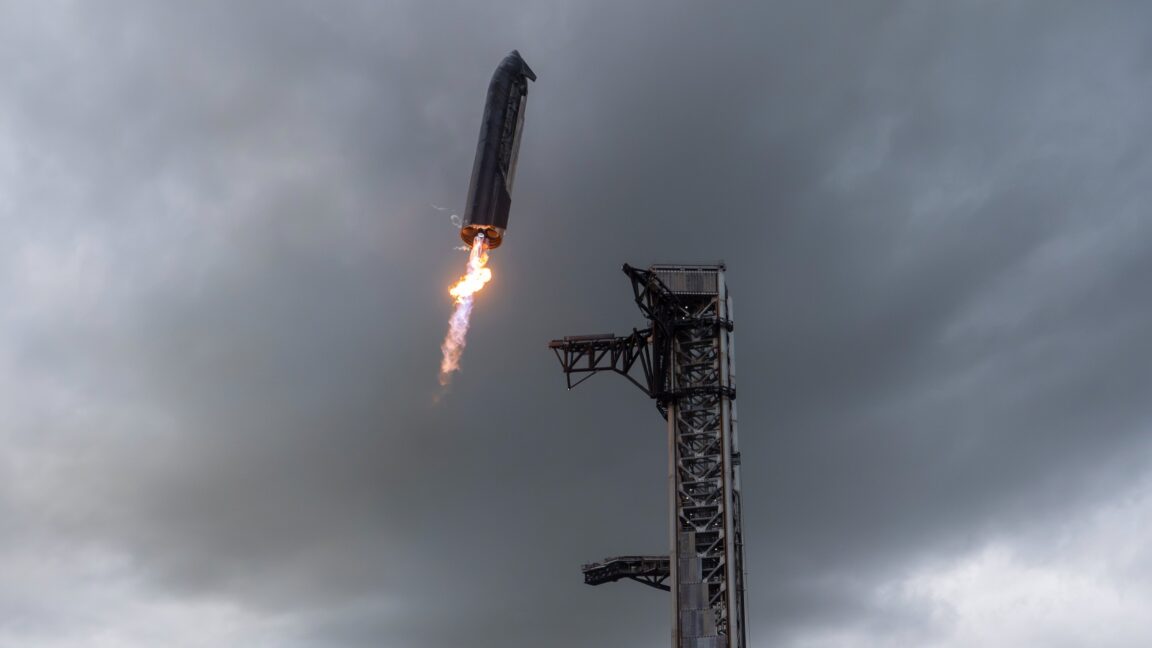
Nevertheless, the success of Saturday’s tower catch should help propel the Starship program toward a higher launch cadence, which is essential for lunar missions. It therefore seems plausible, but not certain, that humans could land on the Moon inside Starship before the end of this decade.
Again, how soon SpaceX achieves this target will depend upon its prioritization of a Human Landing System, among its other major goals to accomplish with Starship. At this point, SpaceX appears to be more focused on revenue-generating activities such as launching Starlink, and eventually, Starmind data center satellites.
Human landings on Earth
Much has been made about the fact that Starship does not have a launch abort system—a feature of most human spacecraft that allows a crew vehicle to be rapidly pulled away from an exploding rocket.
This may not matter should SpaceX conduct its own human spaceflight missions. Unlike NASA, which imposes detailed human-rating requirements on vehicles carrying its astronauts, the Federal Aviation Administration does not certify commercial spacecraft as safe for passengers, instead operating under a regulatory framework that emphasizes informed consent and protection of the uninvolved public. Should SpaceX reach the point where it can launch Starship reliably, it will have the confidence it needs to press forward with human flights. Conceivably, this could happen within a few years.
KioskNews shows a cleaned-up reading view extracted from the publisher’s page — the original always lives on their site, not ours.