Local aid groups in Myanmar step up to help vulnerable communities amid worsening humanitarian crisis

With some 16.2 million people in Myanmar needing humanitarian aid in 2026, local organisations are helping bridge gaps by providing essential supplies and skills training.
New: You can now listen to articles.

This audio is generated by an AI tool.

29 Oct 2026 04:19PM
YANGON: At a sewing workshop on the outskirts of Yangon, Myanmar's largest city, vulnerable youths and people with disabilities are learning to make reusable sanitary pads.
The programme equips them with skills to earn a living while helping women and girls who struggle to access such products.
It is one of several projects run by Step-In Step-Up (SISU), a non-profit organisation that has provided vocational training and employment support in Myanmar since 2016.
“I have three daughters of my own, and I can’t imagine what their lives would have turned out to be if they didn’t have access to sanitary pads,” SISU founder Jackie Appel told CNA.
Appel, originally from South Africa, moved to Myanmar with her family after living in Singapore, where she had become a citizen.
She started by teaching basic English, housekeeping and life skills to 10 women from disadvantaged communities in her home. The number of trainees grew as participants found employment.
According to her, SISU now trains up to 250 women and men at a time, bringing together people of different backgrounds and abilities.

Among the beneficiaries is 23-year-old Khit Myat Noe, who is deaf and has found it difficult to secure employment.
"Because of the situation in our country, life is extremely hard, especially for disabled people," she said through an interpreter.
"There are many difficulties and barriers. Even if we want to learn, there is the obstacle of a lack of sign-language translators."
She added that the lack of job opportunities for Myanmar’s deaf community has made it difficult for them to earn an income.
Through the SISU initiative, Khit Myat Noe now uses her sewing skills to make a living while helping other women in need.
LOCAL GROUPS HELP FILL GAPS
SISU also partners with humanitarian organisations including Medecins Sans Frontieres (MSF), also known as Doctors Without Borders.
The international medical aid organisation has ordered about 200 reusable sanitary pads to help communities. Each pad can be reused for up to 10 months.
Xie Pei Xuan, a humanitarian affairs analyst at MSF, said access to menstrual products and water is especially important for women and girls in crisis situations.
"Not having access to sexual and reproductive health products and water can also heighten the risk of women and girls being confronted with gender-based violence," she said.
She cited the example of women having to travel long distances to access water after a natural disaster, potentially exposing them to assault, harassment or sexual abuse.

Since the 2021 military takeover, aid organisations have faced growing challenges reaching affected communities in Myanmar.
In its humanitarian response plan released in December 2025, the United Nations estimated that 16.2 million people in Myanmar – nearly one-third of the population – would need humanitarian aid this year.
Local networks like SISU are helping to fill some of the gaps.
Moe Thuzar, senior fellow and coordinator of the Myanmar Studies Programme at the ISEAS-Yusof Ishak Institute, said such informal networks play a key role in facilitating aid deliveries, including across borders.
"We do see some kind of coordination at the local level for assistance to reach the communities who need it the most," she said.
BUILDING SKILLS FOR THE FUTURE
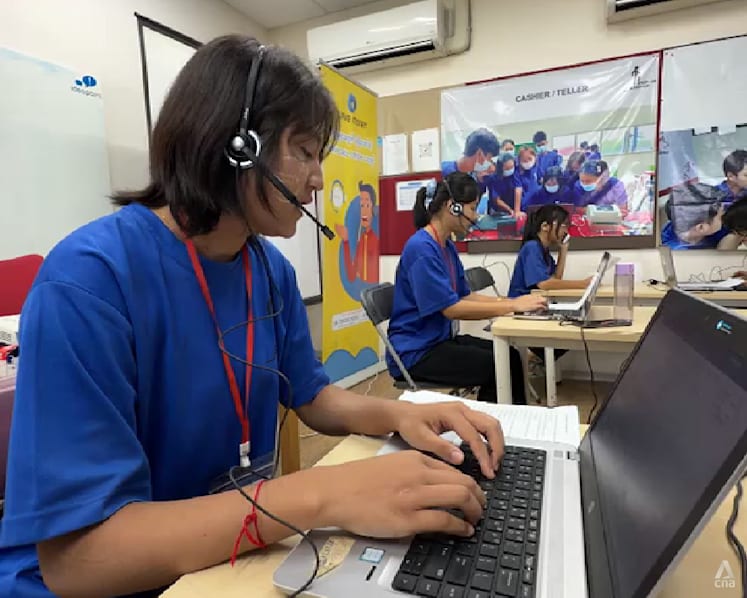
Beyond producing sanitary pads, SISU also runs vocational training programmes in areas such as hospitality, healthcare and food preparation.
Its founder Appel said the mass departure of young people from Myanmar has made it important to equip those who remain with practical skills.
According to a July report by the UN Development Programme, at least 1 million young people may have left Myanmar since 2021.
"There’s a brain drain, and we want to create a brain gain," Appel said.
"Those who don’t have higher education and who can’t go on to university, we have to equip them with skills."
She added that training should be matched to suitable work.
“There are jobs available, but we need to find out what those jobs are and train for those skills so we can help the next generation. Otherwise, they’re going to have no hope,” she said.
FUNDING SHORTFALLS AND ACCESS CHALLENGES
Aid organisations in Myanmar are also grappling with funding cuts that could affect the people they serve.
According to the UN, shrinking funding, insecurity and restrictions on access have hampered efforts to deliver assistance.
In July, the global body said only 43 per cent of the US$890 million needed for Myanmar's 2026 humanitarian response had been received.
Efforts to improve humanitarian access in the country are also on the agenda of the Association of Southeast Asian Nations (ASEAN).
The bloc's special envoy for Myanmar, Maria Theresa Lazaro, arrived in the country on Wednesday (Oct 28) for a two-day humanitarian mission, conducted with the ASEAN Coordinating Centre for Humanitarian Assistance on Disaster Management (AHA Centre), which coordinates disaster relief efforts across Southeast Asia.
The mission kicks off a month-long distribution of rice and essential supplies in Kayin and Shan states, which is expected to reach more than 11,000 households. It also marks the centre's first delivery of humanitarian assistance in northern Shan State.
ASEAN's Five-Point Consensus
Following a 2021 military coup, the Association of Southeast Asian Nations (ASEAN) has excluded Myanmar from high-level meetings as it has yet to make meaningful progress on the bloc's Five-Point Consensus to end hostilities.
During a meeting in April 2021, all ASEAN leaders reached a consensus about the situation in Myanmar.
The five points are:
First, there shall be immediate cessation of violence in Myanmar and all parties shall exercise utmost restraint.
Second, constructive dialogue among all parties concerned shall commence to seek a peaceful solution in the interests of the people.
Third, a special envoy of the ASEAN chair shall facilitate mediation of the dialogue process, with the assistance of the secretary-general of ASEAN.
Fourth, ASEAN shall provide humanitarian assistance through the AHA Centre.
Fifth, the special envoy and delegation shall visit Myanmar to meet with all parties concerned.
KioskNews shows a cleaned-up reading view extracted from the publisher’s page — the original always lives on their site, not ours.